


Unconfirmed Stories of Vincent Bach Instruments
Below is a collection of unconfirmed stories of Vincent Bach and his mouthpieces and instruments. In his advertisements, Vincent was known to ‘market’ various facts about his mouthpieces and instruments.
If others have additional stories or need further clarification, please get in touch with us through the website.
" Vincent would void Bach warranties "
"Vincent Bach would void Bach instrument warranties if the trumpet or trombone players did not properly lubricate or oil their valves or slides." Vincent Bach Corporation included getting started instructions with instruments to makes sure owners proerly oiled and maintained their new Bach instrument.
source: various TPIN and TrumpetHerald stories
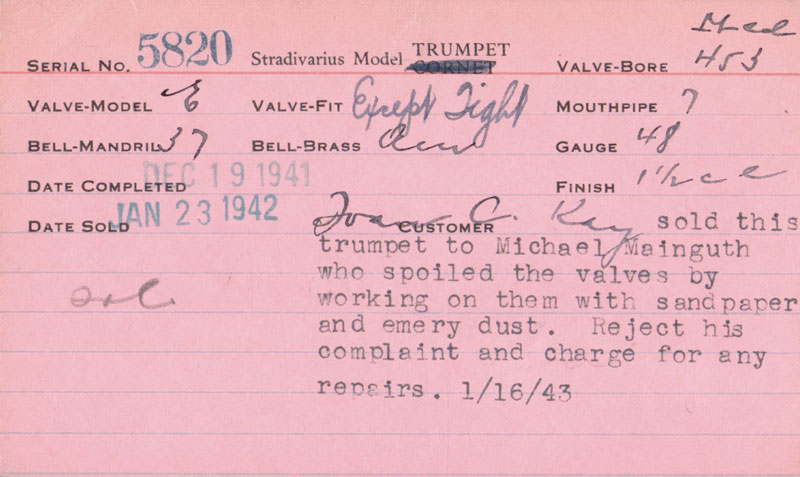
” {dealer} sold this trumpet to Micahel Mainguth, who spoiled the valves by working them with sandpaper and emery dust. Reject his complaints and charge for any repairs. 1/16/43.”
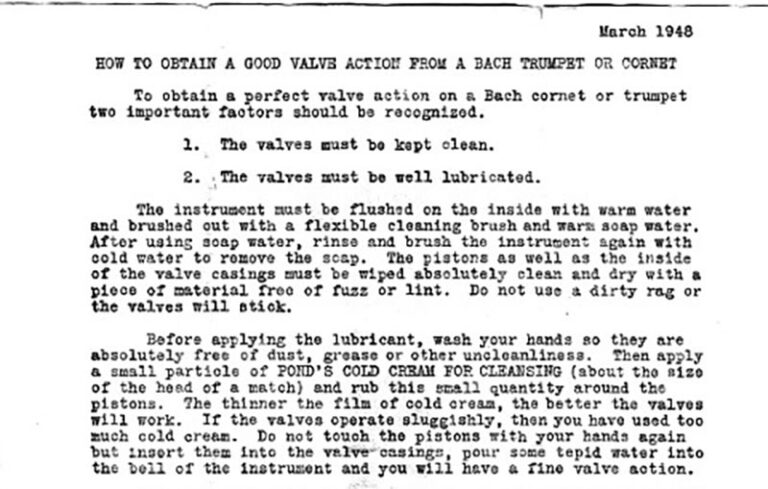
Based on this note on the shop card for this Bach Stradivarius trumpet in 1943, and the instructions included with Vincent Bach Corporation instruments dated March 1948 (example below), this is a reasonable claim.
CONCLUSION: Reasonable Claim
Did you also know?
Vincent Bach Corporation recommended using a small amount of “Ponds Cold Cream for Cleansing” on trumpet piston valves.
A full copy of the Vincent Bach Corporation’s March 1948, “How To Obtain A Good Valve Action From a Bach Trumpet or Cornet,” can be found in the BachLoyalist library.

Vincent advocated the use"Spit Ball" type swabs
to clean brass instruments?
" Vincent Bach promoted the use of blowing cleaning swabs, almost 100 years ago, through a brass instrument to clean Bach brass instruments?"
source: various online discussion forums
In an article from March 1930, The Bandmaster, Vincent Bach, promoted blowing a round ball of a silk sponge through his brass instruments when cleaning them.
“To clean the inside parts that cannot be reached by the “Miracle Cleaner,” get a silk sponge from a drug store, and cut a piece of it into a ball about 1/2″ in diameter. Cut while wet and be sure not to cut the sponge ball any larger. This is to be used while the soap solution is still in the horn. Push the silk spong into the receiver pipe (mouthpipe) and while pressing down the pistons bloe it through the instrument. Do this a few times, also, with the pistons up.”
CONCLUSION: Reasonable Claim
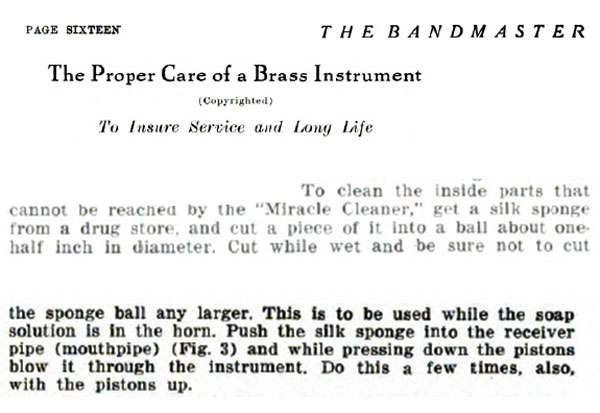
A copy of Vincent Bach’s “The Proper Care of a Brass Instrument” can be found in the BachLoyalist library.
320,000 Players use Bach Mouthpieces (1924)
" It is an important a forward step towards the millennium in musical expression as was the creation of the BACH MOUTHPIECES, which are used by upwards of 320,000 brass instrumentalists in the United States."
source: Bach Advertisement, The Instrumentalist, Sept. 1924
” In an article from November 1926, the tour of the Vincent Bach Corporation on East 41st Street spoke of the factory’s automatic (semi-automatic) lathes.
” The first lathe shapes the exterior of the mouthpiece, cuts it to the right length and feeds itself. Another lathe is used to drill and shape the inside, turning out a unit everything minute and each exactly the measurements designed by Vincent Bach. “
At first glance, the number of 320,000 appears to be very large compared to the number of employees he shared in various publications in 1916-1924 (2-8 employees). Manufacturing a mouthpiece every minute is approximately 500,000 mouthpieces in a working year. The claim of 320,000 trumpet players using Bach’s Mouthpieces from 1919 to 1924 would seem reasonable.
CONCLUSION: Reasonable Claim
Mouthpiece Numbering System
"When Vincent Bach strated making his mouthpieces, he didn't have a sequential series in mind, but rather made copies of good player's mouthpieces and arranged them in order later. They were not a perfectly graduated size so he eventually ended up with 1/2 or 1/4 sizes and no #4."
source: Bob Helmacy 2020
Bach Mouthpieces Numbering System & Cups
"Eventually, when he had established quite a few models, he needed to assign permanent numbers which suggested their relative sizes. The numbers he chose do seem to identify an orderly progression in cup diameters, but the letters describing cups are incredibly arbitrary. (Compare a 2.75C to a 3C--despite the similarity of diameter, their cup shape and depth are vastly different, the 2.75C being one of the very deepest C cups era in the entire line.)."
source: TPIN archives, Erik Veldkamp's Original Bach Fan Page
Mouthpiece Sharp Inside Cup Edge
"Why do so many of the Bach rims have that sharp inside edge?"
In his own writing about his mpc. design, Bach said that this is a deliberate feature. He intended that any improper forcing of the tone would be punished by pain (!). Many players also feel that this well-defined inner edge helps slurred notes to "slot in" more precisely than than they do on a more comfortable, rounded rim. ("Shaped like a toilet seat" is how one of my great teachers, William Vacchiano, memorably described the latter type rim.)
source: TPIN archives, Erik Veldkamp's Original Bach Fan Page
Early Elkhart Quality Bach Trumpets
""Early Elkhart means (to me) those made from the time of the move from Mt. Vernon in 1965 to about 1970 or so, roughly serial number 30000 to 50000."
Here's why: After Selmer bought Bach, as I understand it, they purchased a fairly new state-of-the-art factory from Conn (who was bailing out to Texas for cheap labor), hired the experience Conn workers (as a group probably more skilled and experienced than those working for Bach in Mt. Vernon), and started making a few horns. The average production for Bach in that period is about 3000 horns a year, compared to 16,000 to 20,000 horns per year during the last decade or so. The time and quality shows. The fit and finish is superb, the horns do not come standard with a first valve saddle (a trigger was an extra cost option) and don't need it. The intonation is better and the notes center better, in my opinion."
source: Jim Donaldson, from SchilkeLoyalist, late 1990s
” When Conn moved their brass instrument manufacturing facility to Abilene, Texas, in the early 1970s, it is reasonable to consider that the number of highly experienced brass manufacturing artisans were available for work in The Selmer Company factory in Elkhart and were most likely hired to manufacture Bach trumpets and trombones.
CONCLUSION: Reasonable Claim
Getzen bought Mt.Vernon parts when the factory moved to Elkhart
"When Bach moved to Elkhart, IN the Getzen company bought all remaining "parts" for the Allied Corporation, which at the time was doing their own manufacturing, overhaul repair work AND selling replacement parts for everyone's stuff to stores (as they still do today).
I was informed (by an ex-Getzen employee) that it wasn't unusual to see someone "building" a Mt Vernon trumpet for a buddy or for (backdoor) sales using these parts (on their own time of course). I was told there were a "fair amount" of parts leftover (especially bells), and even matching serial numbers to valves and casings weren't a challenge to a factory equipped for such things...anyway, I've seen a couple of these horns over the years, (that my friend assures me were built by his comrades) and the workmanship is usually better than the stuff the Bach guys were cranking out (put together without extra solder glooping out...no tension on the braces, light buffing and better lacquer jobs, etc...)"
source: TPIN archives, Erik Veldkamp's Original Bach Fan Page
” This story has been debunked over the years by multiple persons. We’re looking for stories from persons from that era with 1st or 2nd hald knowledge.
CONCLUSION: Doubtful Claim
Mouthpiece Blank Supplier
"Bach originally made the mouthpieces form solid rods, but had too much waste, so later had blanks made by Miller Automatics in Brooklyn, New York. These blanks were also purchased by Helmacy. Herco, Muck, Giardinelli, Pardube, Jet-Tone, Al Cass and others are also said to have used these."
source: Bob Helmacy 2020
source: Jon Patton's BrassHistory.net
source: various Bach loyalist questions
