BachLoyalist.com is the ultimate reference to everything related to Vincent Bach & Bach Stradivarius brass instruments. This site has grown through the contributions of fellow Bach loyalists and is one of the most complete references of Bach-related instruments.
Through the years, various models have been manufactured by Vincent Bach and related companies. This list of primary and special edition trombones is the best list we’ve compiled. Please contact us through the footer if you identify a missing model or error below.
Bach Stradivarius Trombone - Model Summary
Here is a summary of known Bach standard models and key characteristics such as bore size & type, Bell diameters and Bell material used of the various Bach Stradivarius Trombone models.
Type
Model
Bore
Bell
Bell Material
Other
Alto
1
2
3
10
Soprano model, pre-1943
39
0.468"
6.5"
Yellow Brass
Tenor
4
0.468"
7"
Yellow Brass
7.5" Bell optional
5
0.485"
7"
Yellow Brass
7.5" Bell optional
6
0.485"
7"
Yellow Brass
7.5" Bell optional
LT6
0.485"
7"
Yellow Brass
Lightweight Outer Slide
8
0.490"
7"
Yellow Brass
LT8
0.490"
7.5"
Yellow Brass
Lightweight Outer Slide
12
0.500"
7.5"
Yellow Brass
16
0.490" / 0.510"
7"
Yellow Brass
LT16
0.509"
7.5"
Yellow Brass
Lightweight Outer Slide
V16
0.485"
7.5"
Yellow Brass
Valve trombone
30
0.514" / 0.525"
8"
Gold Brass
32
?
?
?
Looking for information
34
0.522"
8"
Yellow Brass
34B
0.522"
8"
Yellow Brass
Added F valve
36
0.525"
8"
Yellow Brass
36B
0.525"
8"
Yellow Brass
Added F valve
40
0.525" / 0.547"
9"
Yellow Brass
Used 45 bell section
42
0.547"
8.5"
Yellow Brass
42B
0.547"
8.5"
Yellow Brass
Added F valve
Bass
45
0.547"
9"
Yellow Brass
45B
0.547"
9"
Yellow Brass
Added F valve
46
0.547 / 0.562
9"
Yellow Brass
Sold as 46, Bell stamp 45
50-series
0.562"
9.5"
Yellow Brass
various options
Soprano, Trombone Models | Stradivarius
Model
Year Introduced
Description (Year)
10
pre 1943
Unknown model Produced with a New York-era bell i.e. non-Bronx 67 bell = before 1943.
Example - Model 10
Bach Stradivarius Trombone; Model 10 photo from the Bill Cable collection
Alto, Trombone Models | Stradivarius
Model
Year Introduced
Description (Year)
1
1950s
Limited production model. Produced in the Mt. Vernon era. Estimated that 6 were produced in the late 1950s.
” Cylindrical lide bore: 11.9 mm (.468″). On frequent occasions, this is an important instrument for the first trombone in symphony orchestras for parts written for alto trombone in the extreme high register. Has excellent intonation, a lively, clear tone, and is very effective in the upper register. It is a most desirable instrument for trombone choirs playing medieval compositions.”
– 1961 Bach Instrument catalog
Tenor, Trombone Models | Stradivarius
Model
Year Introduced
Description (Year)
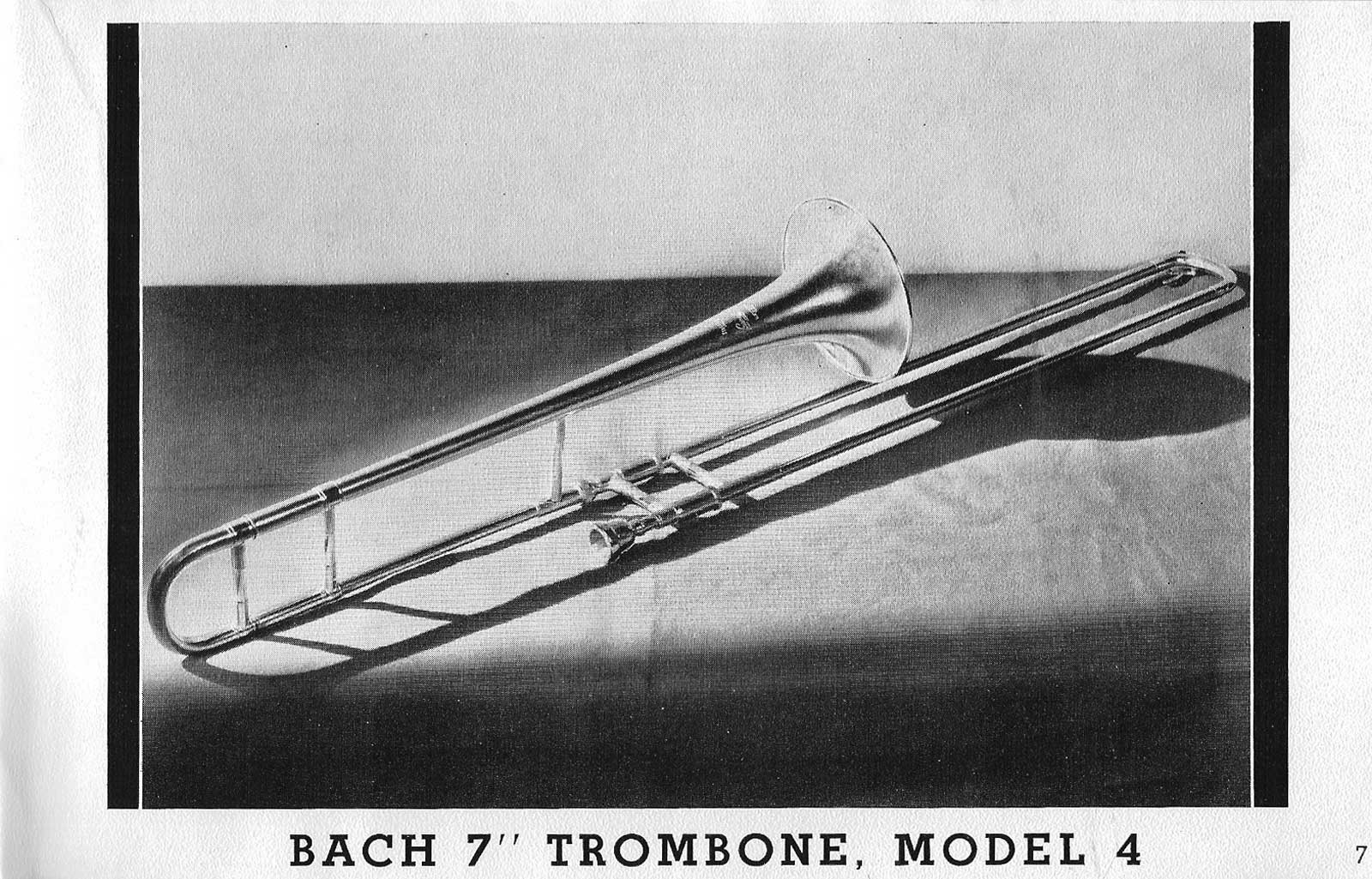
4
1935 – 1965
0.468″ bore
7″ bell
7.5″ bell option available
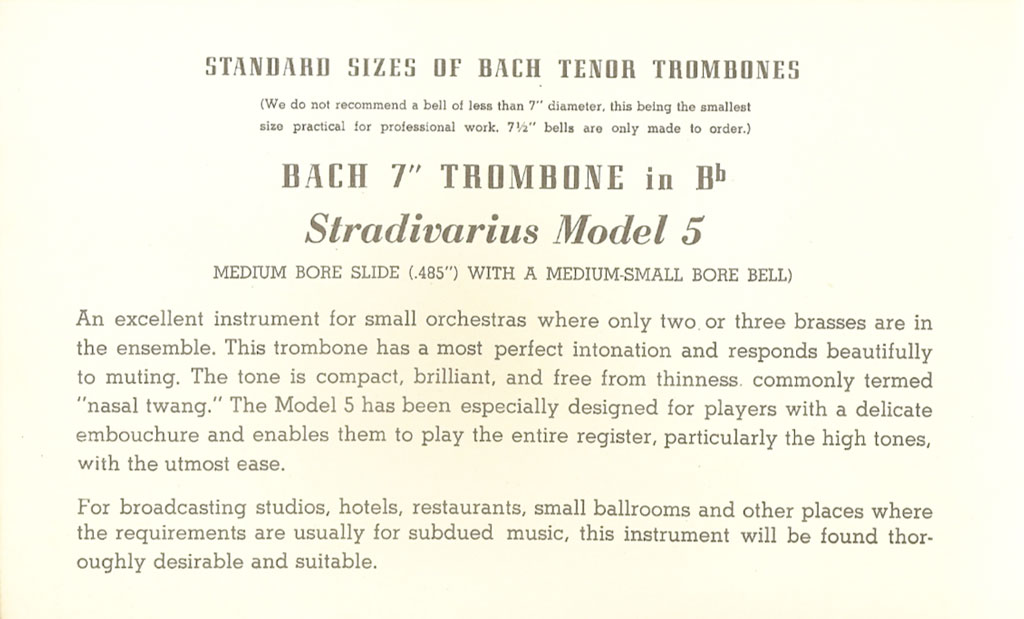
” Medium-Small Bore slide (0.468″) with a medium-small bore bell. An excellent instrument for small orchestras where only two brasses, trumpet, trombone are in the ensemble. This trombone has a most perfect intonation and responds beautifully to muting. The tone is compact, brilliant, and free from thinness, commonly termed “nasal twang.” The Model 4 has been especially designed for players with a delicate embouchure to enable them to play the entire register, particularly the high notes, with the utmost ease.
For engagements in hotels, restaurants, small bedrooms and other places where the requirements are usually for subdued music, this instrument will be found thoroughly desirable and suitable. “
– 1935 Bach Trombone catalog
Bach Trombone Catalog 1935
Bach Trombone Catalog 1935
” Designed primarily for solo playing, with fast technical passages. When trying this instrument you will not find words to express your delight and amazement. Slightly lighter-built slides enable a very fast slide vibrato and astonishing flexibility. Remarkable intonation and response, with or without mute; compact brilliant tone, free of nasal twang. An ideal instrument for smaller orchestras, radio and recording studios, restaurants, and other places requiring subdued music. In designing this instrument, we were guided principally by our desire to help players with delicate embouchures. to enable them to perform the entire register, particularly the high tone with the utmost ease. Therefore, for reliable response, sufficient resistance, and consequently great endurance, this STRADIVARIUS MODEL 4 is the instrument for you. “
– 1961 Bach Instrument catalog
Example - Model 4
5
1938 – 1941
0.485″ bore
7″ bell
7.5″ bell option available
” An excellent instrument for small orchestras where only two or three brasses are in the ensemble. This trombone has a most perfect intonation and responds beautifully to muting. The tone is compact, brilliant, and free from thinness, commonly termed “nasal twang.” The Model 5 has been especially designed for players with a delicate embouchure and enables them to play the entire register, particular the high tones with the utmost ease.
For broadcasting studios, hotels, restaurants, small ballrooms and other places where the requirements are use usually subdues music, this instrument will be found thoroughly desireable and suitable.”
– 1940s Bach Trombone catalog
6
1932 –
0.485″ bore
7″ bell; Medium bore bell
Medium Bore slide (0.485″) with a medium bore bell. There were actually 7 variations on the model 6. These variants were combinations of tuning slide, tuning slide tubes, and the bell size. These were labeled as follows on the bell:
6
6II
6III
6IV – More Common
6IV/V
6VI
6VII – More Common
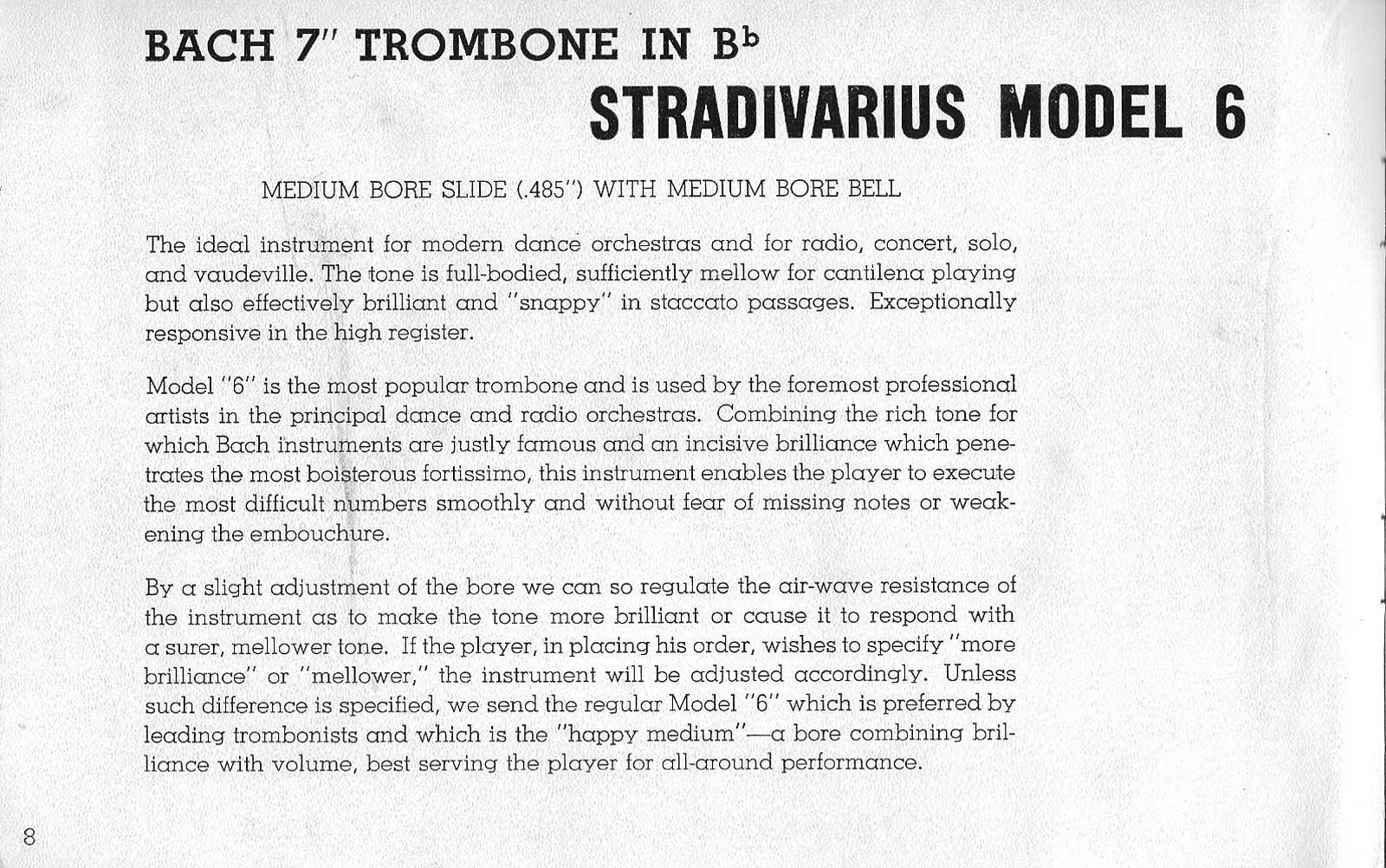
” The ideal instrument for modern dance orchestras and for radio, concert, solo, and vaudeville. The tone is full-bodied, sufficiently mellow for cantilena playing but also effectively brilliant and “snappy” in staccato passages. Exceptionally responsive in the high register.
Model “6” is the most popular trombone and is used by the foremost professional artists in the principal dance and radio orchestras. Combining the rich tone for which Bach instruments are justly famous and an incisive brilliance which penetrates the most boisterous fortissimo, this instrument enables the player to execute the most difficult numbers smoothly and without fear of missing notes or weakening the embouchure.
By a slight adiustment of the bore, we can so regulate the air-wave resistance of the instrument as to make the tone more brilliant or cause ii to respond with a surer, mellower tone. If the player, in placing his order, wishes to specify “more brilliance” or “mellower,” the instrument will be adjusted accordingly. Unless such difference is specified, we send the regular Model “6” which is preferred by leading trombonists and which is the “happy medium” a bore combining brilliance with volume, best serving the player for all-around performance.”
– 1935 Bach Trombone catalog
Bach Trombone Catalog 1935
Bach Trombone Catalog 1935
“The ideal instrument for modern dance orchestras and for radio, concert, solo, and vaudeville. The tone is full-bodied, sufficiently mellow for cantilena playing, but also effectively brilliant and ··snappy” in staccato passages. Exceptionally responsive in the high register. Does not require a powerful embouchure to fill and is therefore well suited to college and high school bands, also for entertainment and radio orchestras. Combining the rich tone for which BACH instruments are justly famous and an incisive brilliance which penetrates the most boisterous fortissimo, this in trument enable the player to execute difficult phrases smoothly and without fear of missing note or weakening the embouchure. The timbre of tone may also be regulated by 1he type of Bach mou1hpiece u ed. For average playing requiring a certain degree of brilliance, a mouthpiece with ··medium-shallow” cup like the BACH TROMBONE MOUTHPIECE #12C or #15C will be suitable. For “hot” playing in the extreme high register, a “shallow” mouthpiece cup like the #14D or #15D will do. For a rich, full tone, give preference to a BACH mouthpiece #11 or #12, which will have deeper cups.”
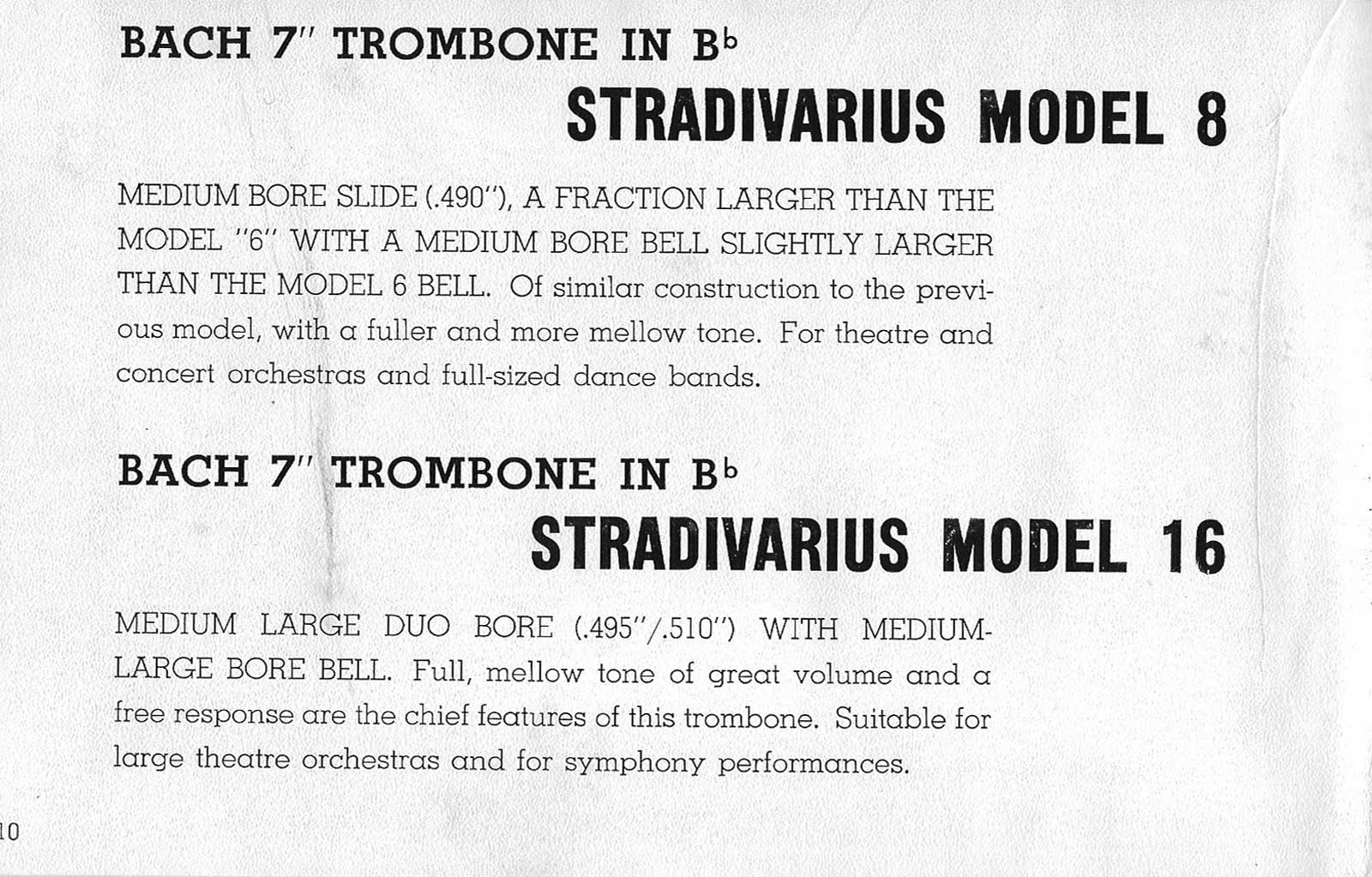
” Medium Bore slide (0.490″), a fraction larger than the model “6” with a medium bore bell slightly larger than the model “6” bell. Of similar construction to the previous model, with a fuller and more mellow tone. For theatre and concert orchestras and full sized dance bands.”
– 1935 Bach Trombone catalog
Bach Trombone Catalog 1935
” Cylindrical slide bore: 12.45 mm (.490″). Both slide and bell are of a slightly larger bore than the Model 6. Similar construction to the previous model. with a fuller and darker tone. Excellent for theatre and concert orchestra and full-sized dance bands. Well suited to all-round work.”
– 1961 Bach Instrument catalog
8ii
…
More than likely the 8ii was later simplified to the model 8
” Cylindrical slide bore: 12.7 mm (.500″). Large-medium bell. A favorite with musicians playing in radio or large sound film studios, also in entertainment orchestras. Produce a brilliant, open tone, very effective for recording and radio work. Excellent response throughout the entire register.”
– 1961 Bach Instrument catalog
16
1932 –
0.490″/0.510″ dual bore
7″ bell, yellow brass (1935)
” Medium Large Duo Bore (0.490/0.510″) with a medium-large bore bell. Full, mellow tone of great volume and a free response are the chief features of this trombone. Suitable for larger theatre orchestras and symphony performances.”
– 1935 Bach Trombone catalog
Bach Trombone Catalog 1935
Bach Trombone Catalog 1935
“Telescopic slide bore: 12.57 / 12.93 mm (.495″ /.509”). Large-medium bell. A smooth. mellow, dignified, singing tone of great volume, great flexibility and remarkable response are the cardinal features of this trombone. Much in demand by theatre musicians (light opera. music halls) and for fairly large-sized symphony orchestras (65 men). This trombone represents the happy medium between the “all-round” instrument and the regular symphony trombones. It is the choice of tone-conscious artists.”
– 1961 Bach Instrument catalog
LT16
…
0.509″ bore
7.5″ bell, yellow brass
” Key of Bb, .509″ medium bore, 7-1/2″ one-piece yellow brass bell, open gooseneck, chrome-plated nickel silver seamless inner slide, lightweight nickel silver outer slide, nickel silver handgrip, tubular nickel silver body braces, genuine Vincent Bach mouthpiece, deluxe wood shell case.”
V16
…
0.485″ bore
7.5″ bell
” The Bach model V16 valve trombone features a 7-1/2″ one-piece hand-hammered bell designed for excellent resonance and projection. The .485″ medium bore valve section design provides balanced and agile response. Professional Monel piston material provides smooth and quick action while the fixed 3rd slide ring and adjustable stop allow for quick adjustments. The clear lacquer finish provides a subtle warmth to the overall sound. The Bach Stradivarius model V16 valve trombone is designed for the player looking for a high performance Bb valve trombone.”
30
…
0.514 / 0.525″ dula bore
8″ gold brass bell
” Dual bore, .514/.525. 8 inch bell, wide bass trombone bell throat. Tenor mutes would fall out. Gold brass slide tubes, yellow crook, gold brass bell. The shop card actually said Model 32 and was crossed off and said 30. Horn was stamped as 30. ” – RJ Mason
“… Only Model 30s built”
Example - Model 30
32
…
Made for the US Army Band in the 1950’s.
34
1948 – 1967
0.522″ bore
8″ bell, yellow brass
Also known as the Palmer-Traulsen model. They were only made at the Mt. Vernon factory, not the prior New York or later Elkhart factory.
” Cylindrical slide bore: 13.26 mm (.S22″). Fairly large bore symphony bell. For the first trombonist in large symphony, opera, and concert orchestra or symphonic band. Remarkably clear and vivid high register so essential for modem symphony work. Refreshingly brisk, energetic, heroic symphony tone, resonant and full of life. Slightly more brilliant than Model 36. Abundant tone volume and carrying power. No risk of overblowing this instrument since there is no player with sufficient power to reach the limit of its fortissimo. The bell of the standard Model 34 is made of Extra Quality Brass of yellow color. For artists who prefer a more mellow, compact and resilient Teutonic tone, we can offer a bell made of “Gold Brass” which is slightly higher priced. The Model 34 trombone has a standard medium-bore mouthpiece receiver opening 12.1 mm (.475″ ).
– 1961 Bach Instrument catalog
34B
1948 – 1967
0.522″ bore
8″ bell, yellow brass
“Cylindrical slide bore: I 3.26 mm (.522″). This model is of exactly the same length. bell and slide bore as Model 34 but is equipped with an extra quart valve (”F” valve) which lower the entire compass, of the instrument by one-fourth and enable the player to continue the chromatic scale below F:2 down to the pedal tones and lower. The “F” valve slide is sufficiently long to be pulled to ·”E”. Very important for playing Wagner operas and for use in smaller concert or theatre orchestras where only one trombone is used and the first and bass trombone parts are conden ed into one single part. The tone, response, volume are identical to that of the Model 34. Range of 8, tenor and bass trombone – page 24. Made with a yellow brass bell or on special order, with the slightly higher priced “Gold-Brass” bell. Standard medium bore mouthpiece receiver opening: 12. mm ((.475″)
– 1961 Bach Instrument catalog
36
1932 –
0.525″ bore
8″ bell, yellow brass
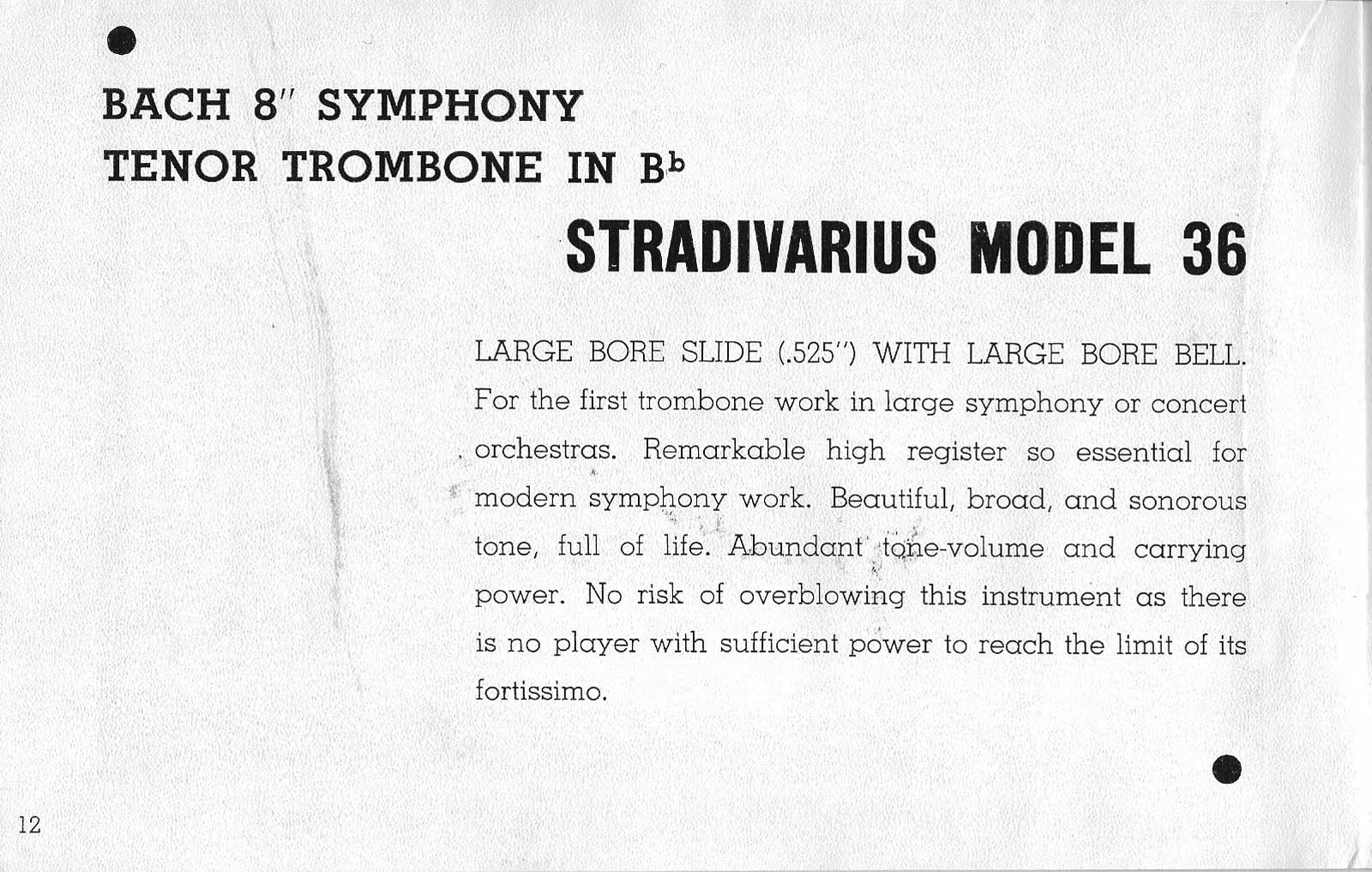
” Medium bore slide (0.525″) with large bore bell.For the first trombone work in large symphony or concert orchestras. Remarkable high register so essential for modern symphony work. Beautiful, broad and sonorous tone, full of life. Abundant tone-volume and carrying power. No risk of over blowing this instrument as there is no player with sufficient power to reach the limit of its fortissimo.”
– 1935 Bach Trombone catalog
Bach Trombone Catalog 1935
Bach Trombone Catalog 1935
“Cylindrical slide bore: 13.34 mm (.525”). The bell bore is slightly larger than the Model 34 which results in a fuller, very beautiful and sonorous tone of massive volume. For the first trombonist in large symphony, opera, and concert orchestra or symphonic band, this superb instrument releases a “rainbow of tone colors”, lively in sforzando attack and rich, mellow timbre if tongue attacks at the roof of the mouth. Beautiful, broad, and resonant tone, full of life. Abundant tone, volume, and carrying power. No risk of overblowing the instrument as there is no player sufficiently powerful to reach the limits of its fortissimo. For artists who prefer a more me!low, compact, and resilient Teutonic tone, we can offer a bell made of “Gold-Brass” which is slightly higher priced. Mouthpiece receiver opening 12.1 mm (.475″).”
– 1961 Bach Instrument catalog
36B
…
0.525″ bore
8″ bell, yellow brass
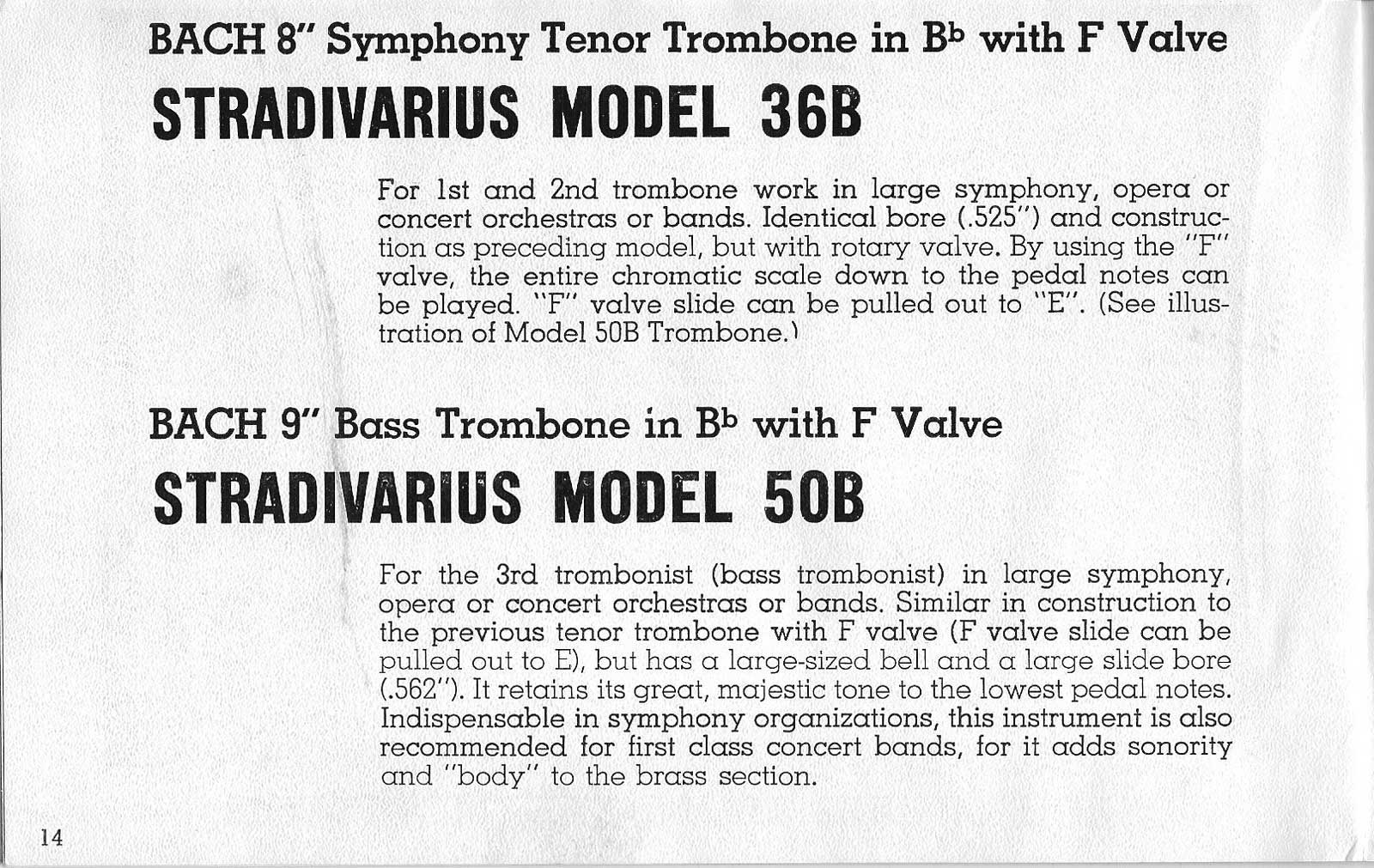
” For 1st and 2nd trombone work in large symphony, opera or concert orchestras or bands. Identical bore (.525″) and construction as preceding model, but with rotary valve. By using the “F” valve, the entire chromatic scale down to the pedal notes can be played. “F” valve slide can be pulled out to “E”. (See illustration of Model SOB Trombone.)” – 1935 Bach Trombone catalog
Bach Trombone Catalog 1935
” Model 36 with F valve.For 1st and 2nd trombone work in large symphony, opera, or concert orchestras or band. Identical bore (0.525″) and construction as the previous model, but with a rotary valve. By using the “F” valve, the entire chromatic scale down to the pedal notes can be played. “F” valve valve slide can be pulled out to “E”.”
40
1931 – early 1940s
0.525 / 0.547″ dual bore
45 bell section (9″ bell, yellow brass)
Produced during the New York era.
42
1952 –
0.547″ bore
8.5″ bell, yellow brass
” All 42 series Bach Stradivarius tenor trombones feature .547″ large bore, 8-1/2″ one-piece yellow brass bell, chrome-plated nickel silver seamless inner slide, brass outer slide, nickel silver handgrip, tubular nickel silver body braces, genuine Vincent Bach mouthpiece, deluxe wood shell case.”
Stradivarius 42 .547 8.5 F
Stradivarius 42B .547 8.5 F
Stradivarius 42BO .547 8.5 F
Stradivarius 42K .547 8.5 F Balanced valve design.
Stradivarius 42C .547 8.5 F Removable F section.
Stradivarius 42CO .547 8.5 F
“Cylindrical lide bore: 13.9 mm (.547”). MEDI M-LARGE bell. Especially designed for the first and second trombonists of the top American symphony and opera orchestras and symphonic bands. This is the fine t in trumpet a great symphony trombonist could possibly wish for because it embodies all the features desirable for achieving ultimate artistry. A captivating, clear, mellow, full tone, broad and resonant. No performer can play this instrument to the limit of its capacity. While the 216 mm (8 ½ “) bell is of similar bore to the Model 36, the larger slide bore and mouthpipe amplify the large tone volume of the bell.”
– 1961 Bach instrument catalog
42B
1952 –
0.547″ bore
8.5″ bell, yellow brass
” Cylindrical slide bore: 13.9 mm (.547″). Identical proportions as the Model 42 but equipped with a “Quan Valve” to “F” permitting the player to extend the chromatic scale below the low “E2” down to the lowest pedal tones. The extra long “F’ valve slide can be drawn to “E”, which facilitates playing the low B natural in tune in the regular seventh pos1t1on. This is the most advanced design for Wagner Operas, Gustav Mahler’s “Das Lied von der Erde”, Strauss and Tchaikovsky symphonies for which a large volume in the low register is of utmost importance. Range of the B~ tenor and bass trombone – page 24.
Both the Model 42 or 42B trombone are furnished with a hand-hammered “Extra Quality Brass” bell of yellow color, which produces a clear, vibrant, martial tone. Upon receipt of a confirmed, special order, the same models can be supplied with a “Gold-Brass” bell (at a slight additional cost), which greatly enhances the tone of the beauty. Produces a richer, darker, compact sound of pure resonant Teutonic timbre and yet the easy response, as well as the great flexibility, are completely retained and remain unsurpassed. o outstanding first or second trombonist in a high-class symphony or opera orchestra can earn greater laurels than by adopting a Gold Brass Model 42 or 42B trombone. These are the instruments our prominent symphony conductors admire most. Both the Model 42 or 42B symphony trombones have a larger mouthpiece receiver opening of 13.87 mm (.546″) “
– 1961 Bach instrument catalog
Bass, Trombone Models | Stradivarius
Model
Year Introduced
Description (Year)
45
1935 – 1969
0.547″ bore
9″ bell
45B
1935 – 1969
0.547″ bore
9″ bell
“For the third (bass trombone) in medium and large-sized symphony orchestra, opera, concert, and military bands. The core of the bell is larger than the Model 42B, but slightly smaller than the Model 508. The tone quality is rich, large, vibrant, and slightly brighter than the 508 and, therefore, well adapted to the works of Rimsky-Korsakov, Stravinsky, Respighi, Ravel, and other modern composers in which the extreme high and low registers are so frequently used. The tuning slide of the “F” valve is extra long and can be pulled out to “E”, a decided advantage when playing the low B natural.”
– 1961 Bach Instrument catalog
46
…
0.547/0.562 dual bore
9″ bell, yellow brass
It was the model 45 bell section with a 0.547/0.562 dual bore hand slide instead of the standard 0.547″ slide the model 45 came with. Although it was sold as a model 46, the bells were still stamped as 45.
50A
1938 –
0.562″ bore
9.5″ bell, yellow brass
” All Bach Stradivarius bass trombones feature a 0.562″ large bore, one-piece yellow brass bell, chrome-plated nickel silver seamless inner slide, brass outer slide, nickel silver handgrip, tubular nickel silver body braces, genuine Vincent Bach mouthpiece, deluxe wood shell case.
MODEL 50A – 9-1/2″ one-piece yellow brass bell, Hagmann Valve rotor mechanism, open wrap.”
50B
…
0.562″ bore
9.5″ bell, yellow brass
” For the 3rd trombonist (bass trombonist) in large symphony, opera or concert orchestras or bands. Similar in construction to the previous tenor trombone with F valve (F valve slide can be pulled out to E), but has a large-sized bell and a large slide bore (.562″). It retains its great, majestic tone to the lowest pedal notes. Indispensable in symphony organizations, this instrument is also recommended for first class concert bands, for it adds sonority and “body” to the brass section.”
– 1935 Bach Trombone Catalog
Bach Trombone Catalog 1935
Bach Trombone Catalog 1935
” THE QUEEN OF THE TROMBONE FAMILY. Excels anything created thus far in BASS TROMBONE construction. Embodies all refinements that could possibly be expected by the elite of the profession – the bass trombonists of the foremost symphony and opera orchestras and the outstanding symphonic bands. The grand, heroic, majestic tone, the superb resonance, the magnificent carrying power,developed to a unique measure of perfection, are but a few of the attributes for which this instrument has justly earned its fame. While the high register (considering the large sized bell core) responds with surprising ease, it is the impressive sonority of the extreme low pedal tones which fascinates the listener.
The extra long tuning slide of the “QUART VALVE TO F” attachment can be drawn to “E”, an important requirement in playing the low B natural in ~ Wagner’s “Ring”; (“Rheingold”, “Die WaJkiire”. “Sieg- • fried”, “Gotterdiimmerung”); “Tristan”; Goldmark’s. “Spring Ovrrture”; Richard Strauss’ “Electra”, “Le q BourgeoisGentlehomme”, “Till Eulenspiegel”, “Concerto for Orchestra”.
The 22Y mm (9″) Model 45B and the 241.2 mm (9½ “) 50B or 5082 are furnished with a hand-hammered, extra quality yellow brass bell which produces a clear, vibrant, martial tone. Upon receipt of a confirmed, special order, the same type instrument can be supplied with a “Gold-Brass” bell (at a slight additional cost) which greatly enriches the beauty of tone – that marvelous, deep compact sound reminiscent of a grand organ. Words cannot describe it. It represents the true Teutonic tone, grandios and of great carrying power so prominently featured in the outstanding German and Austrian symphony orchestras, which adds so much to the sonority and “body” of the entire brass section. In spite of the big tone, the flexibility of the instrument responds with unbelievable ease. These instruments must be played to be appreciated.
– 1961 Bach Instrument catalog
” 9″ bass trombone with F valve.For the 3rd trombonist (bass trombonist) in large symphony, opera, or concert orchestras or bands. Similar in construction to the previous tenor trombone with F valve (F Valve slide can pulled out to E), but has a large bell and a large slide bore (0.562). It retains its great, majestic tone to the lowest pedal notes. Indispensable in symphony organizations, this instrument is also recommended for first-class concert bands, for it adds sonority and “body” to the brass section.”
MODEL 50B – 9-1/2″ one-piece yellow brass bell, traditional rotor mechanism, traditional wrap
” All Bach Stradivarius bass trombones feature .562″ large bore, one-piece yellow brass bell, chrome-plated nickel silver seamless inner slide, brass outer slide, nickel silver handgrip, tubular nickel silver body braces, genuine Vincent Bach mouthpiece, deluxe wood shell case.
MODEL 50T – 9-1/2″ one-piece yellow brass bell, Thayer™ Valve rotor mechanism, open wrap.”
source: Dr. Jason Oliver, D.M.A., Southeastern Oklahoma State University
source: various Vincent Bach catalogs
source: various posts on TromboneForum, TromboneChat
BachLoyalist - Everything about Vincent Bach Instruments
BachLoyalist.com is the ultimate reference to everything related to Vincent Bach & Bach Stradivarius brass instruments. This site has grown through the contributions of fellow Bach loyalists, and is one of the most complete references of Bach related instruments.