BachLoyalist.com is the ultimate reference to everything related to Vincent Bach & Bach Stradivarius brass instruments. This site has grown through the contributions of fellow Bach loyalists and is one of the most complete references of Bach-related instruments.
Vincent Bach and his business operated several locations across greater New York City. When the company was sold to H. & A. Selmer Inc. in September 1961, they moved Vincent Bach-branded mouthpieces (1962) and later instruments (1963-1965) to manufacturing in Elkhart, Indiana.
The following locations are from each of the major locations throughout the history of Vincent Bach, Vincent Bach Corporation, and later the manufacturing of Vincent Bach-branded instruments.
1916 - 1918
Vincent Bach Publishing
West 107th Street, New York City (Publisher)
210 W 107th Street, New York City 1916 – 1918
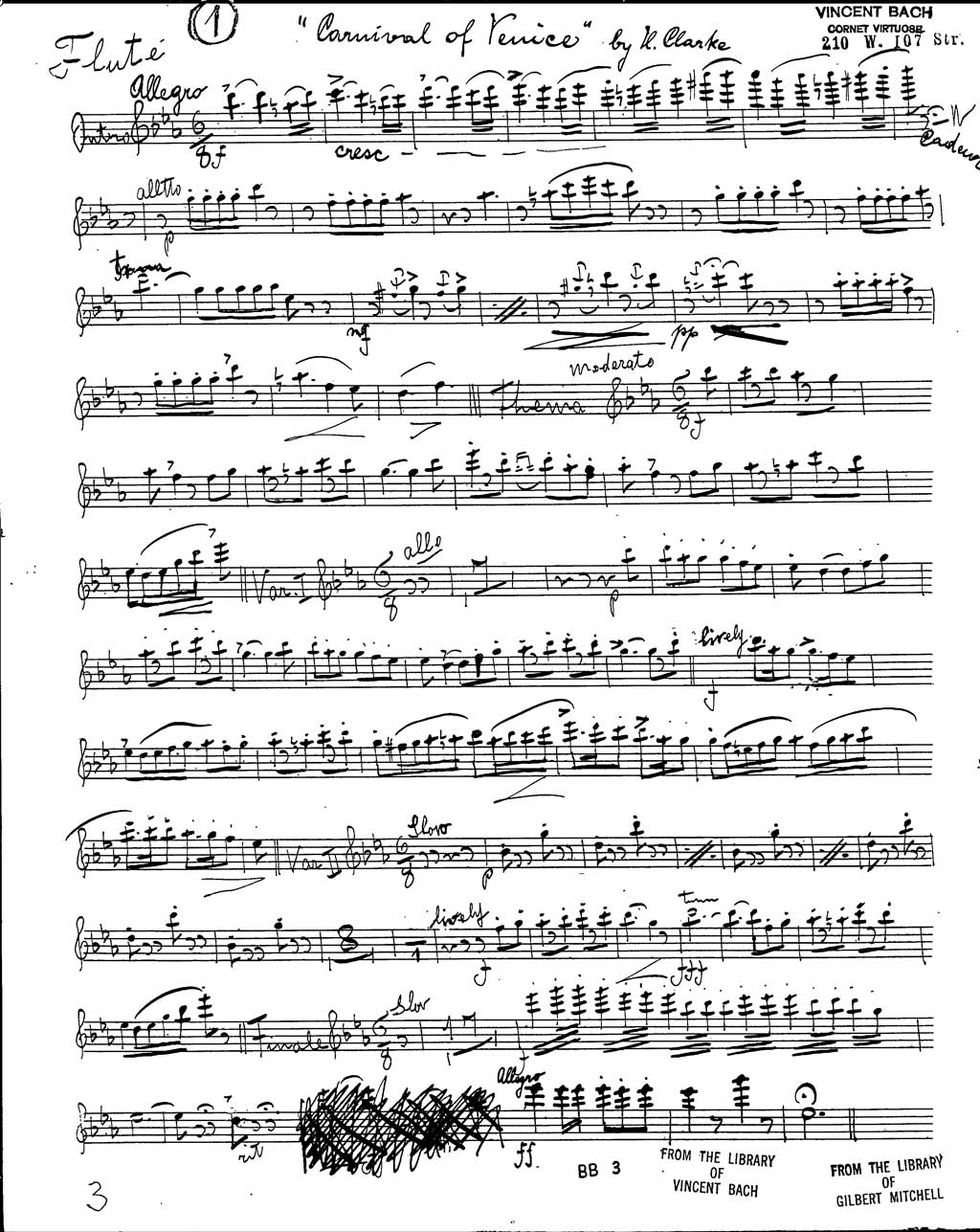
Vincent lived at West 107th Street in New York City and used this address on the back of his earliest arrangements for Solo cornet and accompaniment, marking the beginning of his business in the world of music & musical instruments in the United States.
Vincent Bach ran his publishing business to earn extra money, presumably from his apartment when he first immigrated to the US. This example of a band transcription of Carnival of Venice by Vincent Bach references “Vincent Bach Cornet Virtuoso” and the address of 210 West 107th Street in New York City.
We are looking for an image of an early Vincent Bach publication with the West 107th Street location visible.
Contact us through the website.
source: ITG Collection 1 - Vincent Bach Collection
1917 - 1918
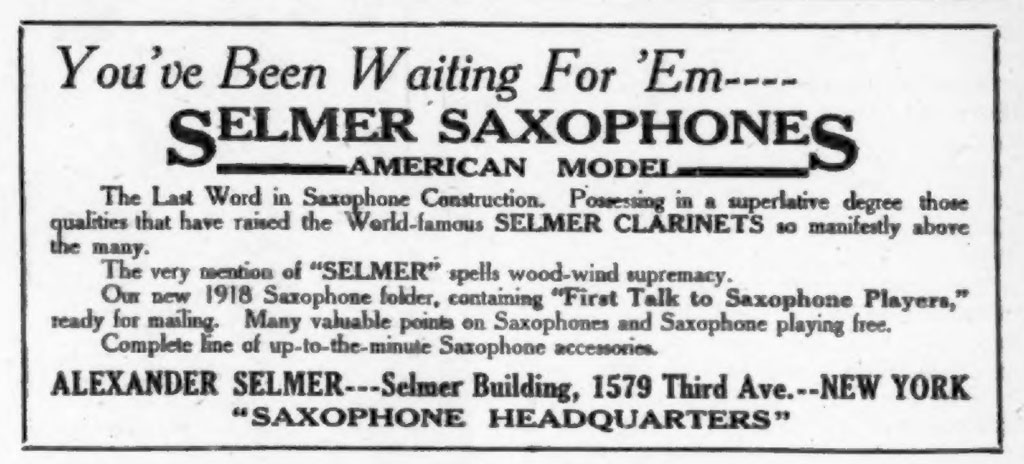
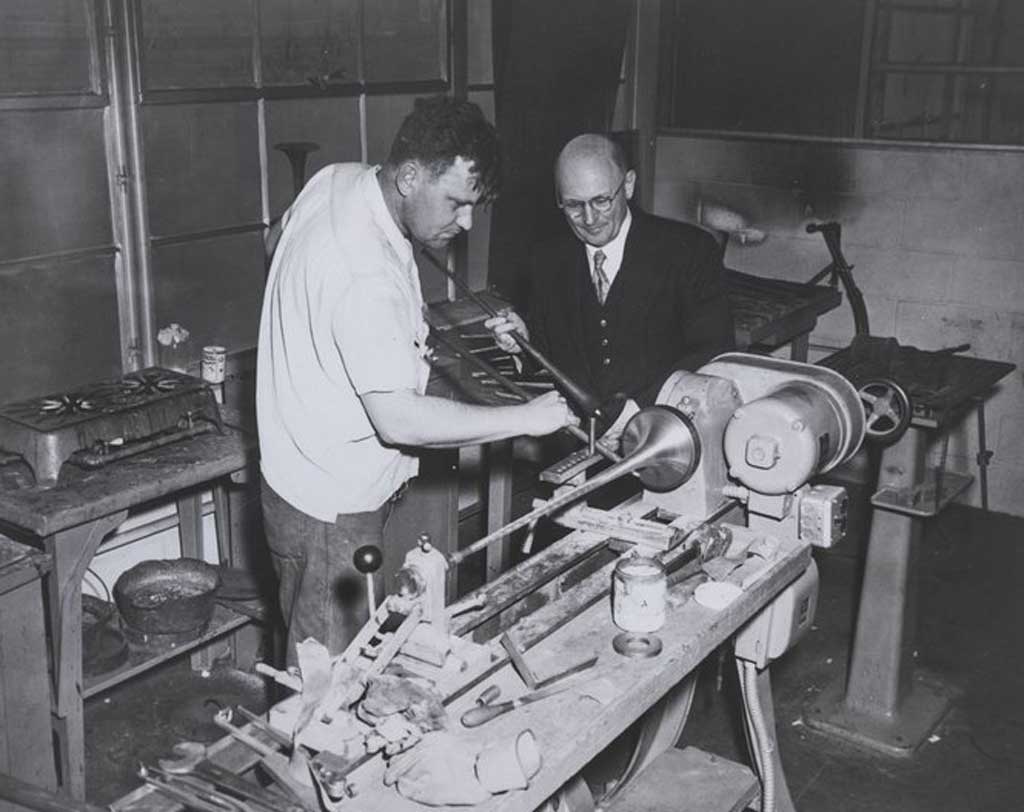
Vincent working after hours in the Selmer Store on 3rd Ave. & 89th Street in New York City.
3rd Avenue & 89th Street (Selmer Store)
1579 3rd Ave, New York City Fall 1917 – Spring 1918
During his time in the US Army, Vincent was allowed to manufacture and modify mouthpieces by George Bundy at the Selmer store at 3rd Avenue and 89th Street in New York City. He was charged for his use of the lathe in the repair shop for $0.50/hour.
This early relationship with Selmer is referenced when Vincent sold his business in 1961 to H. & A. Selmer, Inc., almost 44 years later.
” From Mr. George M Bundy, at that time, Manager of the Selmer firm, of which firm he has become President, Bach obtained permission at a nominal cost to use one of the lathes in the Selmer New York repair shop. “
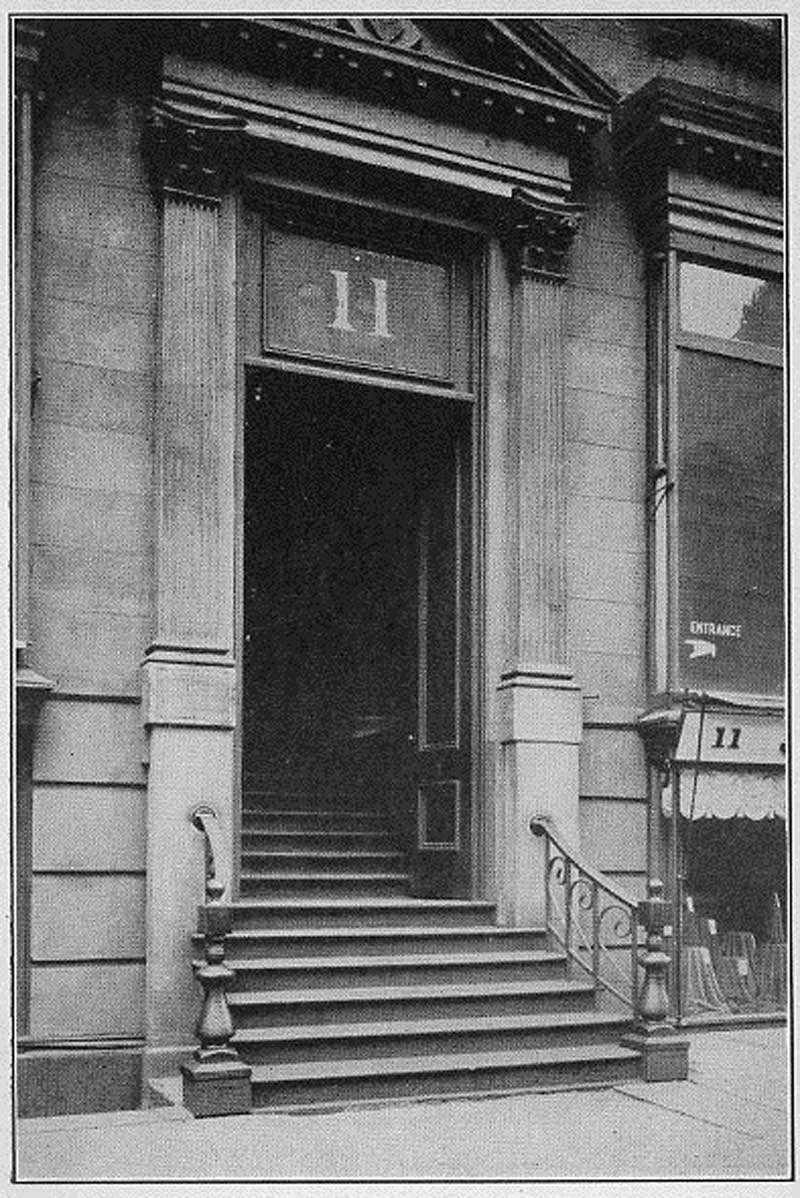
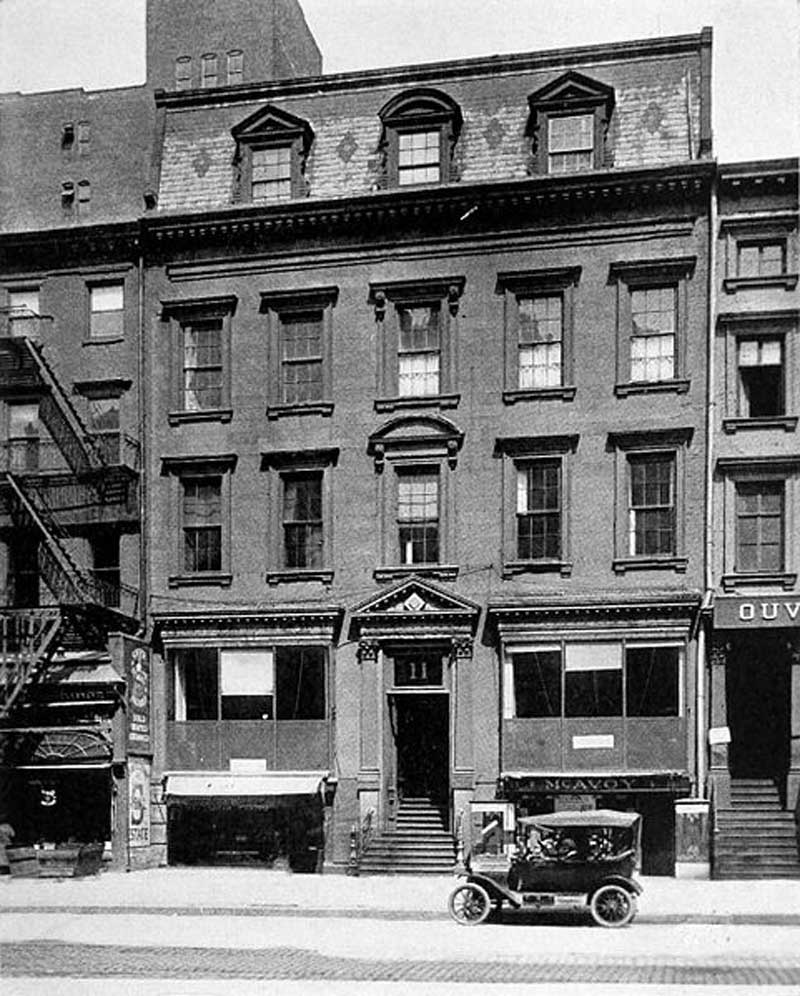
Vincent 's Hobby Shop on East 11th Street during the summer of 1918.
East 14th Street, New York City
11 East 14th Street, New York City May 1918 – 1919
Vincent started the manufacturing of mouthpieces as a hobby, desiring to make a dozen mouthpieces for himself and a few close friends. Vincent made a few mouthpieces for his closest friends, including for Harry Glantz, Philadelphia Symphony Orchestra, and Saul Gaston later the conductor of the Denver Symphony Orchestra.
Vincent described the process taking more than 4 hours for each mouthpiece, in a unconditioned room which would reach 105 deg F in the summer of 1918. Vincent later sold the lathe to a junk dealer, and stopped (temporarily) making mouthpieces.
” In May 1918, I bought a small foot lathe for $300 and rented a small office on the top floor of an old ramshackle builing at 11 East 14th Street.“
” I pushed that lathe pedal for about four to five hours to turn out one mouthpiece by hand.“
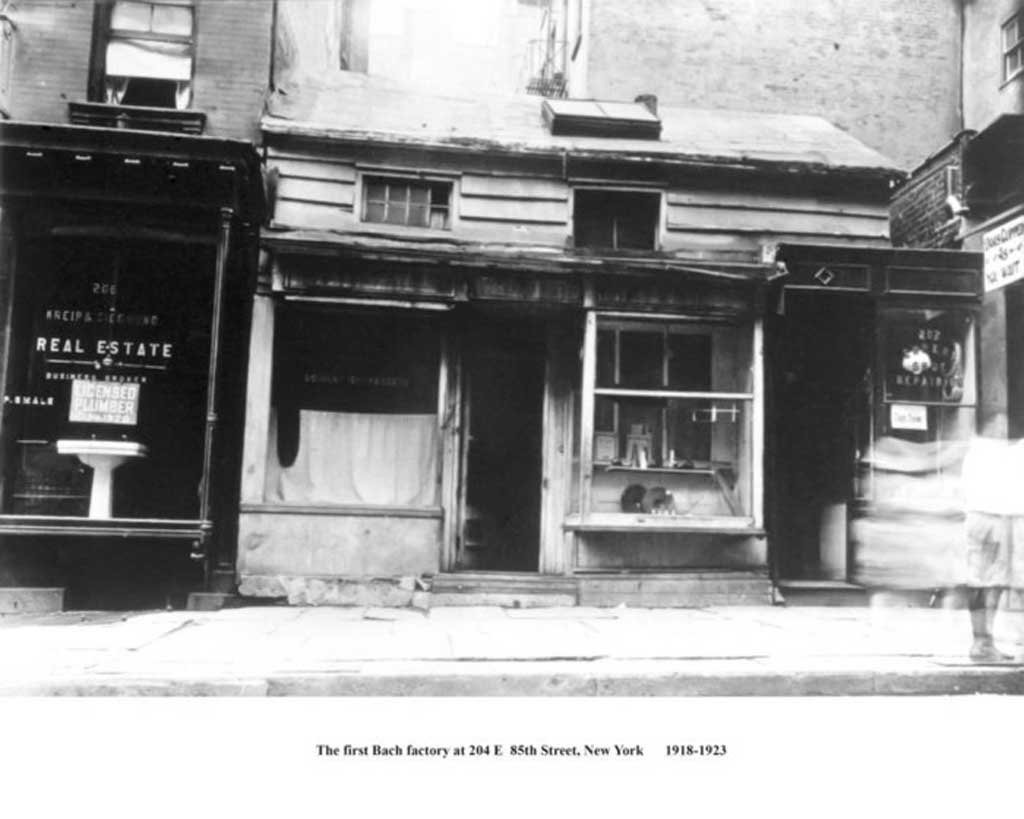
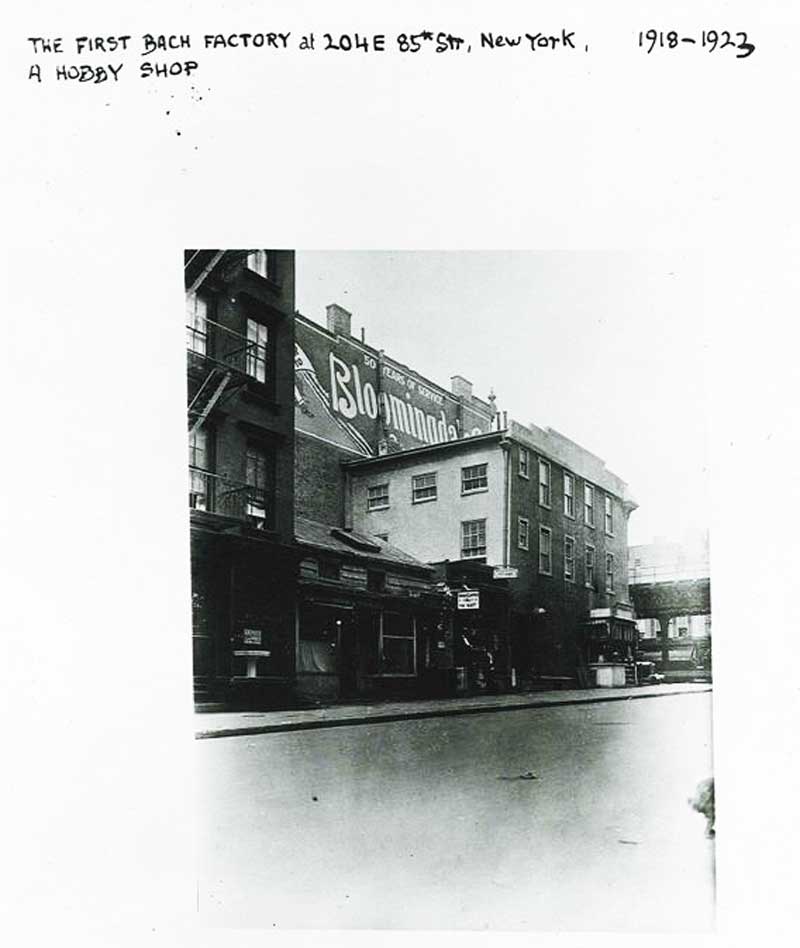
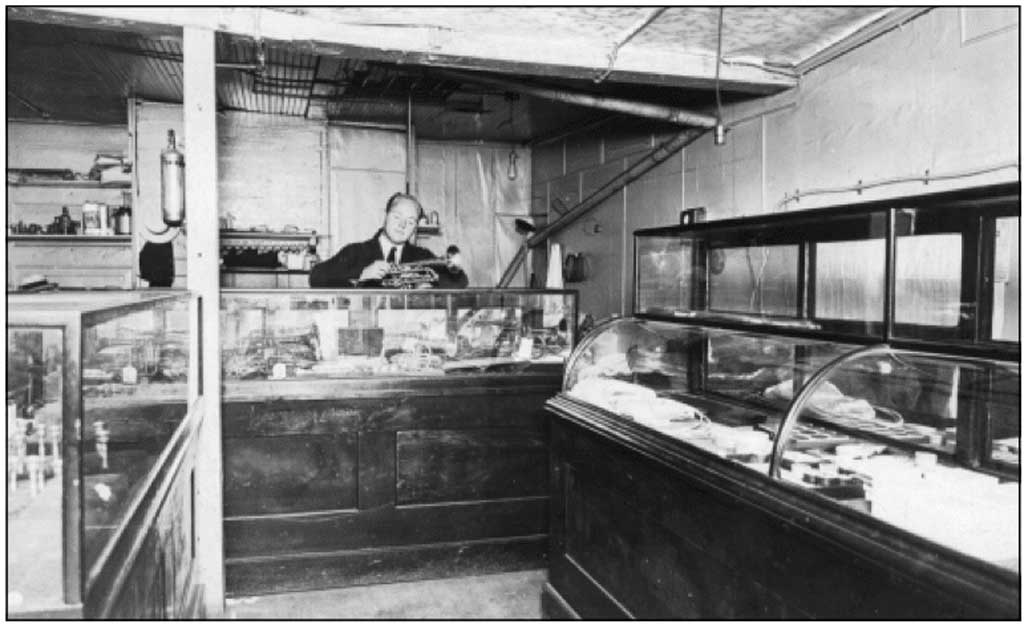
Vincent referred to the East 85th building as his "workshop"
East 85th Street, New York City
204 E 85th St, New York City April 1919 – 1922
Vincent’s first shop, located down the street from the Musician’s Union hall. Vincent signed a lease on April 1919 for $35/month for the ‘junk shop’ to begin manufacturing of trumpet & cornet mouthpieces. Vincent bought a Seneca Falls lathe with all the accessories available for $1250, where Vincent made installment payments.
After reaching success and running out of space, Vincent signed a lease for the “loft” or upper floor of the property at 237 East 41st street on or before Feb. 13th, 1922.
Statistics
5 mouthpieces per week (Vincent alone)
Hired one employee (1919)
6 mouthpieces per day (1919)
12 mouthpieces per day (1920)
” Most of my combined earnings were put into additional tools and equipment and mighty little for my personal needs.“
Moving to the East 41st Street Factory
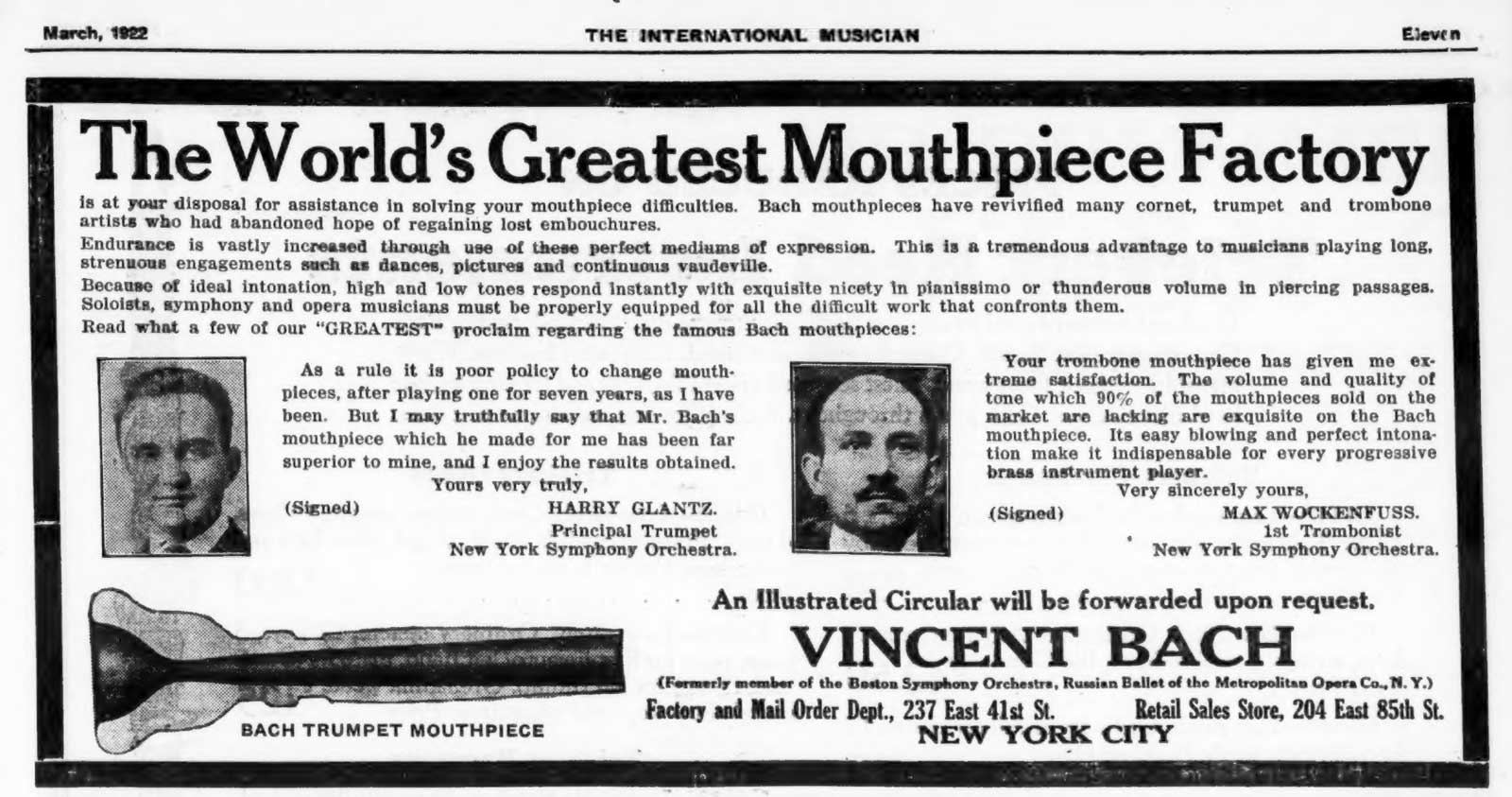
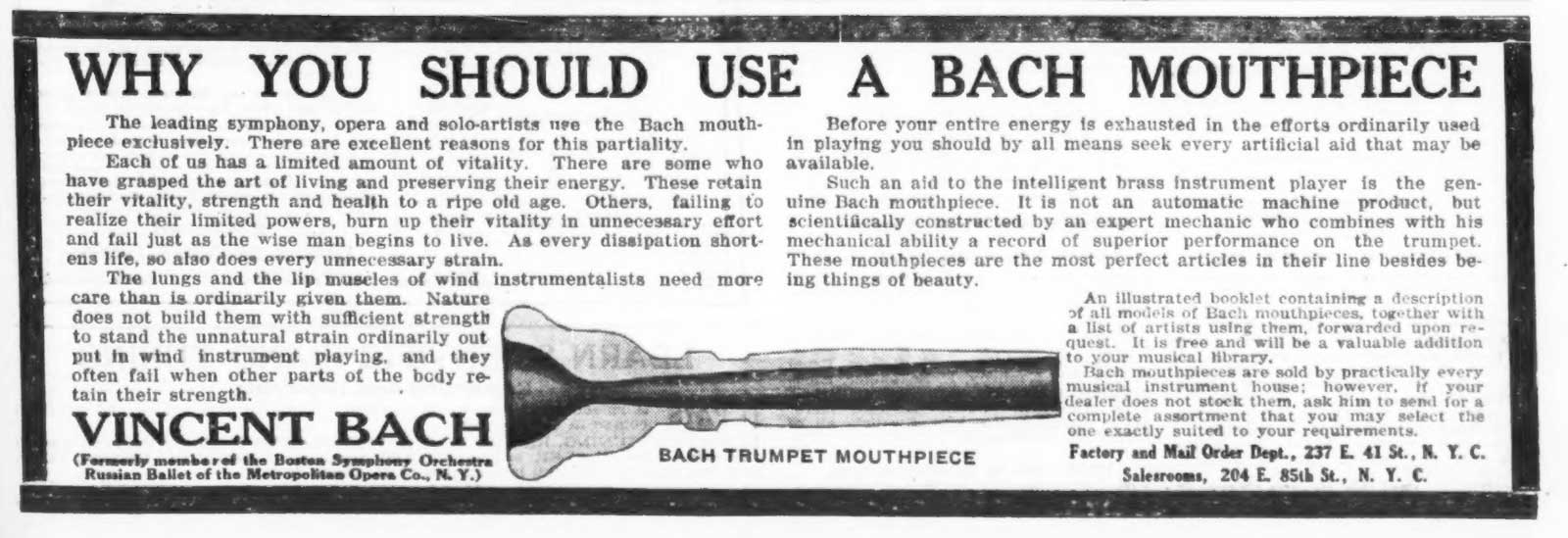
Vincent Bach Corporation moved from East 85th Street to a new factory on East 41st Street in February 1922. In March & April 1923, he described his East 85th location as his “Retail Sales Store” and the “Factory & Mail Order Dept.” as the East 41st street location.
International Musician, March 1922
International Musician, April 1922
source: The Selmer Company
source: Fladmoe 1975, page 46
1922 - 1928
Vincent Bach Corporation's first 'real' factory
East 41st Street, New York City
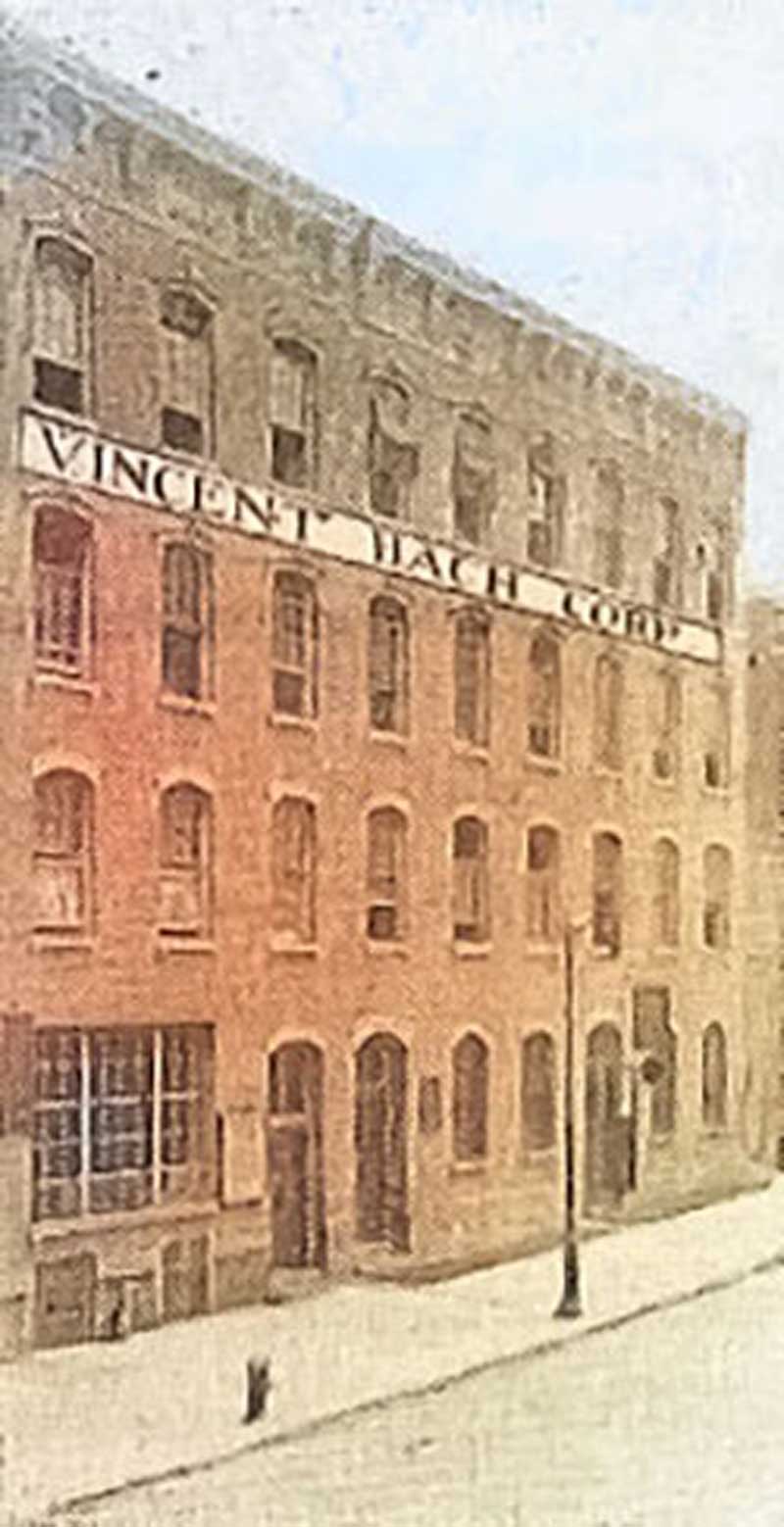
237 E 41st Street, New York City 1922 – 1928
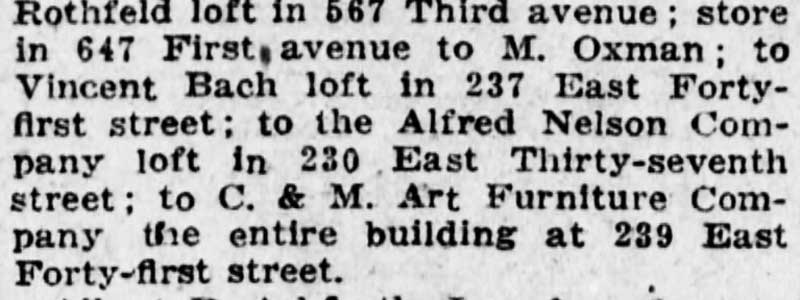
According to public records and a newspaper article, Vincent signed a lease for the “loft” or upper floor of the property at 237 East 41st street on or before Feb. 13th , 1922.
Statistics
3 employees (1922)
10 employees (1925)
Vincent’s first real factory was located on 237 East 41st Street in New York City. According to public records and a newspaper article, Vincent signed a lease for the “loft” or upper floor of the property at 237 East 41st street on or before Feb. 13th , 1922.
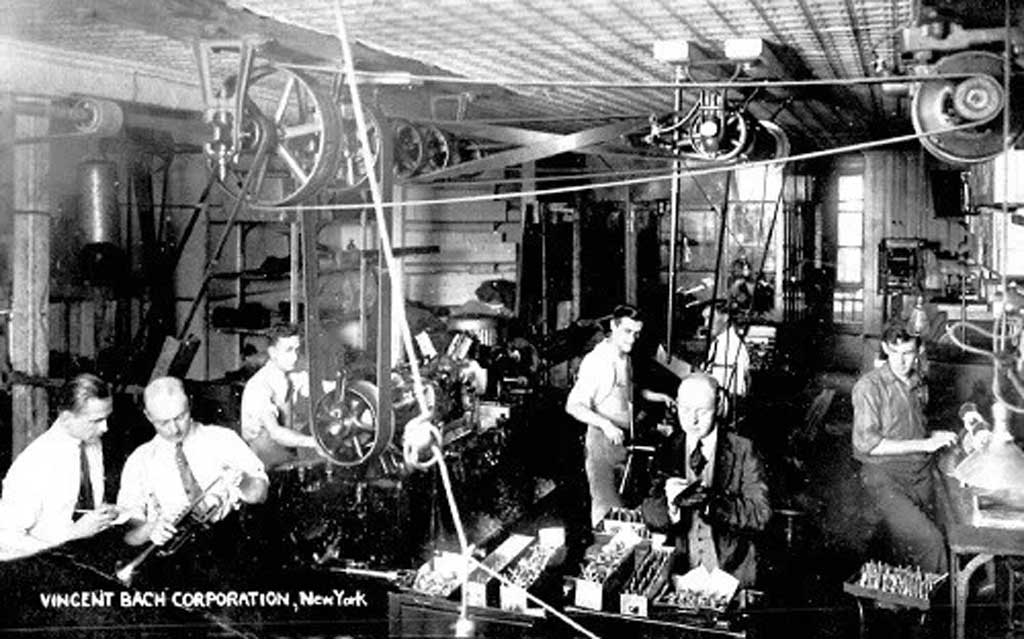
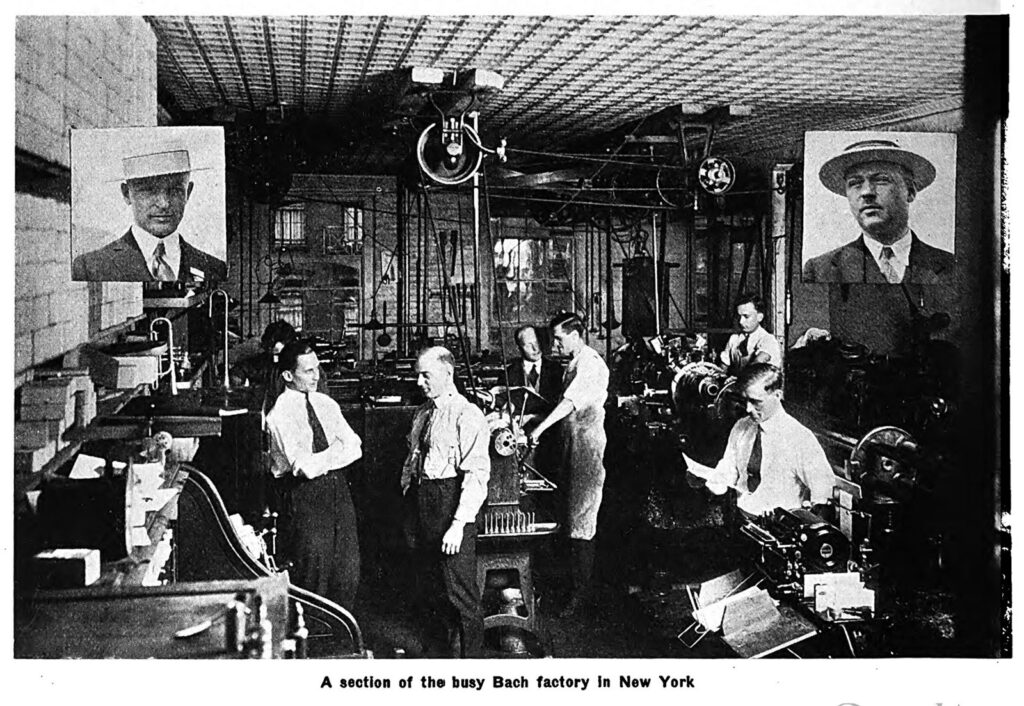
In the photo of the building, it be assumed that Vincent’s factory was the top floor of this building. An addition photograph of what is believed to be the interior of the factory, shows a series of leather belt driven lathes used in the manufacturing of his Bach mouthpieces.
Coincidently, Bach is shown holding a trumpet, which was not formally introduced until the fall of 1924. This factory was used until the Fall of 1928.
Musical Merchandise, Nov. 1926 Vincent (Left), Hans (Right)
source: Vincent Bach Corporation catalog (1958)
source: Groves
source: Fladmoe 1975, page 46
source: New York Herald, Feb. 13, 1922, p.18
1928 - 1953
Moved from East 41st to the Bronx factory.
East 216th Street, Bronx
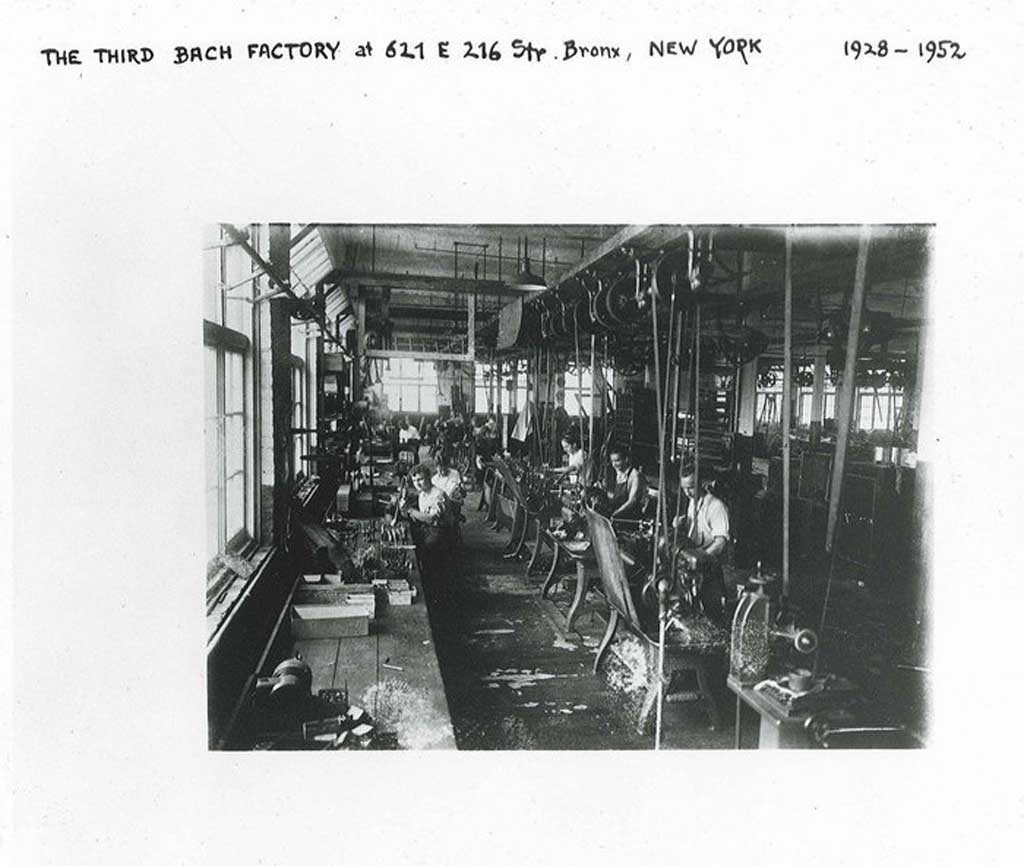
621 E 216th Street, Bronx, NY 1928 – 1953
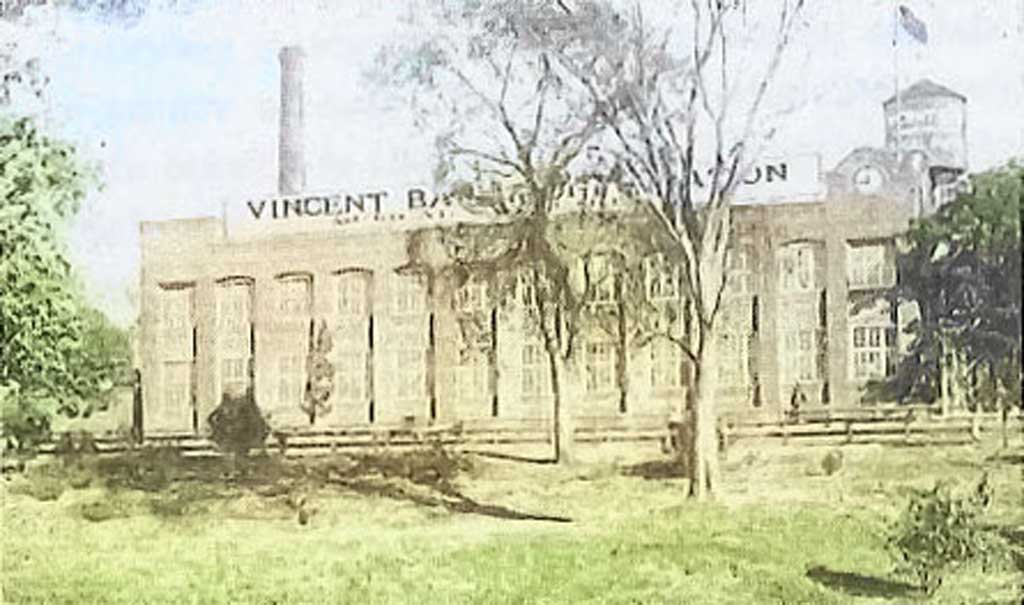
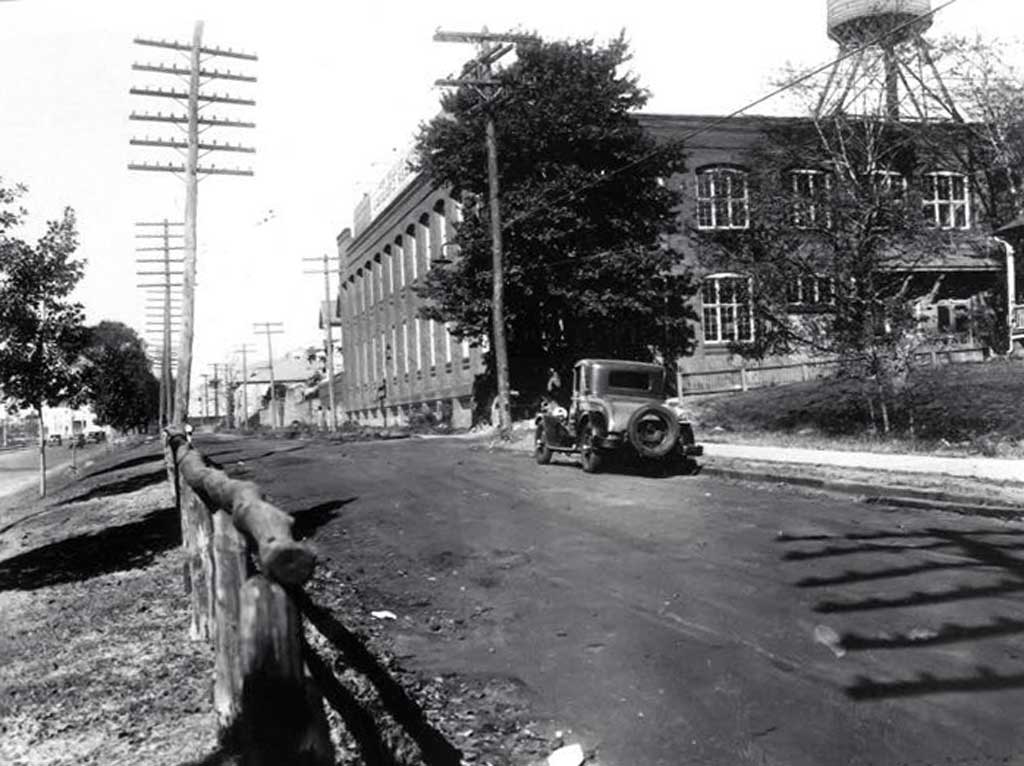
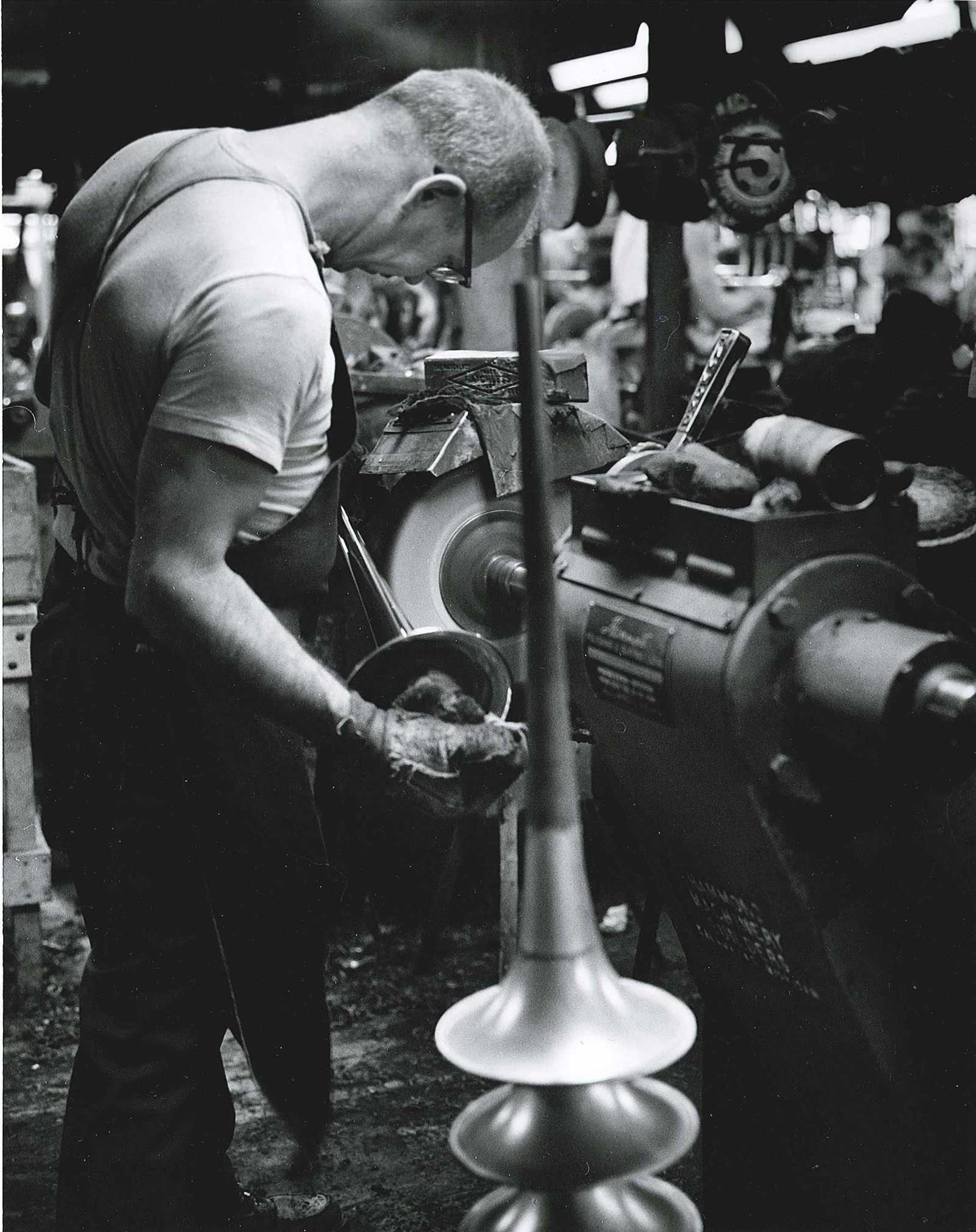
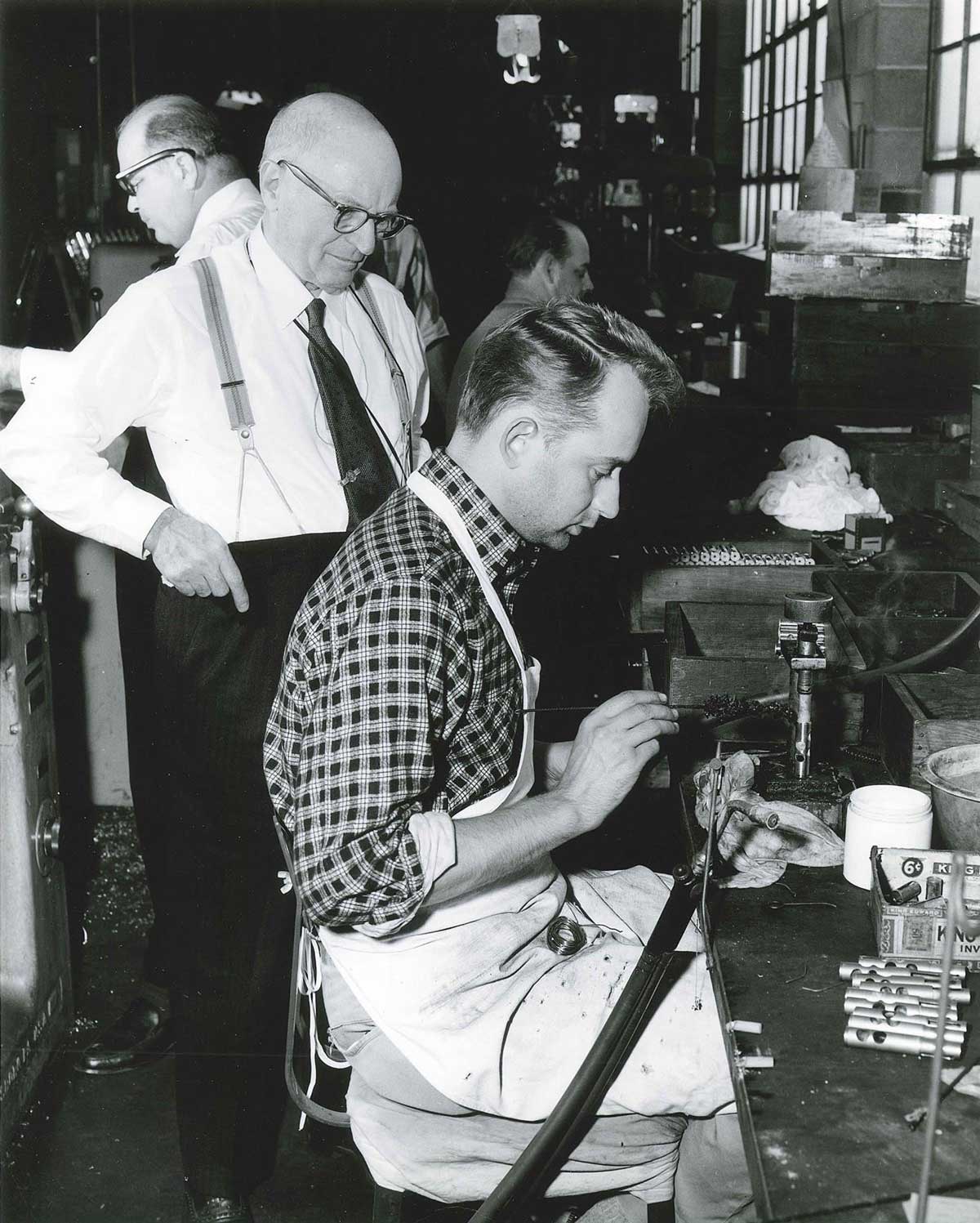
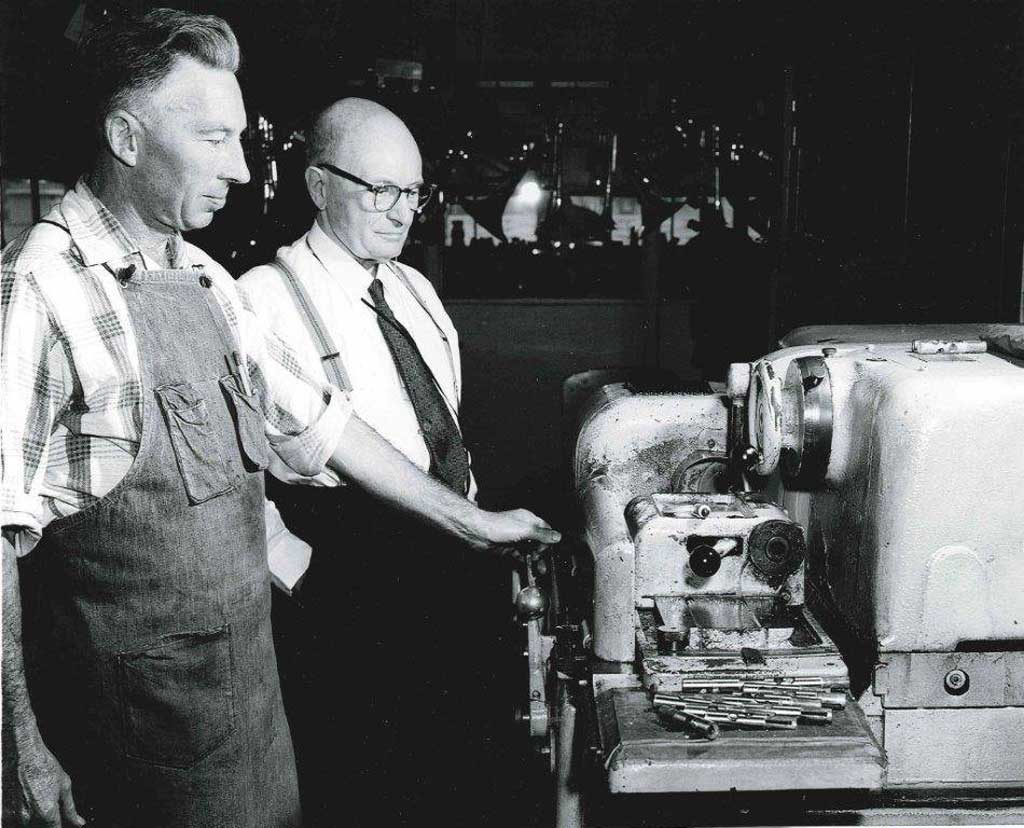
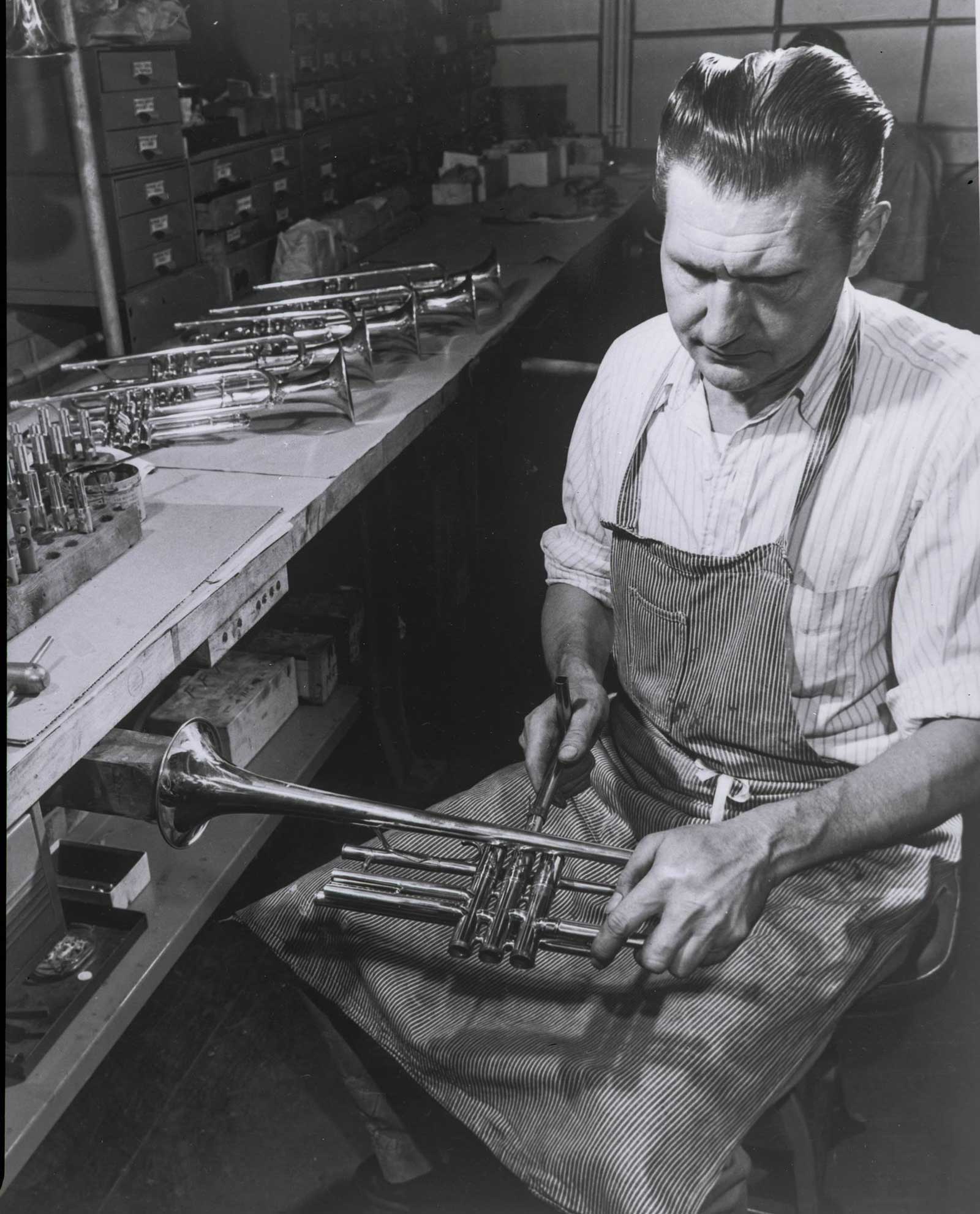
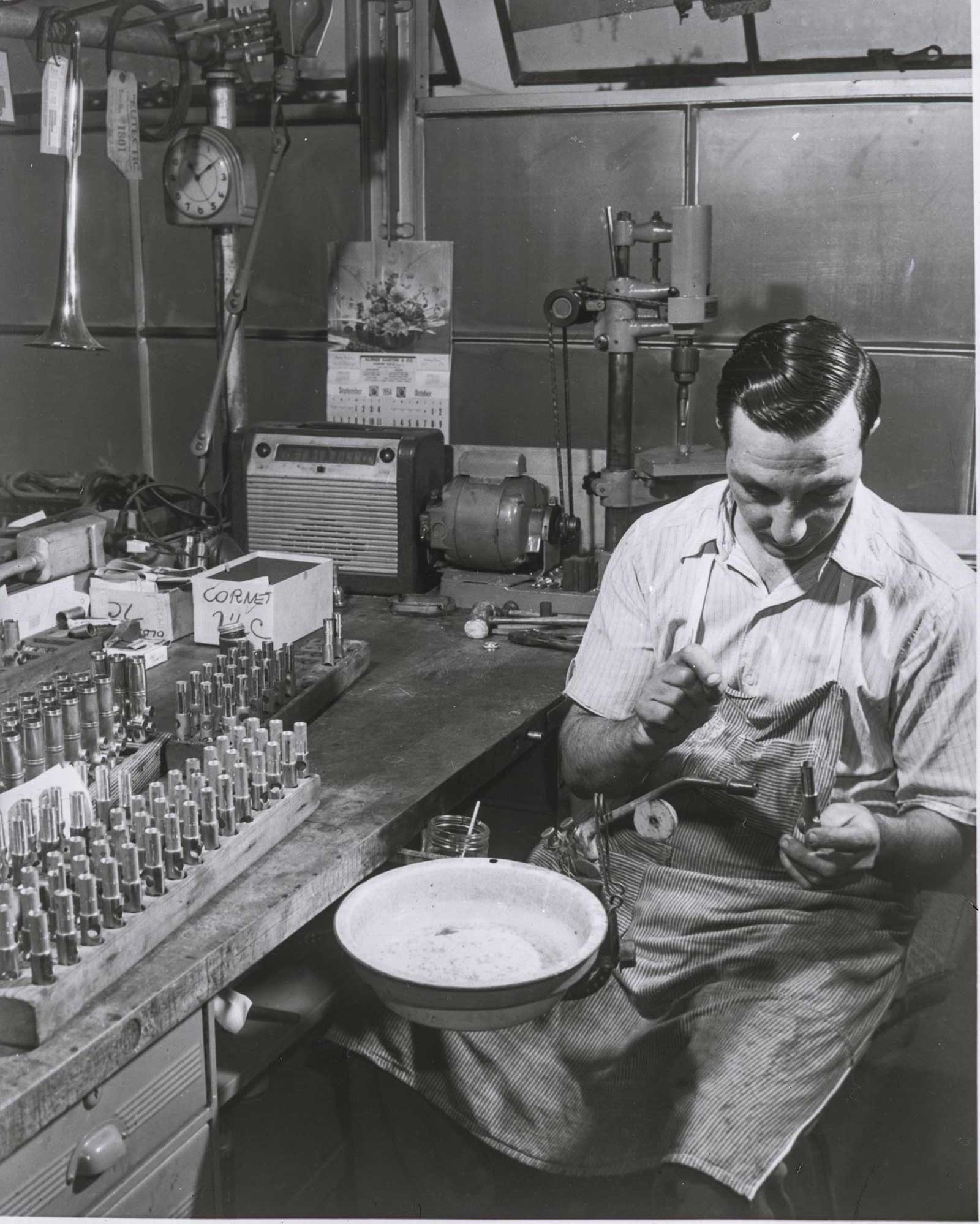
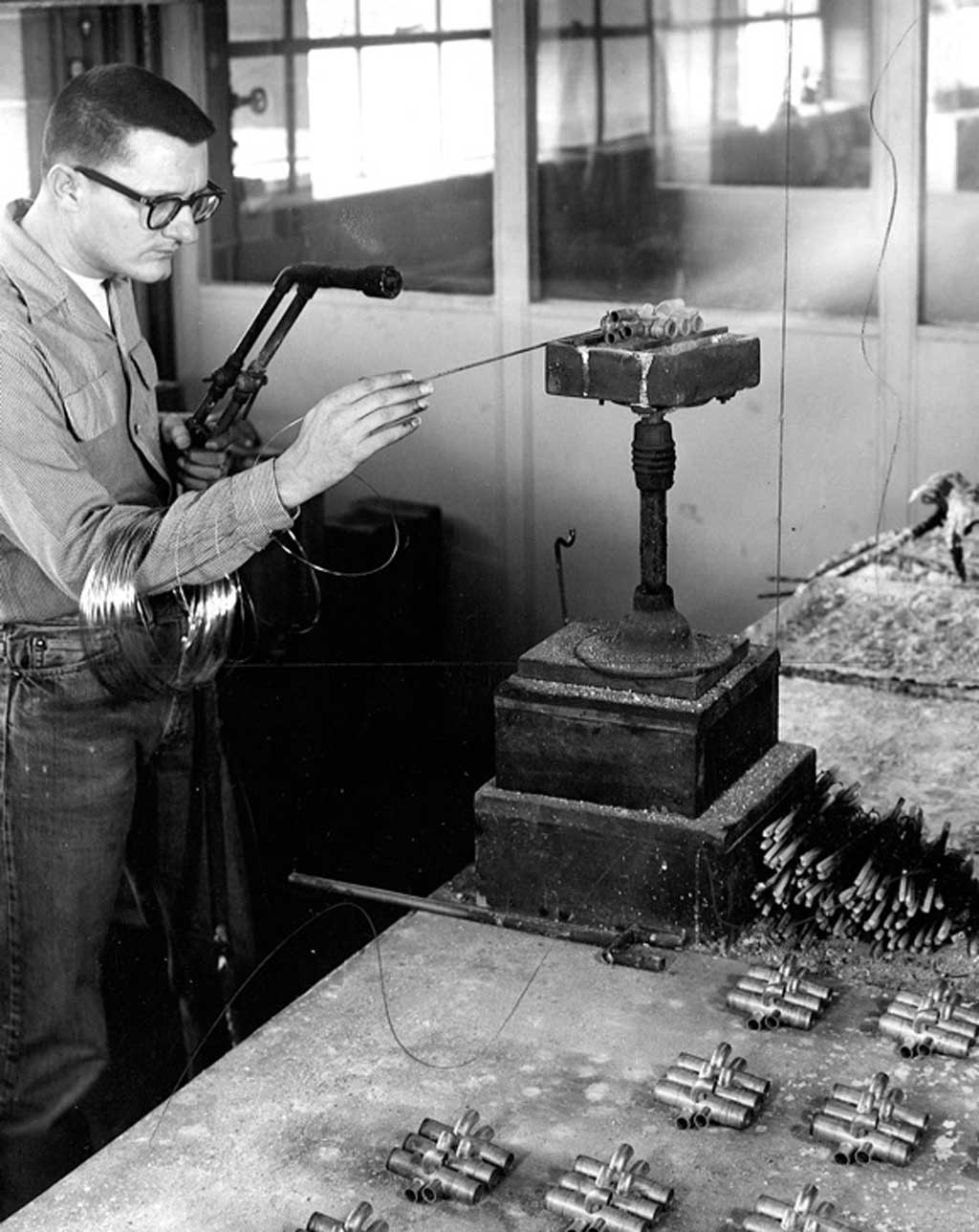
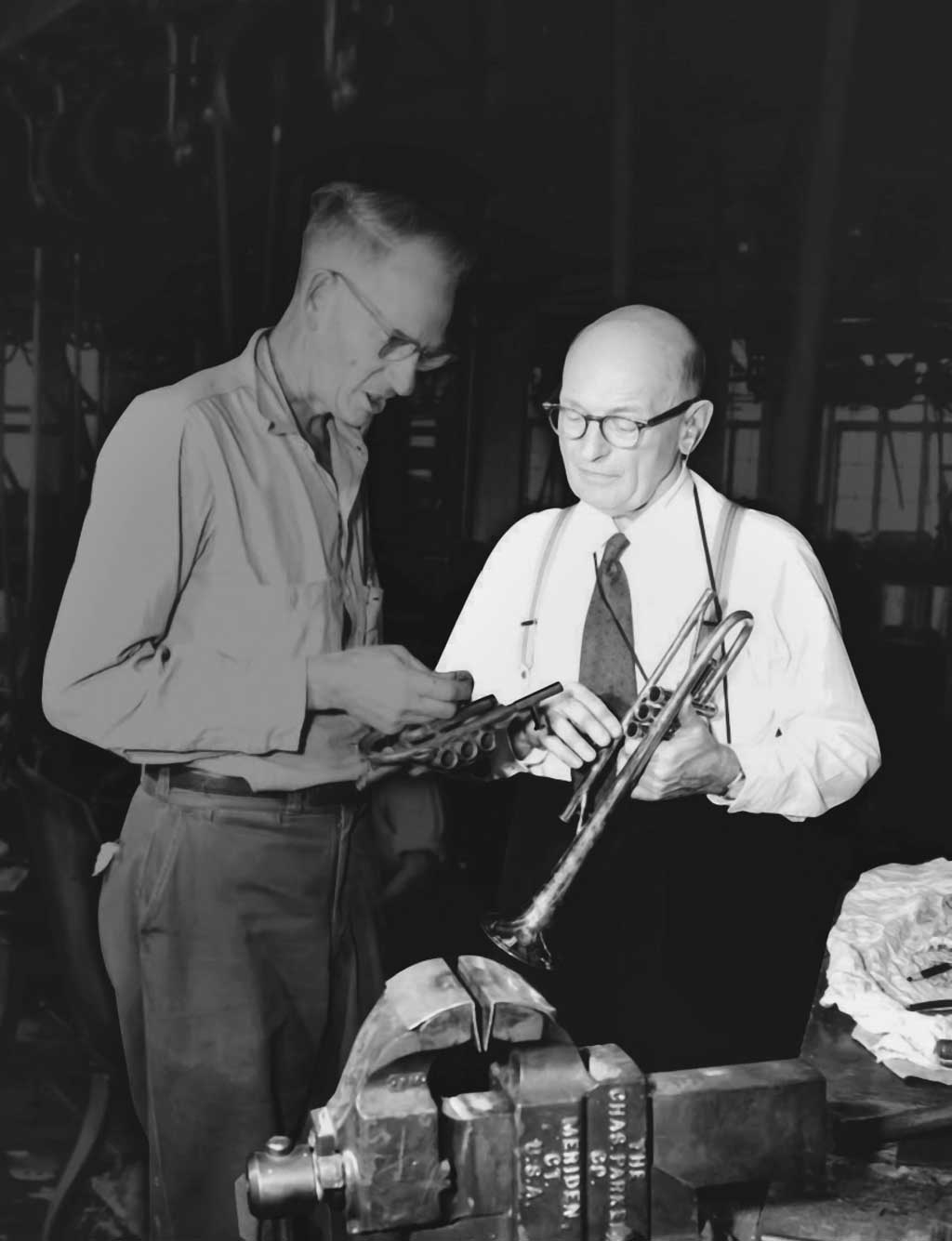
Vincent’s primary factory location was used for 25 years of the manufacturing of Bach brass instruments. Bach employed more than 40 employees at any given time at this location.
Phone#: Olinville 4454 Olinville 4455
Statistics
40 Factory workers (Fladmoe)
4 Office workers (Fladmoe)
50 employees (Groves)
~ 26,000 ft2 (NY Times)
Circa ~ 1930
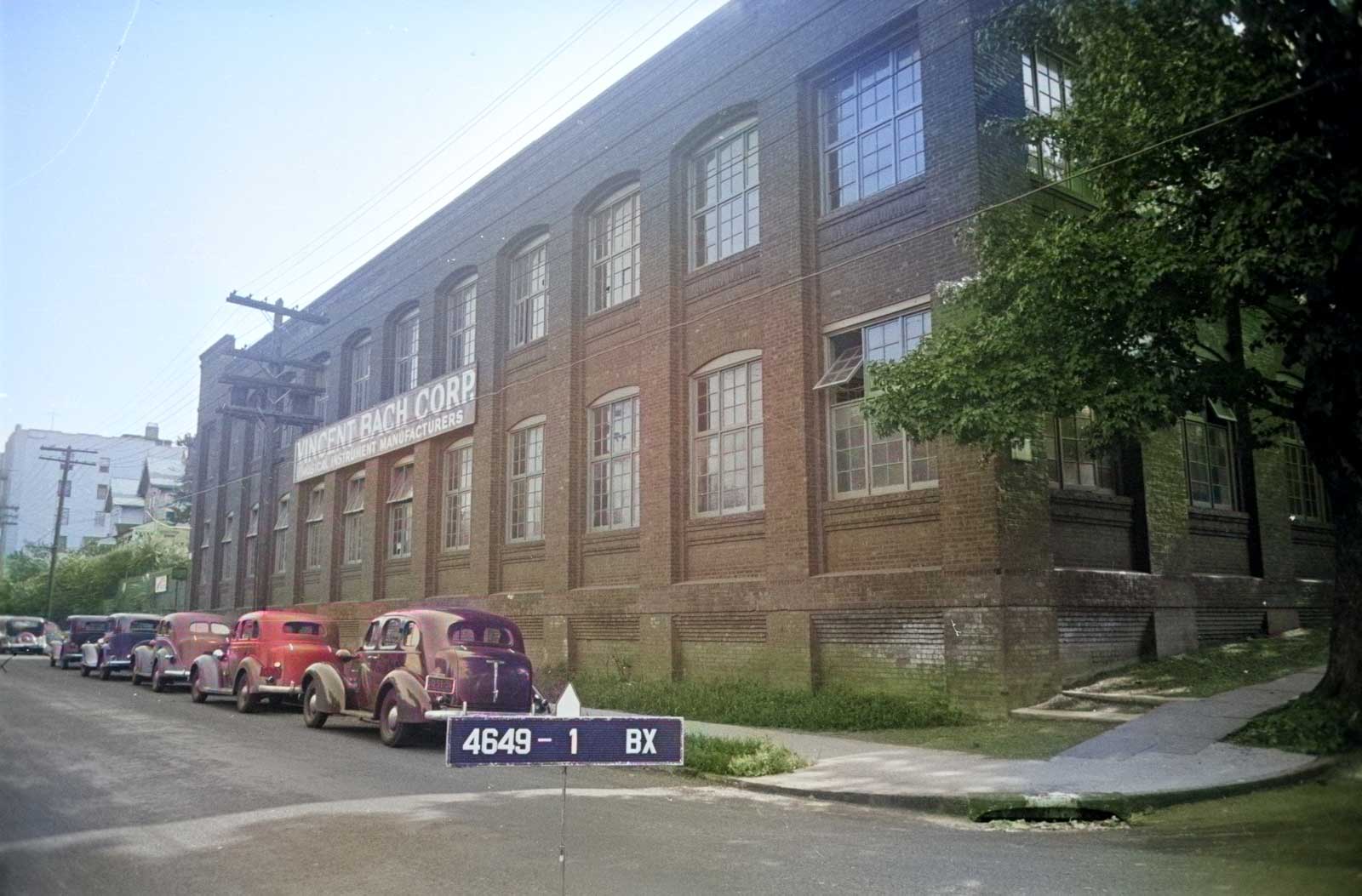
~1940, from NYC Municipal Archives. Recolored by BachLoyalist.com
” Between 1939 and 1941, the Works Progress Administration collaborated with the New York City Tax Department to collect photographs of most buildings in the five boroughs of New York City.
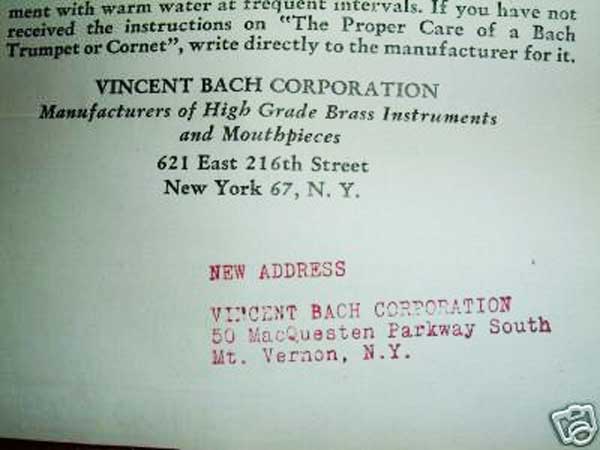
Vincent Bach Corporation stamped their change of address on various printed materials from the factory during the fall of 1953 until new catalogs and manuals were printed. Vincent was frugal, and nothing was wasted.
Sale of the 621 East 216th Street, Bronx (Fall 1952)
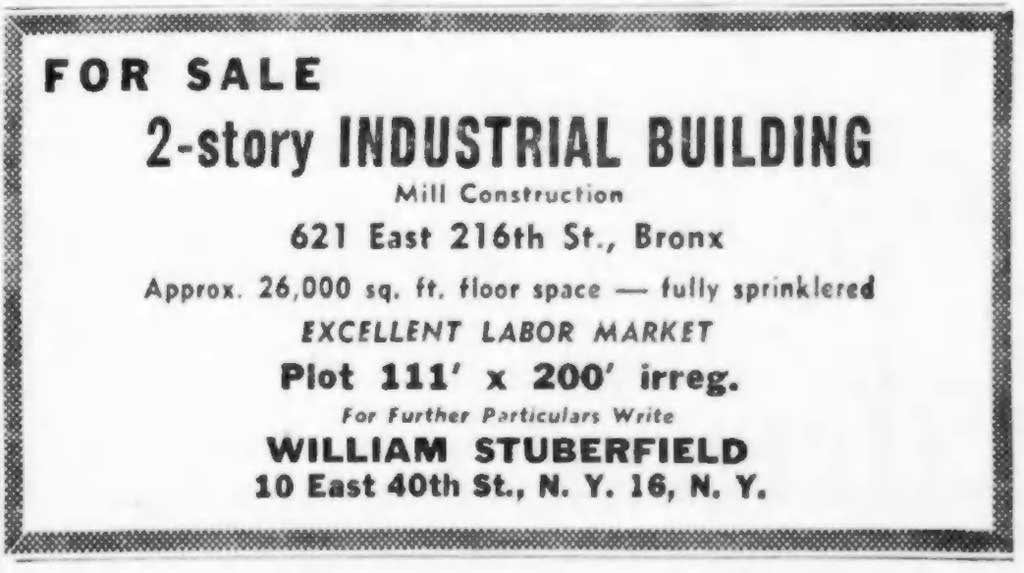
The building owner (William Stuberfield) listed the Bronx factory for sale in May of 1952. This may have been a surprise to Vincent Bach, who quickly designed and built the Mt. Vernon factory, and moved in the Spring of 1953.
It is assumed that Vincent Bach Corporation continued to operate in the building after the sale, until it moved to its new Mt. Vernon factory in 1953.
Listed for sale; May 1952 NYT
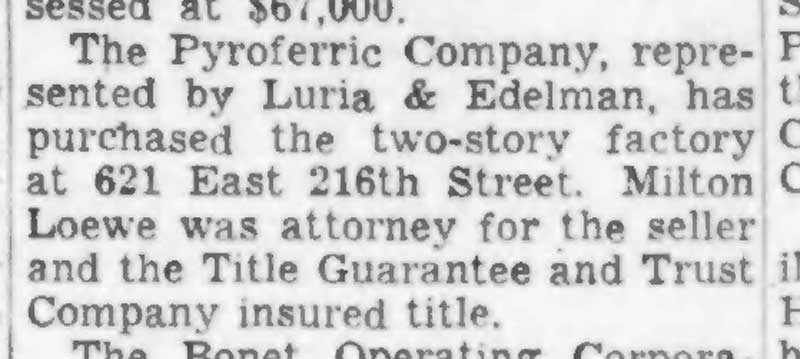
Sold; October 1952 NYT
source: Vincent Bach Corporation catalog
source: Groves
source: Fladmoe 1975, page 52
source: eBay listing image
source: NY Times
1953 - 1964
Moved from the Bronx factory to the newly constructed Mt. Vernon factory
Mt. Vernon
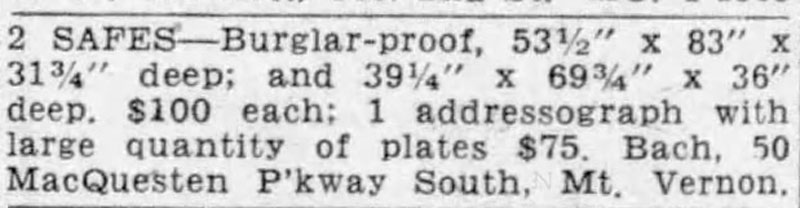
50 S Macquesten Pkwy., Mt. Vernon, NY 1953 – 1963/1965
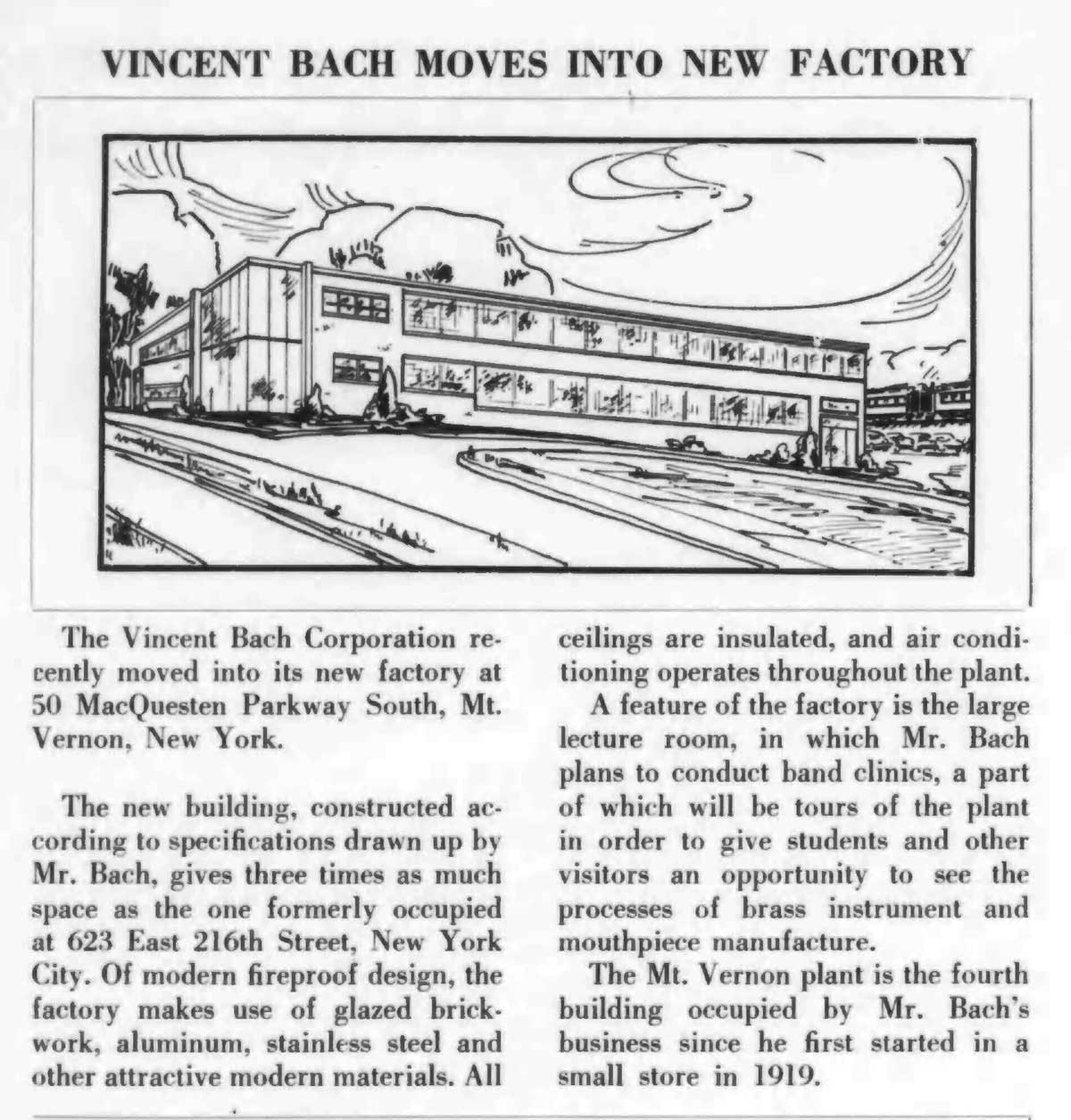
” The new building, constructed according to specifications drawn up by Mr. Bach, gives three times as much space as the one formerly occupied at 621 East 216th Street, New York City.” – 1953
Phone #: Mt Vernon 4-0900
Factory Design & Construction
Architect: Emilio J. DiRienzo, Mt. Vernon
Contractor: Bianco & Pepe, Inc.
Statistics
36 workers (1956)
50 employees (1957)
Cost $150,000 to build the new factory
$250,000 Revenue (1954)
$250,000 Revenue (1956)
source: Mt. Vernon Argus, various
Vincent BACH on the opposite of the building, facing the rail line.
“The Vincent Bach Corporation recently moved into its new factory at 50 MacQuesten Parkway South, Mt. Vernon, New York.
The new building, constructed according to specifications drawn up by Mr. Bach, gives three times as much space as the one formerly occupied at 623 East 216th Street, New York City. Of modern fireproof design, the factory makes use of glazed brick- work, aluminum, stainless steel and other attractive modern materials. All ceilings are insulated, and air condi- tioning operates throughoutthe plant.
A feature of the factory is the large lecture room, in which Mr. Bach plans to conduct band clinics, a part of which will be tours of the plant in order to give students and other visitors an opportunity to see the processes of brass instrument and mouthpiece manufacture.
The Mt. Vernon plant is the fourth building occupied by Mr. Bach’s business since he first started in a small store in 1919.” [1]
Jan 1954 - Mt. Vernon Argus
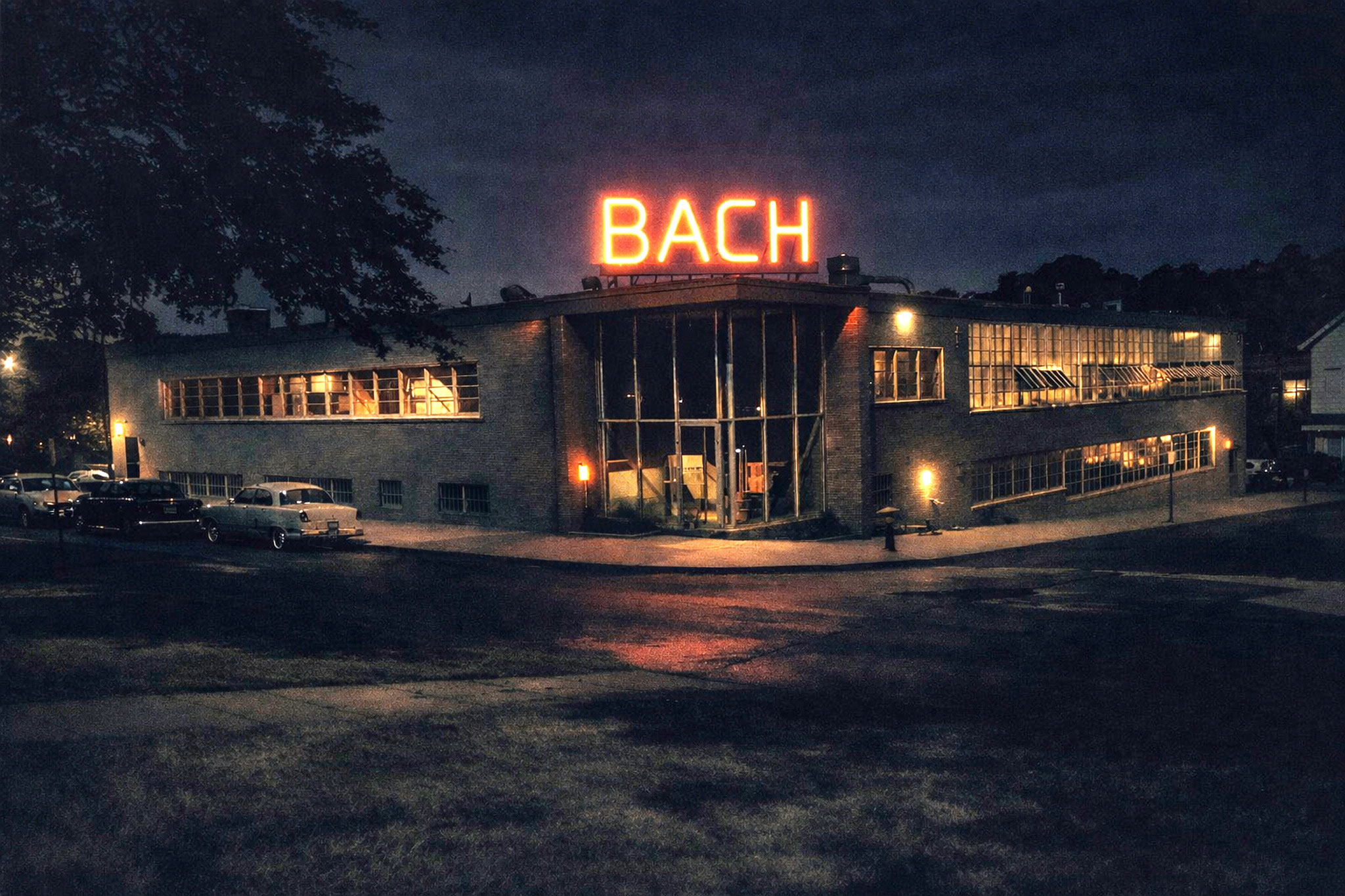
BachLoyalist - AI-modified original image
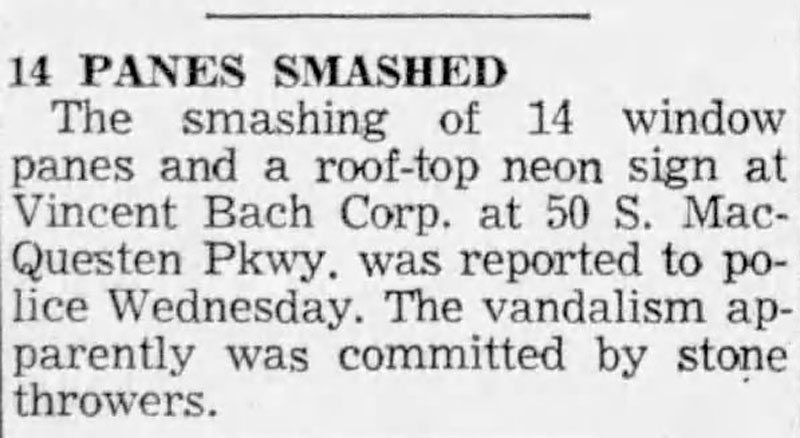
While the image of the Mount Vernon factory is well known, this refers to the “neon sign” installed on the roof. It is assumed that the BACH sign had neon installed in the center of each letter, as shown in this AI-generated image.
source: South Bend Tribune,
Sept. 19, 1958, pg. 28
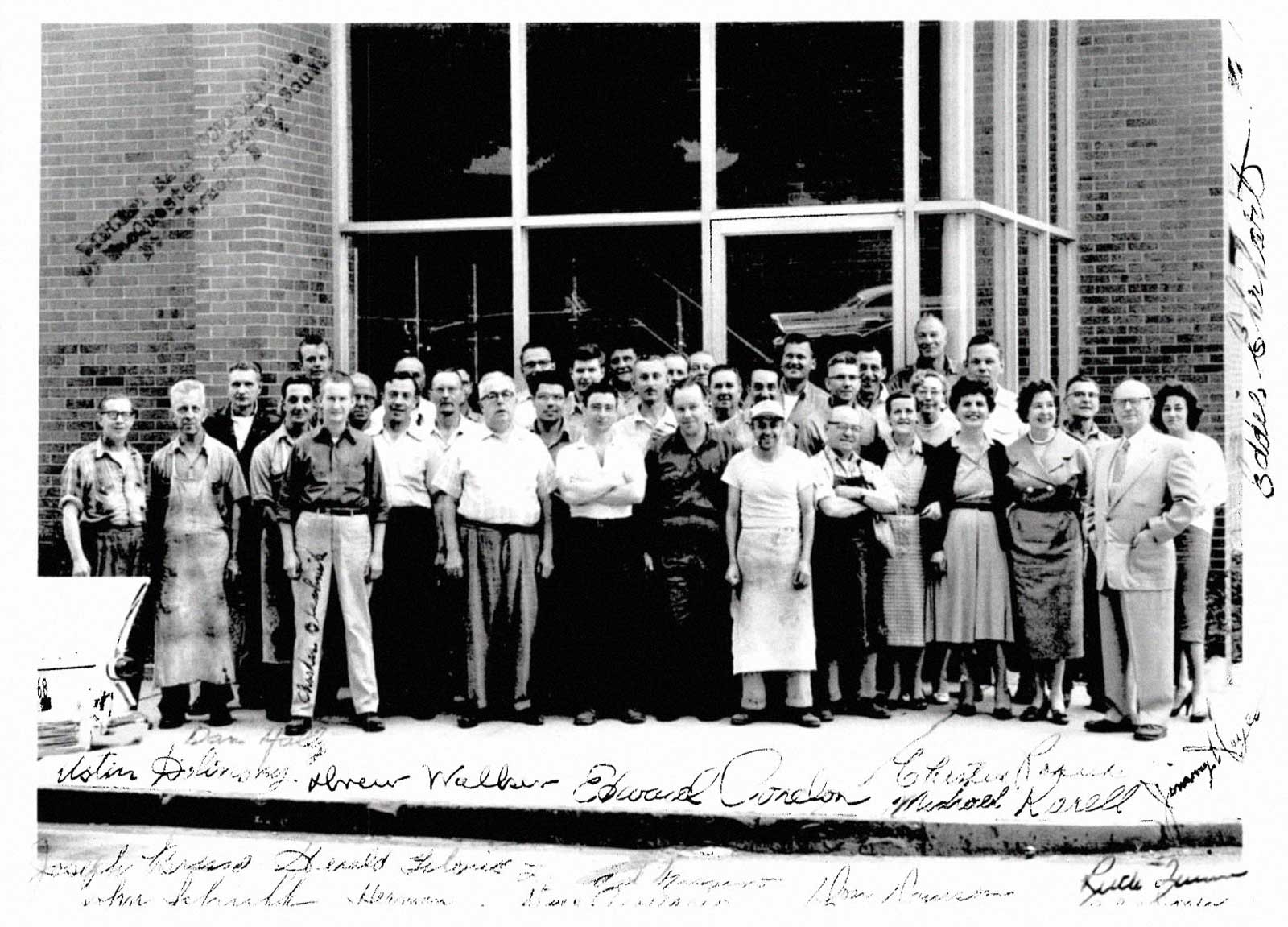
Vincent Bach Corporation - Mt. Vernon employees
Vincent Bach Corp. Employees (est. late 1950s)
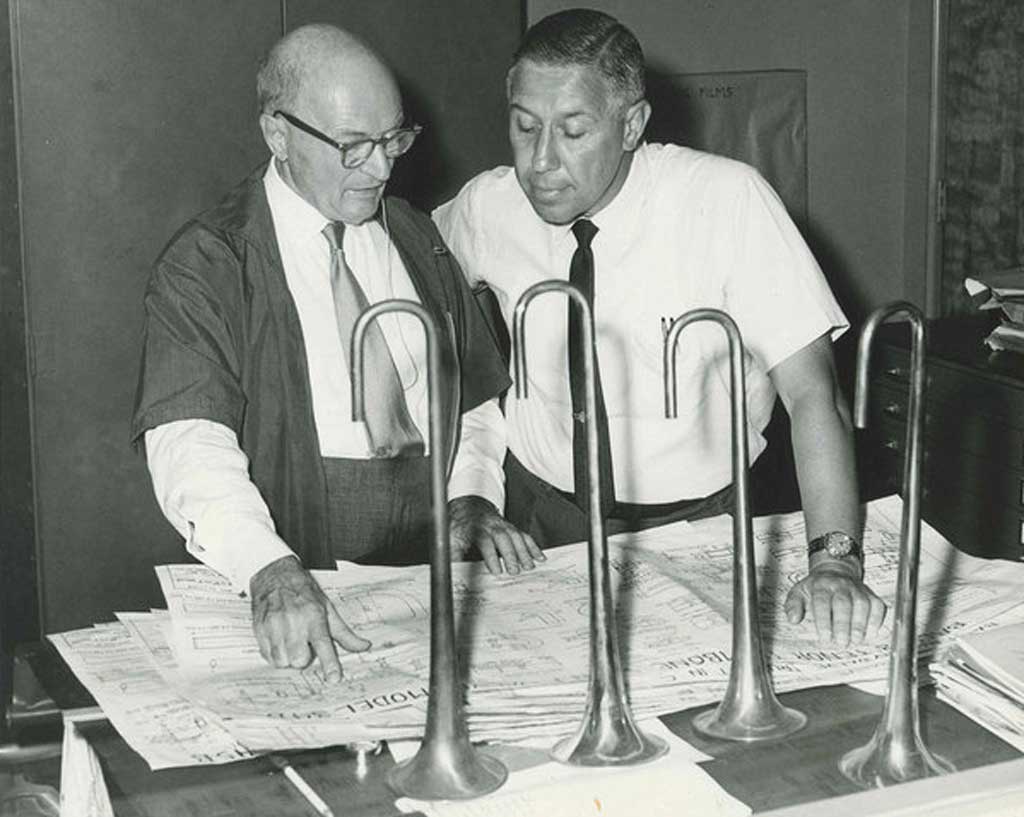
Vincent & John (Jack) Feddersen, President H.&A. Selmer, Inc. 1961 (?)
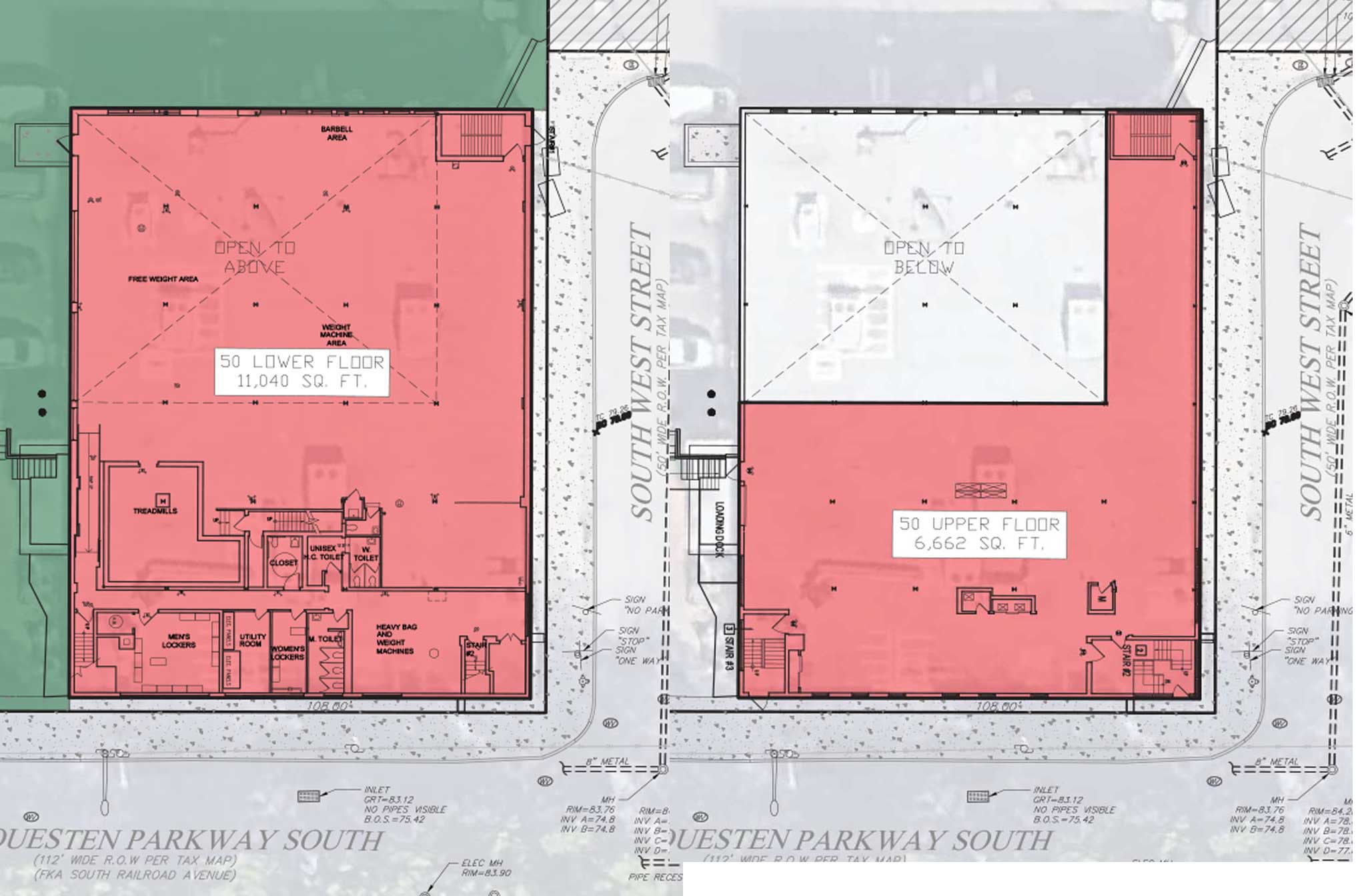
50 South MacQuesten Floor Plans (CBRE 2024)
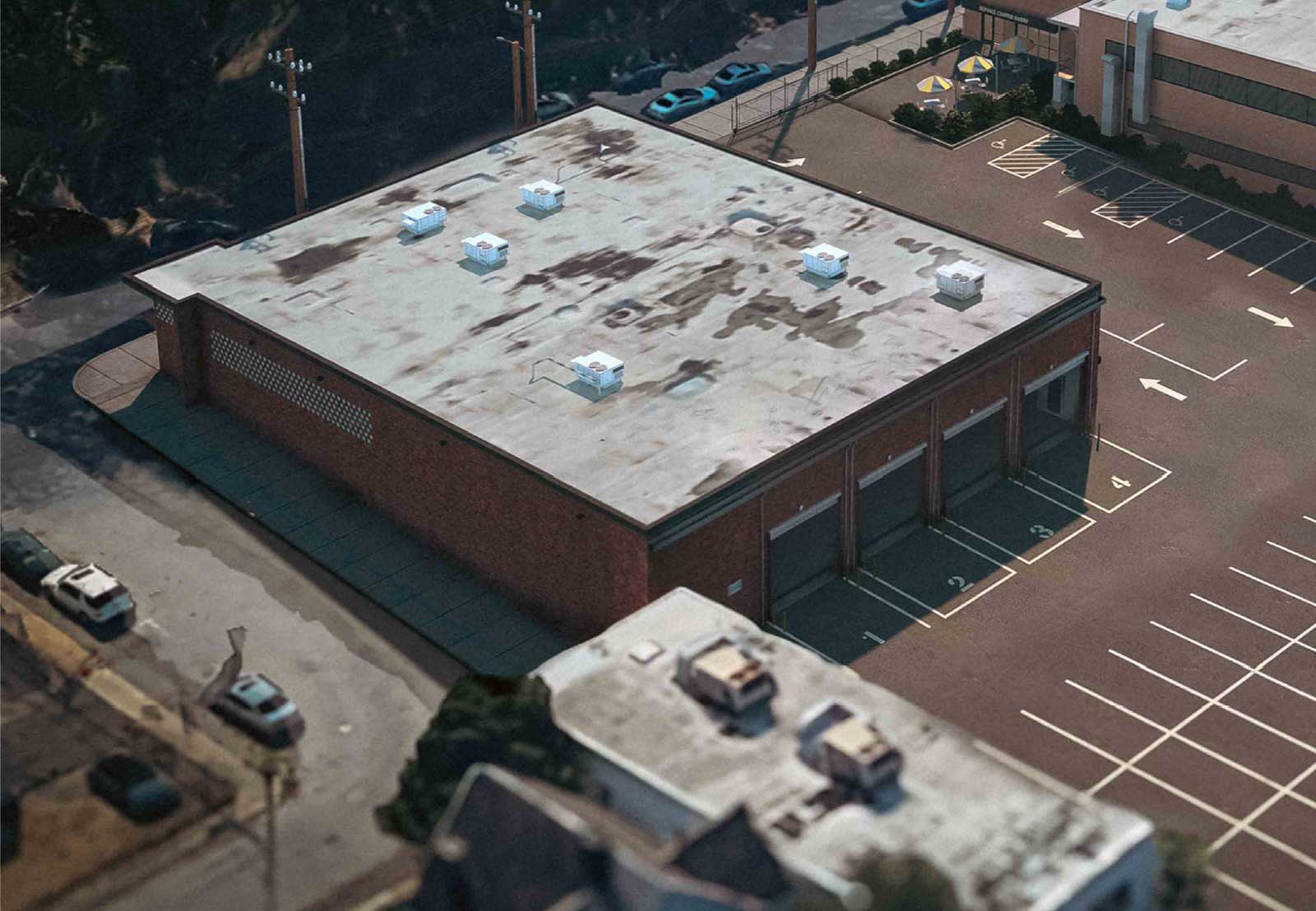
50 South MacQuesten Parkway (CBRE 2024)
source: Vincent Bach Corporation catalog
source: The Instrumentalist, Oct. 1953, pg. 16 [1]
source: CBRE Real Estate Listing; 2024
1963 - 1970/1973
Moved from Mt. Vernon to the former Buescher plant in Elkhart.
Elkhart
225 East Jackson Blvd., Elkhart, IN 1963 – 1970/1973
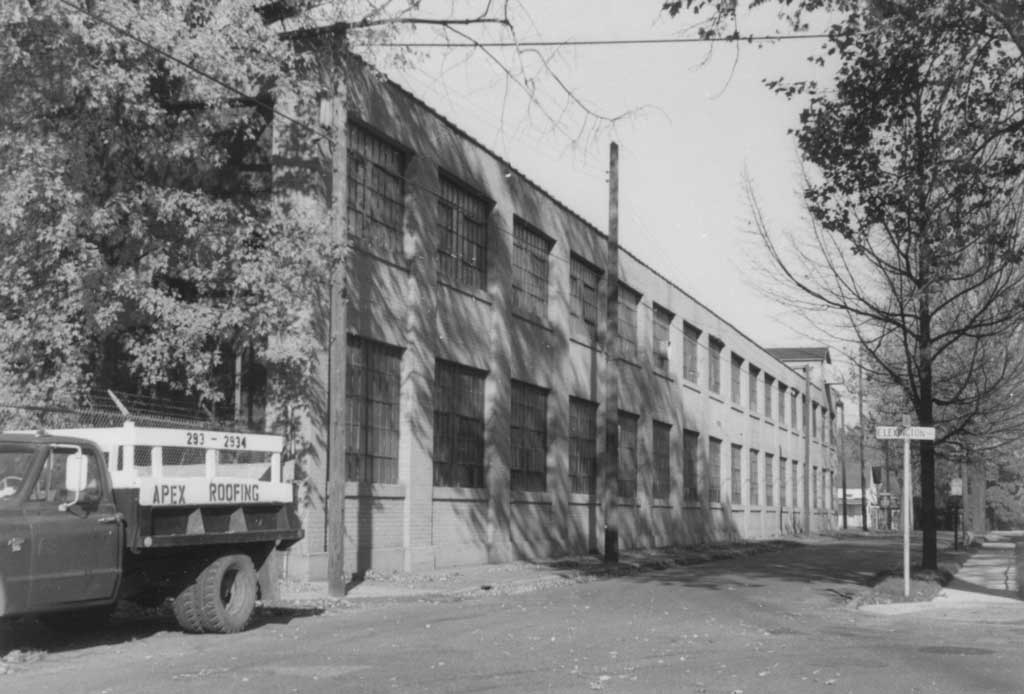
When the Vincent Bach Corporation relocated to Elkhart, it was initially situated in the former Buescher factory, which Selmer had purchased shortly before the move. The manufacture of Vincent Bach mouthpieces moved to Elkhart in 1962.
This factory was old and generally run-down, as reported in various oral histories from Bach Elkhart employees.
Statistics
## employees (TBD)
source: TBD
Buescher Factory - 1940s
H. & A. Selmer/Bach factory 1963, when Mt Vernon mfg. was relocated.
source: Factory Street Photo
H. & A. Selmer, Inc. factory in 1963;formerly the Buescher brass factory
Courtesy of the Elkhart Public Library.
1970 - present
Moved to the former Conn facility on Industrial Parkway
Elkhart
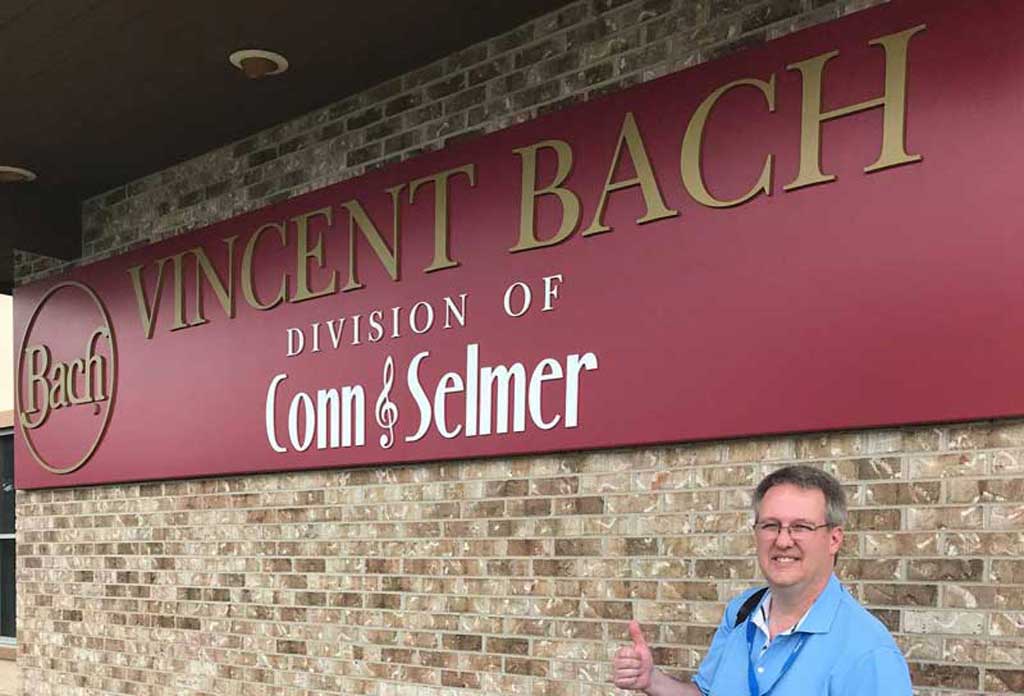
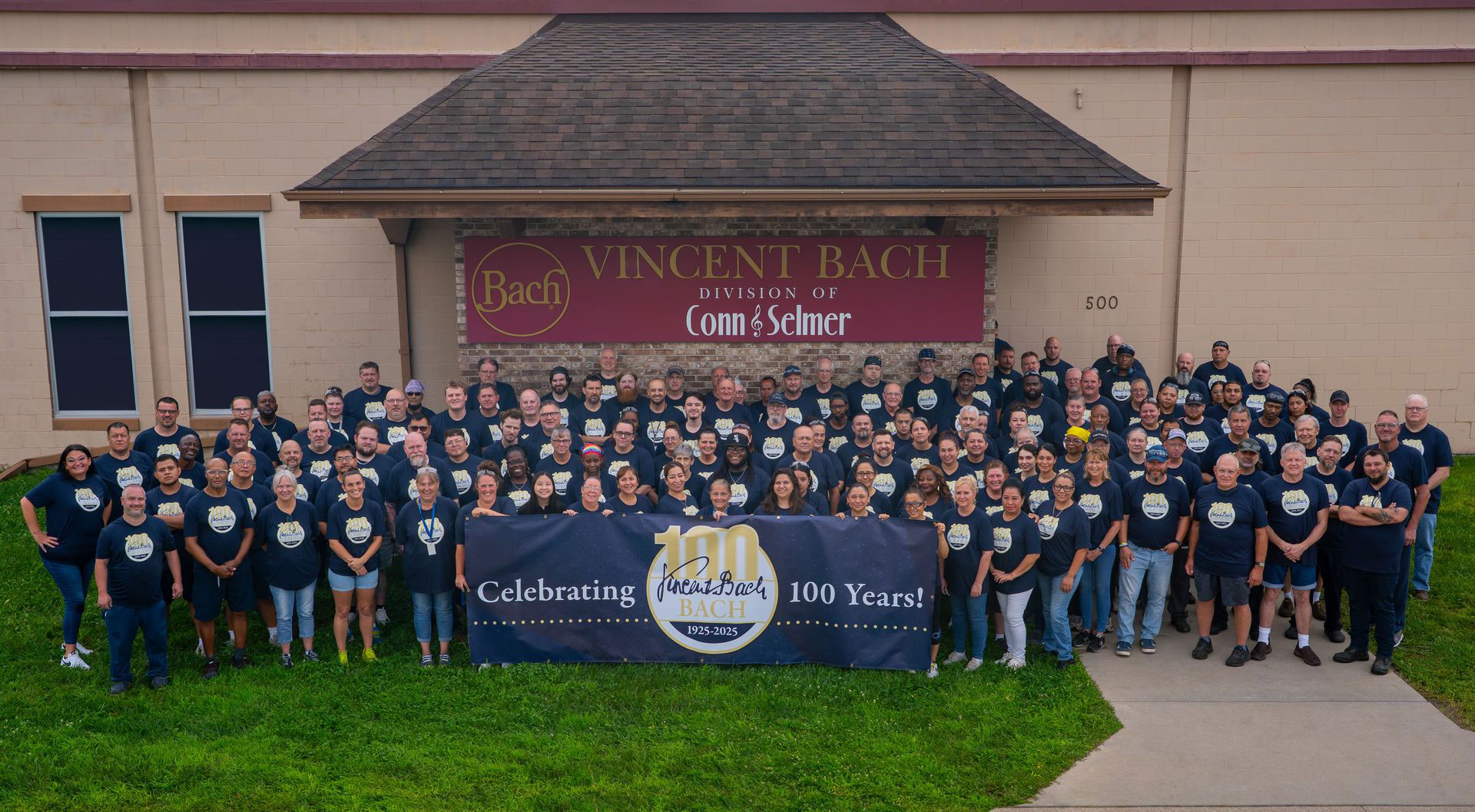
500 Industrial Parkway, Elkhart, IN 1970/1973 – present
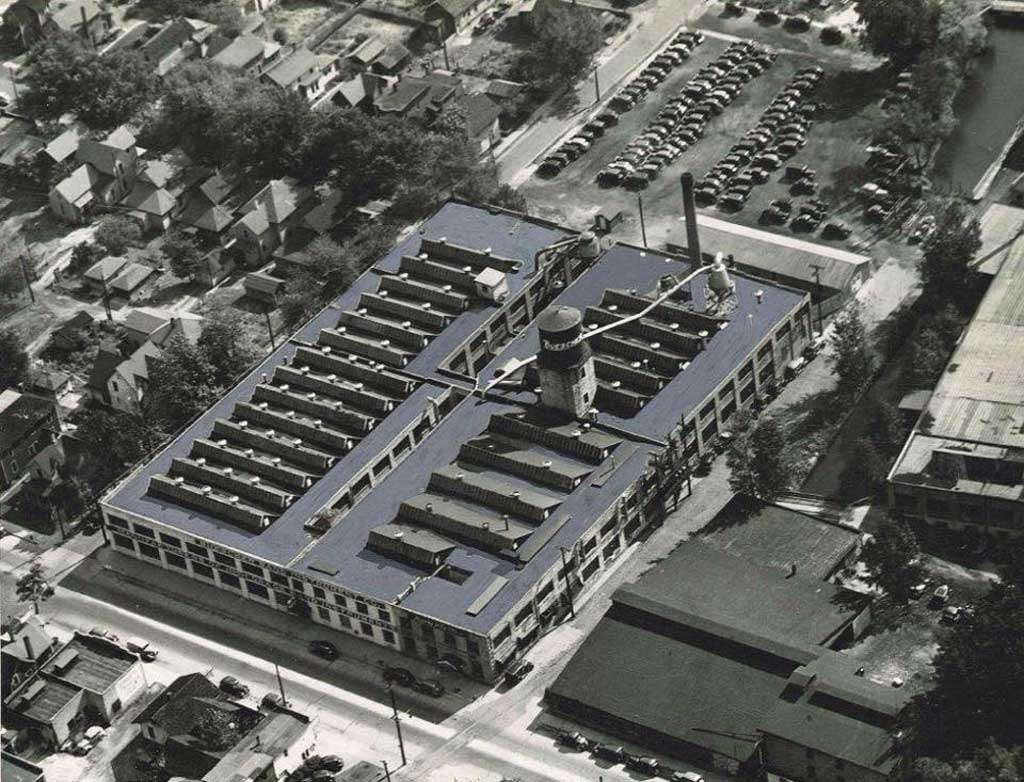
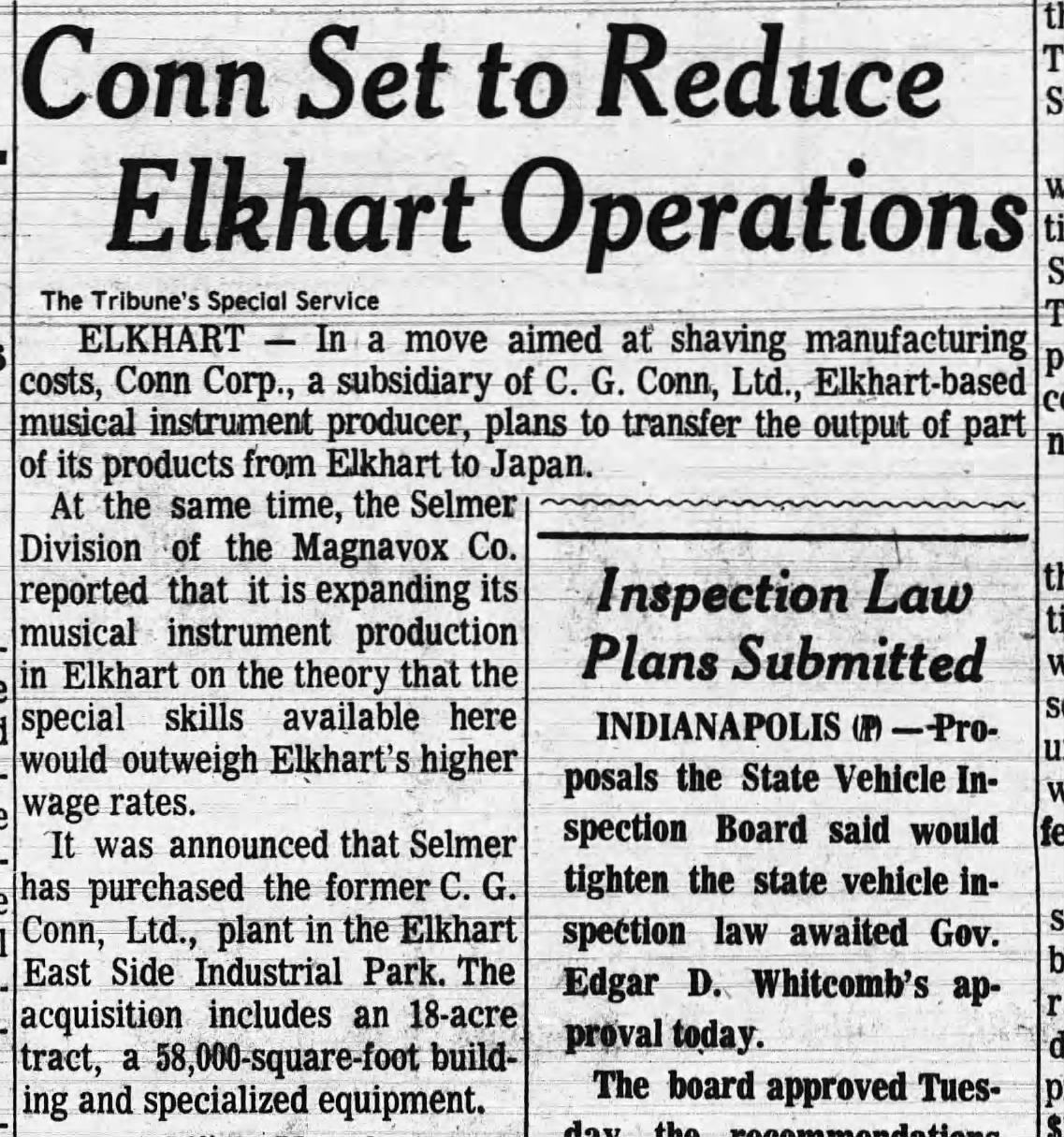
In 1970, Selmer (USA) bought G. C. Conn’s Elkhart manufacturing facilities as Conn was transferring manufacturing to Texas at that time. It took a few years to transfer all H. & A. Selmer / Bach brass instrument manufacturing from the 225 Jackson Ave. factory.
The professional series of Bach trumpets and trombones are still made at the former Conn factory at 500 Industrial Parkway, Elkhart, IN.
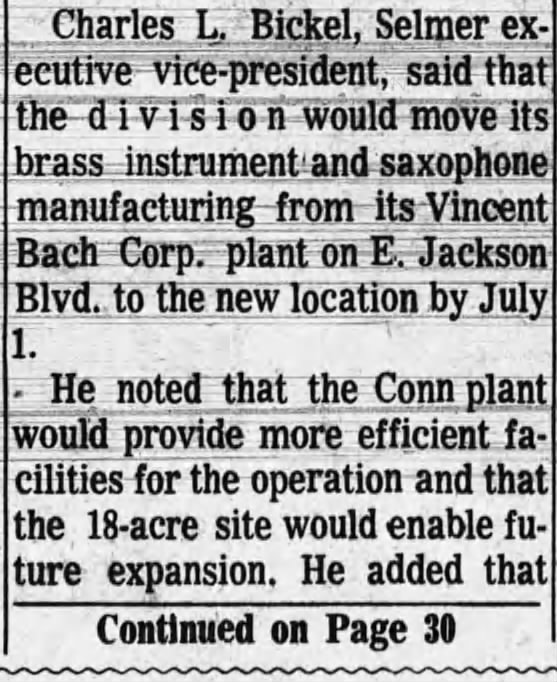
When C.G. Conn Ltd. announced their move from Elkhart, the Selmer Company announced the purchase of the Elkhart East Side Industrial Park, known as Industrial Parkway. Selmer (started) moving the brass instrument and saxophone manufacturing to this facility in July 1970.
Not all equipment an instrument manufacturing operations were moved until roughly 1975, when the East Jackson plant was closed.
Bach FEST 2018 with BachLoyalist
Elkhart 100 Years of Vincent Bach instruments - August 2025
Source: BachLoyalist, The Selmer Company, Conn Selmer
source: various Bach loyalist papers, books, and general historical sources.
BachLoyalist - Everything about Vincent Bach Instruments
BachLoyalist.com is the ultimate reference to everything related to Vincent Bach & Bach Stradivarius brass instruments. This site has grown through the contributions of fellow Bach loyalists, and is one of the most complete references of Bach related instruments.