BachLoyalist.com is the ultimate reference to everything related to Vincent Bach & Bach Stradivarius brass instruments. This site has grown through the contributions of fellow Bach loyalists and is one of the most complete references of Bach-related instruments.
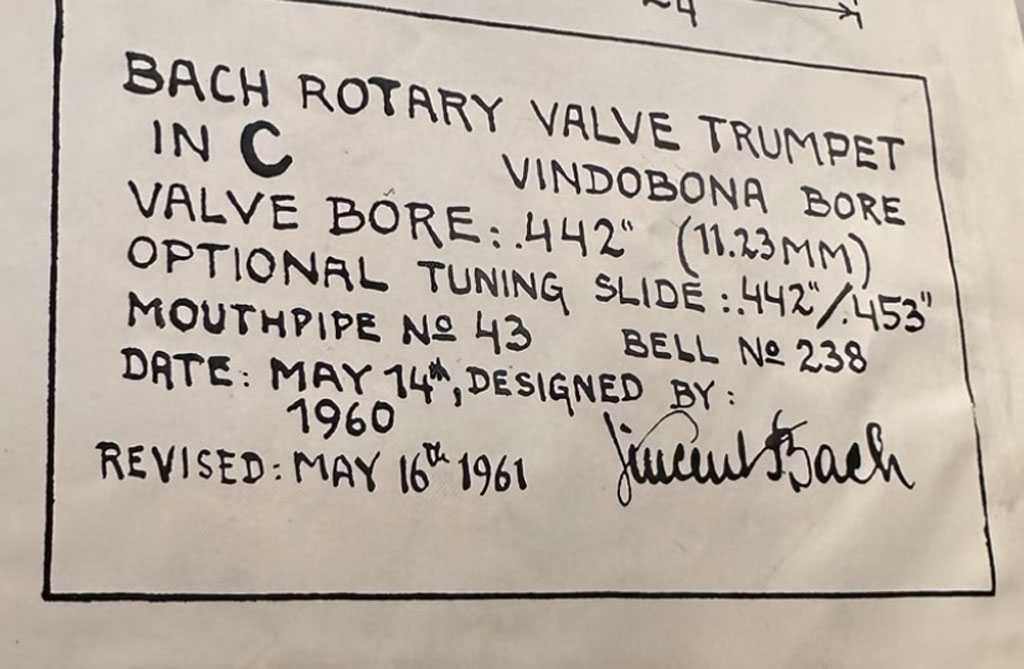
Vincent Bach introduced the concept of pairing the bell size (72, 65) of a German rotary trumpet with the valve block (ML) of a French-style instrument (Bach Stradivarius), which gave birth to a uniquely American trumpet sound in the early 1960s. The “Vindobono” bore was introduced on Bach trumpets and cornets. “Vindobono, ” refers to the “Viena” sound profile.
"Vindobona" or "Vindabona"?
While Vincent Bach referred to it as a “Vindobona” bore when it was designed in 1960 and introduced in the 1961 catalog, it was eventually renamed the “Vindabona” bore, which more closely matched the pronunciation of the name. Selmer/Conn Selmer later and currently use the spelling “Vindabona” bore trumpets.
Introduction of the Vindobona Bore (1961)
Introduced in 1961, the “Vindobona” bore was a new option across Bach Stradivarius Bb, C, and other high-key trumpet models. This concept was developed by Vincent Bach, who had experimented with telescoping leadpipes on a small number of Bach Stradivarius C trumpets.
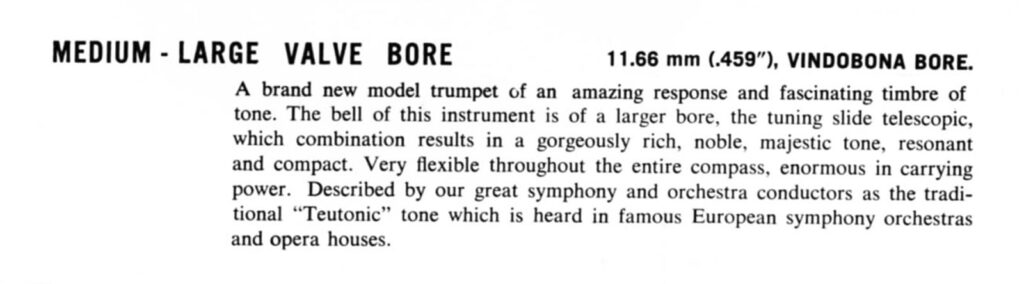
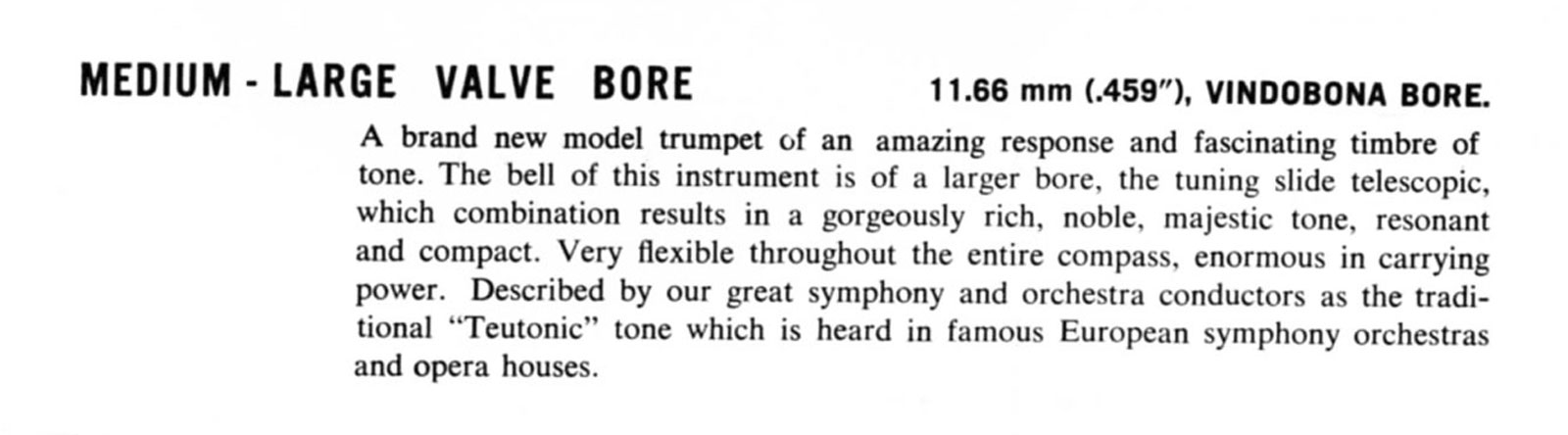
” A brand new model trumpet of an amazing response and fascinating timbre of tone. The bell of this instrument is of a larger bore, and the tuning slide is telescopic, which combination results in a gorgeously rich, noble, majestic tone, resonant and compact. Very flexible throughout the entire compass, enormous in carrying power. Described by great symphony and orchestra conductors as the traditional “Teutonic” tone which is heard in famous European symphony and opera houses.”
– Vincent Bach Corporation, 1961, page 8
Vindabona Bore - 1986 Description
” I used to make trumpets of corresponding valve and bell bores: a small bore valve with a small bell, a medium bore valve with a larger bell (with some combinations in between). But I also made the Vindobona bore trumpet and cornet with a large bell, a medium-large bore valve (.459″), and a small mouthpipe to give resistance.”
Today’s preference for big tone is reflected in the popularity of in instruments with medium-large and large bores. But remember, to produce a large volume of tone requires the player to blow an equivalent volume of air into vibration. Those who have a more delicate embouchure or tire easily should choose medium bores that require less effort to fill. Medium bores produce greater resistance but less volume of tone and carrying power.
For a European-style Teutonic tone, choose the Vindobona bore. And, for more flexibility, select a medium-large bore trumpet and order an extra tuning slide of a smaller telescopic bore or a medium bore tuning slide offering the resistance of a medium bore trumpet, less volume, and carrying power.
– Bach Brass Catalog, 1986, page 3
Vindabona Bore - 2024 Description
” The new 19072V is the long-awaited successor to the classic Bach Vindabona trumpet models. We worked with our top artists to improve on Bach’s original design concepts of a large bell flare with a step bore design to create something special. A revised #44 leadpipe in lightweight nickel silver and MLV bore size that grows from .448″ – .459″ balances the large #72 bell. This instrument provides the player with a nearly unlimited color palate and breadth of sound while maintaining the agility of a much smaller bore instrument. Vincent Bach’s original idea of pairing the bore and bell size of a German rotary trumpet with the valve block of a French instrument gave birth to a uniquely American trumpet sound. Bach’s Research & Development team examined the most famous horns in Bach’s history to identify the optimal weight, construction, material, and assembly of Bach’s valve cluster. As a result of our efforts, we have produced a newly designed valve cluster, delivering a faster response and a more vibrant sound. Nothing beats the sound of Bach.”
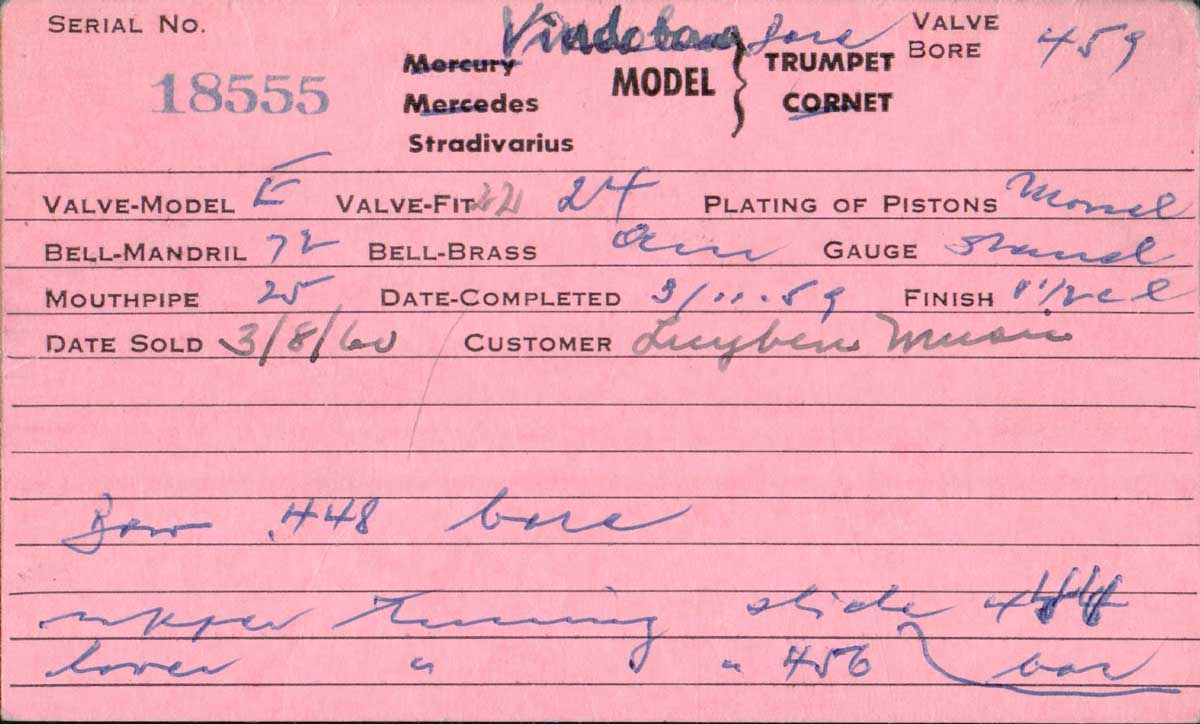
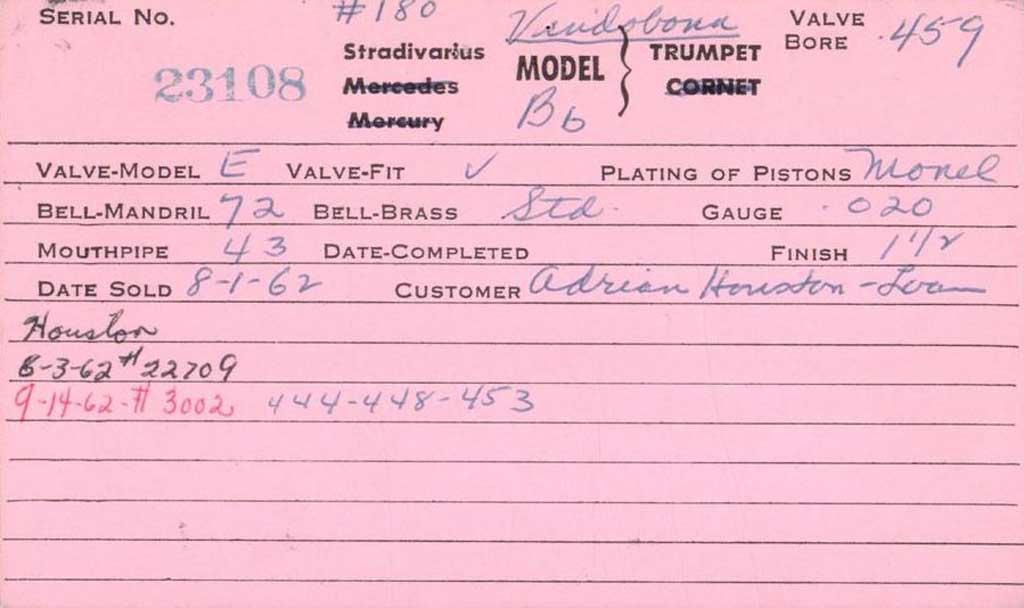
The earliest known Vindobona trumpet had a tuning slide with a top leg diameter of 0.444 inches and a bottom leg diameter of 0.456 inches.
These measurements were included on the Bach Mount Vernon Shop Cards of the earliest known Vindabona models.
On this earliest known example, the main tuning slide is stamped “444” on the top ferrule and “456” on the bottom ferrule.
The 1961 version had a lower leg 0.453-inch tuning slide diameter.
Vindobona Specifications (1959)
Tuning Slide Spec.
0.444″ top leg
0.448″ slide bow
0.456″ bottom leg
Valve Stamp (varied)
ML only (1959 SN# 18555 example)
Bell
72 (??? thickness)
No Vindobona shield
The tuning slide’s top leg diameter was 0.444 inches, and its bottom leg diameter was 0.453 inches. These measurements were included on Bach Mount Vernon Shop Cards of the earliest Vindabona models.
The earliest Vindabona models omitted an MLV on the 2nd valve casing and were only indicated by ML on the casing. Without examining the shop card or measuring the tuning slide, there is no method to determine if the trumpet is a Vindabona model.
Bach Vindobona Bore, 65G Bell
Vindobona Specifications (1961)
Tuning Slide Spec.
0.444″ top leg
0.448″ slide bow
0.453″ bottom leg
Valve Stamp (varied)
ML only (1962 SN# 23108 example)
MLV (1965 example)
Bell
65G
72 (0.020″ thickness)
Bach Vindobona Bore, 72 Bell
In addition to the tuning slide design, 0.453-inch filler tubes are installed until you reach the 0.459-inch valve block casing and slides. The #72 standard-weight bell has a 0.462-inch diameter at the bell tail, where it enters the valve casing.
– attributed to Tedd Waggoner (2013) through the Bach Vindabona MLV Trumpet Guild / Richard.
Vindabona Specifications (1990s)
Tuning Slide Spec.
0.444″ top leg
0.448″ slide bow
0.453″ bottom leg
Lower tuning slide 0.453″ filler tubes
0.462″ at the end of Bell tail
Conn Selmer reintroduced the Bach Stradivarius 19072V in 2023 as the long-awaited successor to the classic Bach Vindabona trumpet models.
The earliest versions of the Vindobon Bb trumpets used a Vindobona shield engraved onto the bell. During the 1962 to 1963 era, Vindobona models were not marked differently on the trumpets, and players may have an example and not know what they have.
Finally, as the Vindobona models were being transitioned to Elkhart, the bore size valve stamp was changed to include a “V” in the size. For example, MLV represents a Vindobona model.
A separate bell shield was applied to a Vindobona, Rotary C trumpet prototype.
Summer 1961 – Jan. 1962
Bell Engraving: Shield
Valve Stamp: ML
Bell: Mt. Vernon 65
Model: Mt. Vernon
Example: SN#22206
Special thanks to Jens Lindemann for sharing detailed photos of the Bach Vindobona Bb trumpet, serial number #22206.
1962 – 1963
Bell Engraving: None
Valve Stamp: ML
Bell: Mt. Vernon 72
Model: 180
Example: SN#: 23106
1964 – 1965
Bell Engraving: None
Valve Stamp: MLV
Bell: Mt. Vernon
Model: 180
Example: SN#xxxxx
Bach Stradivarius Vindobona Trumpet - Examples
Vincent Bach built his first Vindobona Bb trumpet models with BOTH 72 and 65 bells about the same time as Vincent sold his business to H. & A. Selmer, Inc.
Vindobona, 72 Bell
The earliest known Vindobona trumpet, 72 bell, was serial #18555 mfg. in March 1959 and sold in early March 1960.
Vindobona, 65 Bell
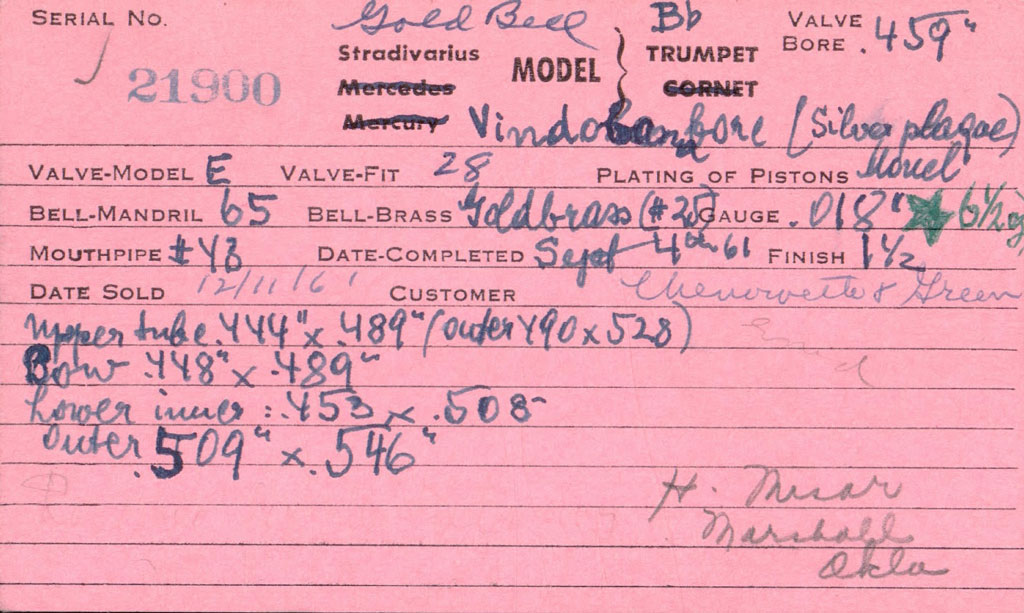
The earliest serial number, Vindobona Bb trumpet, 65 bell, was serial #21900, built on Sept. 4th, 1961, a few weeks before H. A. Selmer bought the company.
1962 Bach Stradivarius Vindobona, Bb model
Serial Number#: 23108
Model: 180 series
Bell: 72 (0.020″) / Leadpipe: 43
Tuning Slide Spec.
0.444″ top leg
0.448″ slide
0.453″ bottom leg
Valve Stamp
ML (No MLV stamp)
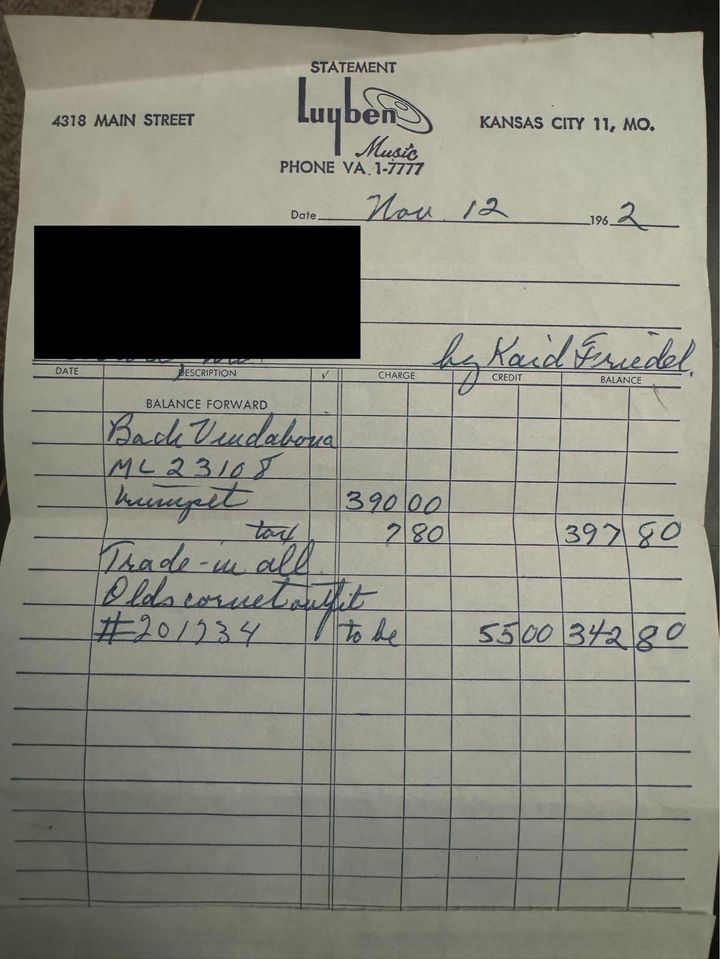
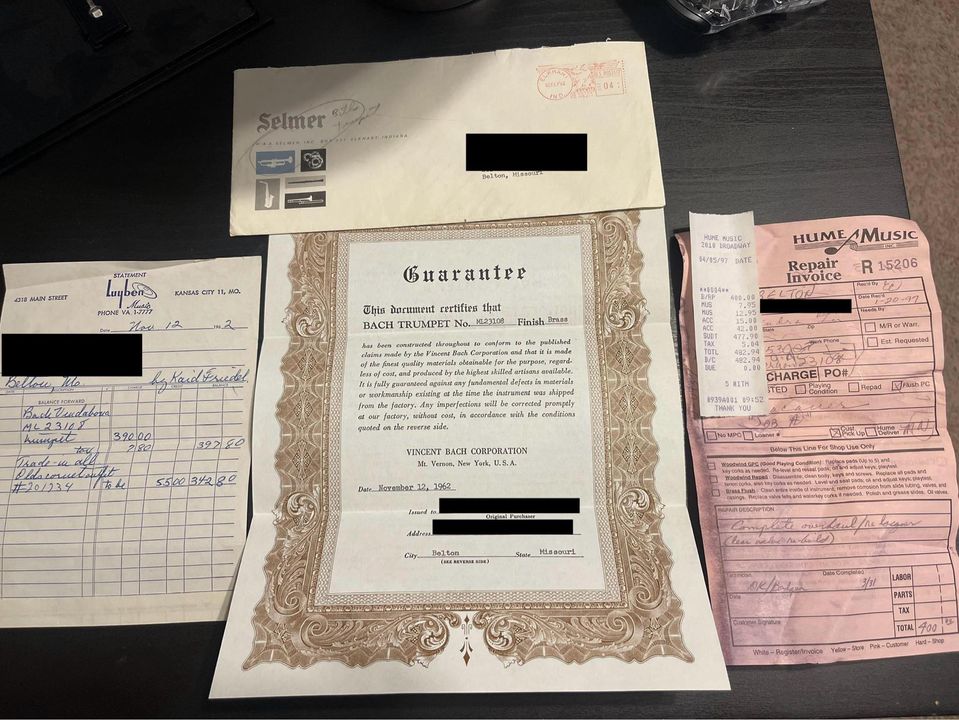
This example was an early 180-series Vindobona model manufactured in the Mount Vernon factory in August 1962. This example included the warranty card and documentation from The Selmer Company in November 1962.
Note: The 180 series was first introduced in February 1962 by Vincent Bach Corporation, part of the H. & A. Selmer Company.
source: shared from the Chris Edman collection
source: various information shared by fellow Bach loyalists
BachLoyalist - Everything about Vincent Bach Instruments
BachLoyalist.com is the ultimate reference to everything related to Vincent Bach & Bach Stradivarius brass instruments. This site has grown through the contributions of fellow Bach loyalists, and is one of the most complete references of Bach related instruments.