


Story of "How Vincent Bach Started his Business" from 1928
The Metronome
November 1928 (Originally published in March 1928)
” The first installment of the story of Vincent Bach appeared in the March issue of THE METRONOME Because of the unusual interest shown in it by young and ambitious readers we have had reprints made of it and copies will be sent free on request.
– The Editor
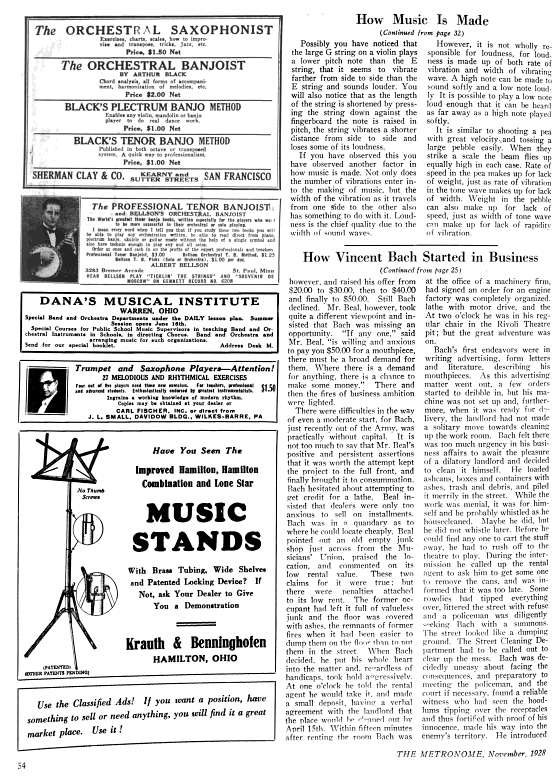
How Vincent Bach Started in Business
By STEPHEN KEMP
” Conditions in the musical world are unsettled and somewhat uncertain. Epochal changes are in process. Reproduced music is displacing musicians in many theatres, and great anxiety is present among professional musicians as to whether or not their livelihood is in complete jeopardy. It might be well to consider that changes similar in character have invaded practically every business profession and industry in the past and that it has become an accepted principle among thinking men that such changes have invariably worked to the ultimate benefit of the persons affected, although only the passing of time demonstrates the manner and method of the improvement. At the first installation of automatic machinery, in fact, machinery of every kind, the displaced workers raged against the innovations but afterward came to approve them. As musicians, we can only see the direct curtailment of the use of orchestras now, and what the end will be can hardly be predicted, but we are safe in believing that as the phonograph did not work, the injuries at first anticipated and as the radio has promoted the employment of musicians rather than curtailed their activities so over a period of time will the present development work out to the betterment of musical conditions In the meantime however many players see themselves displaced and at the moment no relief is insight. Thoughts are being turned to other employment to entering into business, and to all possible means of increasing the income sharply reduced or about to be eliminated entirely, by the new procedure.
Under the circumstances, a little story about a business venture by one of our own will probably prove of interest; therefore, we present a sketch of the efforts that discouragement, gradual accomplishment, and final success of Vincent Bach, a great artist, a diligent worker, and a master mechanic. One who raised himself from extremely modest financial beginnings to comparative affluence through the intensive development of an article long given away by manufacturers and judged as an unimportant accessory by the musical instrument trade, the brass mouthpiece.
During Vincent Bach’s engagement with the Boston Symphony Orchestra, he obtained a trumpet mouthpiece that seemed to meet every requirement of an important artistic performance. His search for it had been continual. While playing with the Russian Ballet Orchestra of the Metropolitan Opera Company New York, he made the serious, although generous, error of lending his mouthpiece to a trumpet player friend who desired a duplicate for his own use. This overzealous friend, when endeavoring to have the inside bore of the mouthpiece copied, hit upon a little larger and different bore that seemed to him to be a marvelous improvement over Bach’s mouthpiece.
Thinking to surprise and please his friend Vincent, he had the bore of the original mouthpiece altered to accord with what he considered a very decided improvement. It surprised Bach indeed but far from pleased him. In fact, the mouthpiece was ruined, and Bach’s search for a satisfactory one to replace it was again laboriously resumed. Mouthpieces were purchased by the score, tried, changed, and discarded. His entire leisure time, which was limited because of rehearsals, recordings show, and at least two hours of daily practice for solo playing, was taken up in persistent efforts to find a satisfactory mouthpiece. From the constant changing of mouthpieces, his embouchure was irritated, and he really considered himself fortunate when he entered the US Army during wartime, because his position as bandmaster afforded him an opportunity to give his lips a much-needed rest. When the war ended and he was discharged, he decided that the best step to take was to make a mouthpiece for himself rather than to experiment with the products of workmen whose knowledge of the actual needs of musicians was meager. From Mr. George M Bundy, at that time, Manager of the Selmer firm, of which firm he has become President, Bach obtained permission at a nominal cost to use one of the lathes in the Selmer New York repair shop. Mr Bach’s first efforts were confined to making the best cup shape, and after many experiments, he succeeded in making one, which enabled him to play tirelessly, but the problem of a bore was still unsolved.
On some mouthpieces, the upper register was brilliant, and the lower notes dull; on others, pedal notes were full and round, while high tones were shrill and hard to produce. In time, however, Bach found the exact combination of cup and bore that seemed to him ideal. In his own playing, he used it exclusively and observed a remarkable improvement in his embouchure, but he still continued his experiments. He finally used the lathe at Selmer’s so constantly as to interfere with the work of the firm and was ultimately politely informed that
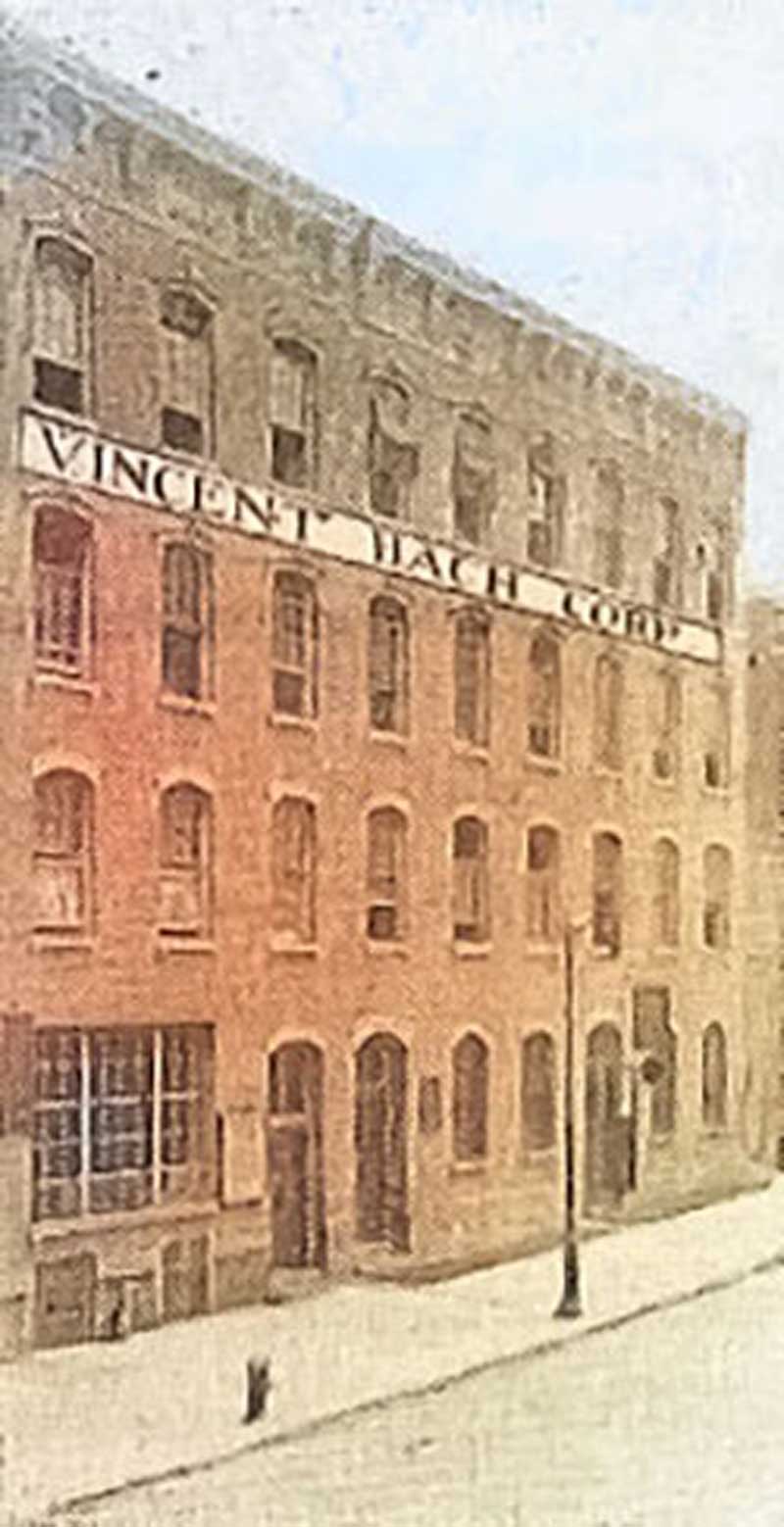
The Present Quarters at 237 East 41st Street
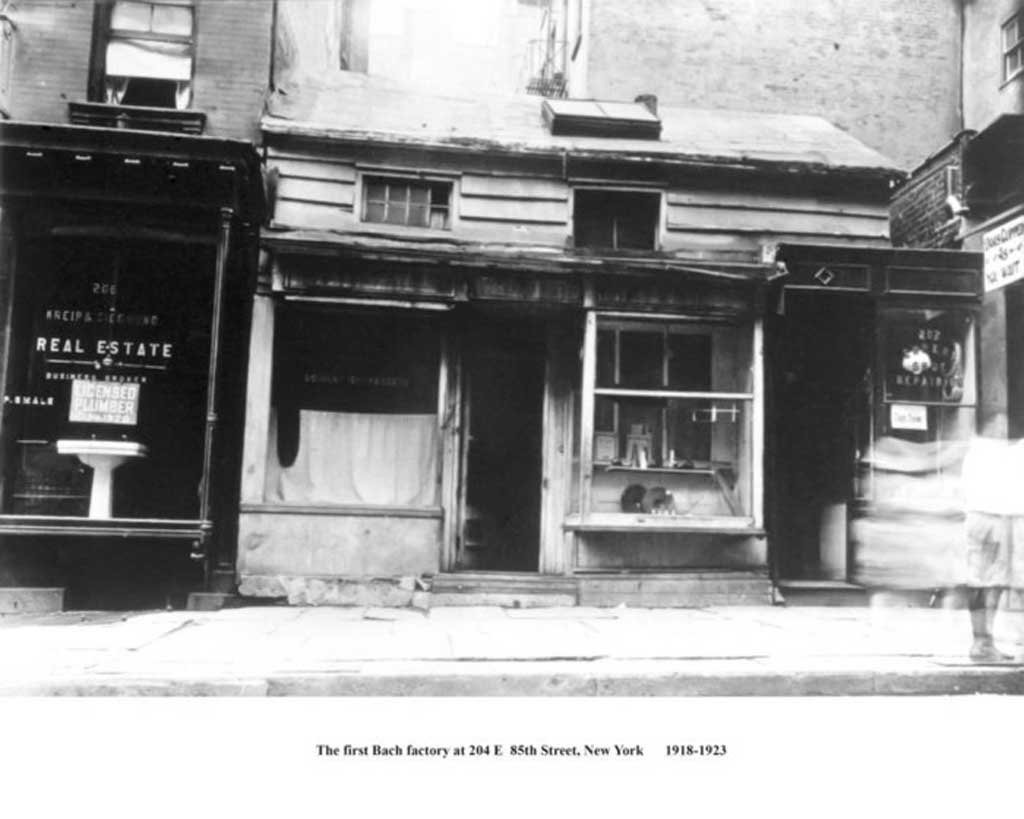
The first Bach establishment business
the privilege granted him would have to be revoked. Having started and still being absorbed in his experimental work, he rented a small room on the top floor of an old ramshackle building at 11 East 14th Street and, in May 1918, purchased a second-hand lathe and installed it in his new quarters. At that time, Mr Bach had not the slightest idea of entering into the manufacture of mouthpieces as a business. His sole desire was to make a perfect mouthpiece duplicate it about a dozen times and, in sure, himself against any mouthpiece misfortunes in the future.
The operation of a foot lathe next to the roof on burning hot days can hardly be recommended as an indoor sport, and while Bach worked in his B. V. D.’s and tried many ways to keep cool, the strain was too great to bear. After he had completed twelve mouthpieces with which he expected to meet all his future requirements, he sold the machine to an old iron dealer, retained his most important tools, closed up his little shop, and abandoned the manufacture of mouthpieces.
Emerson stated that if you build a better mousetrap than anyone else, though you live in a wilderness, the world will beat a path to your door. The inherent truth of this principle was well illustrated in the case of Vincent Bach. At that particular time, he was playing regularly in the Rivoli Theatre orchestra and frequently was designated to play trumpet solos. Every musician noted the peculiar brilliance and beauty of his tone and the minimum of effort with which he played. It attracted great attention, and soon, the word was passed around in musical circles that Bach had perfected a new and marvelous mouthpiece. Trumpet players immediately flocked to him, insisting they be allowed to try his mouthpiece. After trials they offered him large prices for his own or an exactly similar mouthpiece. The price offered was as high as $20.00. Although reluctant to part with the accessories that had cost him such efforts to produce, he felt great sympathy for the trumpeters laboring with inferior mouthpieces, and one by one, the precious few passed into other hands until only three remained. He definitely decided he would not part with the last three.
In April 1919, Bach was playing his usual daily visit to the musician’s headquarters on East 85th Street and was conversing with Mr. M.F. Beal, a clarinetist and a friend of long standing who at that time was an advertising writer for the Selmer firm. They were approached by a trumpet player who pleaded with Bach to sell one of his remaining mouthpieces. Bach refused emphatically, as he had no wish to start in making mouthpieces again under the old conditions and especially as he could not see good judgment in spending another 300.00 for a lathe. The trumpeter insisted
, however, he raised his offer from 20.00 to 30.00, then to 40.00, and finally to 50.00. Still, Bach declined. Mr. Beal, however, took quite a different viewpoint and insisted that Bach was missing an opportunity. “If anyone,” said Mr Beal, “is willing and anxious to pay you 50.00 for a mouthpiece, there must be a broad demand for them. Where there is a demand for anything, there is a chance to make some money.” There and then, the fires of business ambition were lighted.
There were difficulties in the way of even a moderate start for Bach, who was just recently out of the Army and practically without capital. It is not too much to say that Mr Beal’s positive and persistent assertions that it was worth the attempt kept the project to the full front and finally brought it to consummation. Bach hesitated about attempting to get credit for a lathe. Beal insisted that dealers were only too anxious to sell on installments. Bach was in a quandary as to where he could locate cheaply. Beal pointed out an old empty junk shop just across from the Musicians Union, praised the location, and commented on its low rental value. These two claims for it were true, but there were penalties attached to its low rent. The former occupant had left it full of valueless junk, and the floor was covered with ashes, the remnants of former fires when it had been easier to dump them on the floor than to put them in the street. When Bach decided, he put his whole heart into the matter and, regardless of handicaps, took hold aggressively. At one o’clock, he told the rental agent he would take it and made a small deposit, having a verbal agreement with the landlord that the place would be cleaned out by April 15th. Within fifteen minutes after renting the room, Bach was at the office of a machinery firm and had signed an order for an engine factory was completely organized lathe with motor drive, and at two o’clock, he was in his regular chair in the Rivoli Theatre pit, but the great adventure was on.
Bach’s first endeavors were in writing advertising form letters and literature describing his mouthpieces mouthpieces. As this advertising matter went out, a few orders started to dribble in, but his machine was not set up, and furthermore, when it was ready for delivery, the landlord had not made a solitary move towards cleaning up the workroom. Bach felt there was too much urgency in his business affairs to await the pleasure of a dilatory landlord and decided to clean it himself. He loaded ashcan boxes and containers with ashes, trash, and debris and piled them merrily in the street. While the work was menial, it was for himself, and he probably whistled as he housecleaned. Maybe he did, but he did not whistle later. Before he could find anyone to cart the stuff away, he had to rush to the theatre to play. During the intermission, he called up the rental agent to ask him to get someone to remove the cans and was informed that it was too late Some rowdies had tipped everything over littered the street with refuse and a policeman was diligently seeking Bach with a summons The street looked like a dumping ground The Street Cleaning Department had to be called out to clear up the mess Bach was decidedly uneasy about facing the consequences and preparatory to meeting the policeman and the court if necessary found a reliable witness who had seen the hood lums tipping over the receptacles and thus fortified with proof of his innocence made his way into the enemy’s territory He introduced
himself to the officer explained matters with all the persuasive force at his command and while his reception was brusque and ungentle he finally convinced the policeman that he was an unintentional offender. Accompanied by a vigorous warning he was told it would be overlooked this time. So a little more progress was made.
Next morning at seven o’clock before any musicians congregated at the union Bach full of ambition appeared on the scene with a pail, mop, brush, and soap and was soon cleaning walls floors and windows with vim and vigor. Unfortunately for his vanity, John Siroto a trombone player then with the Rivoli Orchestra ,now with the Cleveland Symphony and himself an early riser passed through East 85th Street and saw Bach at his lowly task. John knew about the new venture and was curious to see the beginning of it. He was compelled to laugh at the ludicrous picture and the more so as Bach was noted for his fastidiousness. He made a few bright remarks about the situation while Bach somewhat embarrassed only said, “You won t laugh at me a few years from now.”
At last the little place was shipshape the lathe was installed and with no further delays. Bach started the actual manufacture of mouthpieces for sale. When he had finished three mouthpieces he proudly exhibited this sign in the window Mouthpieces Made to Order. Promptly a customer called to test his ability. The customer tried three mouthpieces stated they were no good and departed. Shortly afterwards Bach who had continued to work during the test noted there were only two mouthpieces left. He rushed out and around the corner to locate that customer but he was not to be seen. He is probably using the first commercial Bach mouthpiece yet.
At that time with the only equipment being one lathe and a few somewhat primitive tools the output was about one mouthpiece daily. The price was $4.00 in brass. Such an output would not pay the rent and installments as they came due so he necessarily retained his position as first trumpeter at the Rivoli. Almost his entire earnings were put into additional tools and equipment and his personal needs were neglected. This went on for nearly two years until he came to a point where his clothes were beyond repair excepting one blue serge suit, and when a hole developed in the seat of these trousers he went in the backroom of a little tailor shop and waited while they were patched for another period of service.
The sales were by no means proportionate to his labor and advertising efforts at the beginning and the outlook was very dark at times Nevertheless he persisted.
After about two years Bach’s endeavors began to bear fruit. His sales increased to such an that he found it necessary to a substitute to play his matinees This enabled him to work and to produce three during the day. Even at that income barely covered rent advertising expenses and incidentals He drew no salary.
Already many prominent were using the Bach mouthpiece including the leading trumpeters the Metropolitan Opera Orchestra, Boston Symphony, New Philharmonic and others honor of being considered the premiere mouthpiece maker by gentlemen was sufficient to Bach to ceaseless efforts and on mouthpiece problems opened up at eight in the morning did the necessary cleaning over his mail and then worked the lathe until about 11.00 AM. At that time musicians began gather at the union and to over flow out into the street instrument players made the place a hang out and with its half curtained bare windows and surging crowd it took on all the appearance of a speak easy police passed many curious at it. The constant questions the musicians and the confident requests for little favor jobs took so much time that Bach closed 1:30 PM and started playing own matinees again. During twenty minute intermission in afternoon he had his lunch and 5:30 PM was back at the to put in another hour of toil the evening he was at the again grabbed a hasty during the night show intermission and after the performance answered his mail at a small below the stage. He worked writing letters in long hand about midnight when the theatre closed. This was his daily routine including Sundays and holidays. The rewards for such zeal are inevitable. His business grew.
After several years the mouth piece business had reached sufficient proportions to justify the and Bach resigned at the Rivoli put in about sixteen hours a day his little shop and began to prosper His quarters finally became crowded and he removed to East 41st Street where he took entire floor in a factory building The great open spaces between desk on one end and the lathe the other were the cause of humorous comment by visitors Shortly however he found it necessary to engage a stenographer and a boy The boy’s duties were to keep the place clean polish mouthpieces and pack the shipments The actual making mouthpieces was still done by Bach.
A great deal of time was spent in perfecting forming tools which made it possible for him to produce mouthpieces in uniform sizes They were numbered so that players could always obtain duplicates their favorite mouthpieces He also started experimenting
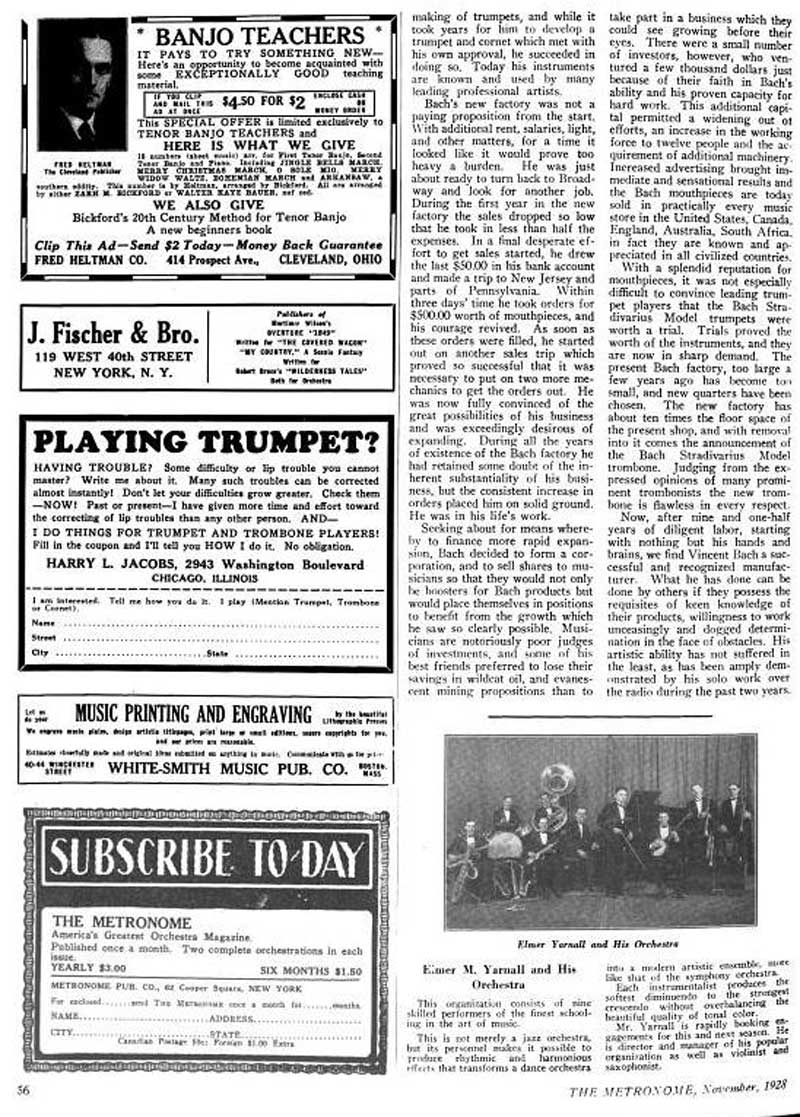
making of trumpets and while it took years for him to develop a trumpet and cornet which met with his own approval he succeeded in doing so Today his instruments are known and used by many leading professional artists,
Bach’s new factory was not a paying proposition from the start. With additional rent salaries light and other matters for a time it looked like it would prove too heavy a burden. He was just about ready to turn back to Broadway and look for another job. During the first year in the new factory the sales dropped so low that he took in less than half the expenses. In a final desperate effort to get sales started he drew the last 50.00 in his bank account and made a trip to New Jersey and parts of Pennsylvania. Within three days time he took orders for 500.00 worth of mouthpieces and his courage revived. As soon as these orders were filled he started out on another sales trip which proved so successful that it was necessary to put on two more mechanics to get the orders out .He was now fully convinced of the great possibilities of his business and was exceedingly desirous of expanding During all the years of existence of the Bach factory he had retained some doubt of the inherent substantiality of his business but the consistent increase in orders placed him on solid ground. He was in his life’s work.
Seeking about for means where by to finance more rapid expansion Bach decided to form a corporation and to sell shares to musicians so that they would not only be boosters for Bach products but would place themselves in positions to benefit from the growth which he saw so clearly possible. Musicians are notoriously poor judges of investments and some of his best friends preferred to lose their savings in wildcat oil and evanescent mining propositions than to take part in a business which could see growing before their eyes. There were a small of investors however who ventured a few thousand dollars just because of their faith in Bach’s ability and his proven capacity hard work. This additional capital permitted a widening out efforts an increase in the force to twelve people and the acquirement of additional machinery Increased advertising brought immediate and sensational results the Bach mouthpieces are sold in practically every music store in the United States, Canada, England, Australia, South Africa, in fact they are known and appreciated in all civilized countries were.
With a splendid reputation mouthpieces it was not especially difficult to convince leading trum pet players that the Bach Stradivarius Model trumpets worth a trial Trials proved the worth of the instruments and they are now in sharp demand. The present Bach factory too large a few years ago has become too small and new quarters have been chosen The new factory has about ten times the floor space of the present shop and with removal into it comes the announcement of the Bach Stradivarius Model trombone Judging from the ex pressed opinions of many promi nent trombonists the new trom bone is flawless in every respect.
Now after nine and one half years of diligent labor starting with nothing but his hands and brains we find Vincent Bach a successful and recognized manufacturer What he has done can be done by others if they possess the requisites of keen knowledge of their products willingness to work unceasingly and dogged determination in the face of obstacles His artistic ability has not suffered in the least as has been amply demonstrated by his solo work over the radio during the past two years
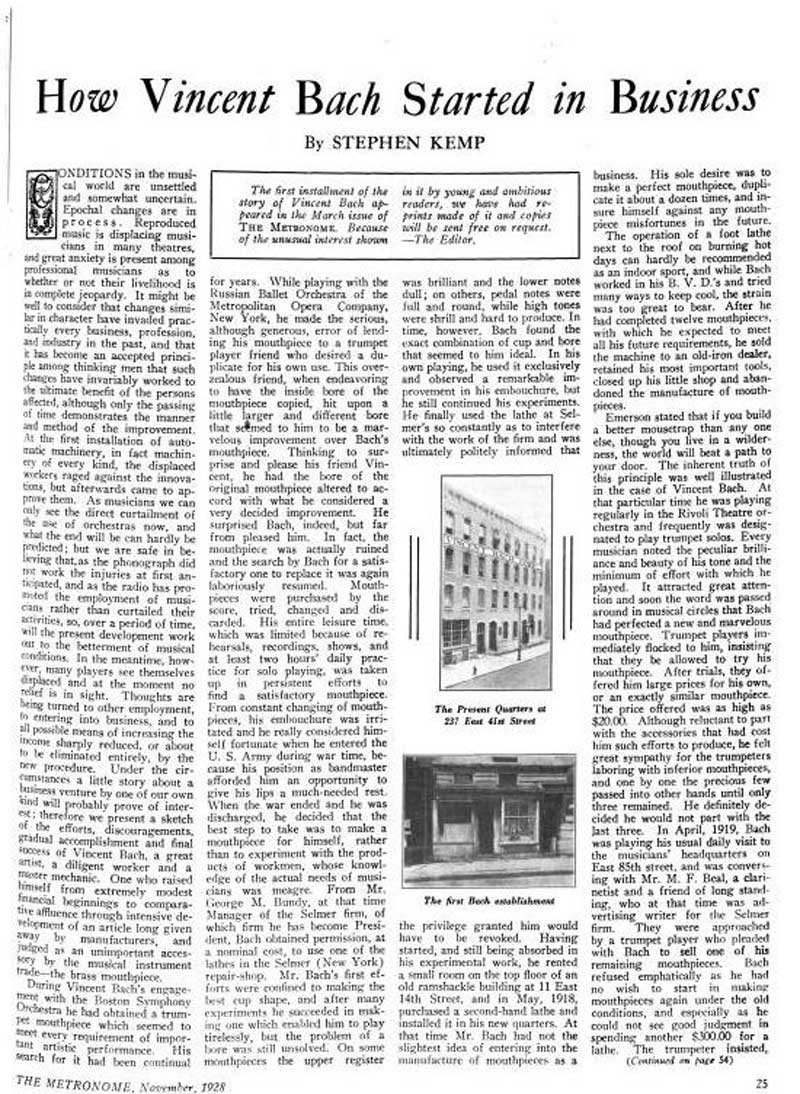
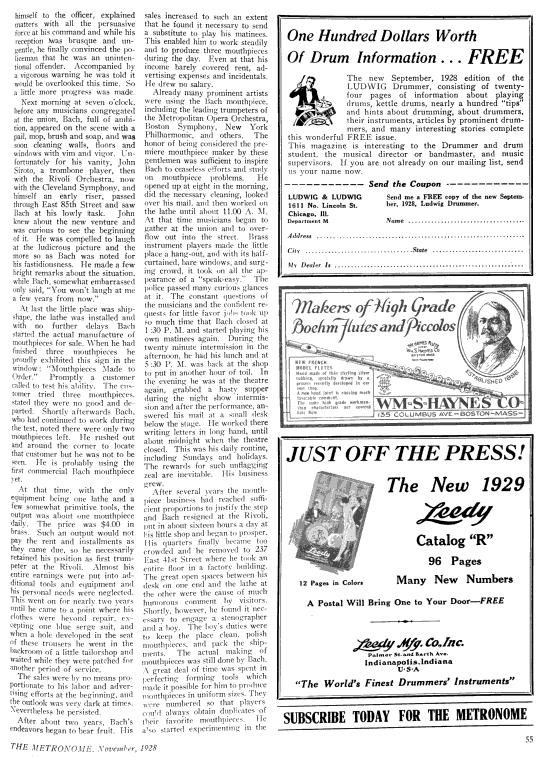
source: The Metronome, November 1928, p25
