Vincent Bach stories and advice given through the years.
In various publications, there are various interviews, stories, and advice given by Vincent Bach to young or semi-professional musicians. Below are a few examples through the years that have been summarized into this lists.
Vincent Bach had a featured column in Jacob’s Band Monthly magazine/newsletter, where he wrote featured sections and answered questions from students and semi-professionals. Here are some of the articles and Vincent’s answers to questions submitted each month. We do not know if this continued past 1928. Please get in touch with us through the footer if you have additional examples from Jacob’s Band Monthly.
Cornetist’s Road to Success
By VINCENT BACH
As a specialist in the matter of mouthpieces for musical instruments, I have much opportunity to come in contact with players having lip troubles. In fact, the majority of players call on me only when they have lip problems to solve and not when their embouchures are in good condition There are many talented cornetists who have so-called natural embouchures They reach the high and low notes with ease and have a perfect staccato and legato When asked how they accomplish their fine playing the most of them will have to think for a while before they can reply for they probably never before gave thought as to how they do it.
Through constant association with musicians who desire advice on their mouthpiece problems I find that in most instances the mouthpiece is not the only point on which the player needs advice He either does not play or practice correctly Embouchure tonguing and tone production are fully described in the booklet The Art of Trumpet Trumpet Playing. This booklet has appeared in a series of in previous issues of the Jacobs Music Magazines. The majority of musicians do not know how to practice do they make this work interesting for themselves chapter on How to Practice appeared in this column month last month. This chapter thoroughly explains that principal object of practicing must be to develop faculty of concentrating on a certain subject. The may be to play a scale properly with the fingers as well with tongue and lip movement.Avoid practicing thought lessly and do not let the mind wander while practicing certain study. One of the reasons why players without concentrating on their work is that they daily studies and continue playing the very same day after day. In time they know them from memory can play them so well that careful thought is not for their performance.
It is important for the player to practice new studies. The muscle system of the lip is very intricate and properly trained will attain great flexibility and strength. There are hundreds of different degrees to which the lip muscles can be contracted or expanded to produce various dynamic effects to slur notes up or down and resist the instantaneous stroke of a staccato. If the limits his daily practice to a certain few pieces his lip be trained to respond only to a certain few movements. Should he enter an orchestra and have to play different from his daily studies his lip muscles will be and he will tire quickly.
If a player studies from the Arban Method and through every study so often that he can almost them backwards, he will find it hard to concentrate on same studies he has played so many times before. He should procure additional cornet methods for instance the methods of Gatti, St Jacome or Alexandre Petit. These are foreign methods different from each other. It will be interesting to the player to study certain on scales legato or triple tonguing from one of the methods if he wishes to revive his embouchure. He will find numerous intricate passages which will rejuvenate embouchure and make him concentrate on what he is doing as he will not be playing from memory. A student when learning music does it because he music and desires good music. To practice a number tedious scales is monotonous and not at all stimulating In order to succeed in any work one must bear in mind strive for a definite object. A painter imagines how finished work will look and where it will be exhibited and admired. A musician should also set himself a definite goal. If you know that you are to play in a certain concert on a definite date you will not be wasting your time in practicing the solo in order that you will be ready to play it well. Acquire a number of good cornet solos with piano accompaniment. Practice your own solo parts and get a good pianist to play with you in public. This will stimulate your ambition and also correct any faulty rhythm you may have. When you practice alone you may have the tendency to slow have the tendency to slow down when the passage becomes too difficult but when playing with piano or orchestra accompaniment you will have to keep strict time as otherwise the accompaniment will run away from you.
You also can better detect your weak points and make a special effort to correct them. Players sometimes put aside studies which do not suit their embouchures player having a stiff tongue will not be anxious to play triple tonguing polkas or other solos with much tonguing. He will select compositions which can be played with little effort. But the really progressive student will not put difficult music aside and because he finds it difficult to perform certain articulations he will use so much more effort to acquire perfection. The secret of success is not how many hours you practice but how and what you practice. Do not follow the road of least resistance but acknowledge your faults and get the best of them.
Besides the above mentioned methods I might also recommend Technical Studies by Herbert Clarke published by Herbert L Clarke 245 Prospect Avenue Long Beach California; Richard Shuebruk Studies published by Richard Shuebruk 332 East 87th Street New York City; the methods published by the Virtuoso Music School Buffalo New York or the Etuden fur Es Trompete by Ernest Sachse this last can be obtained from Carl Fischer 62 Cooper Square New York City.
Complying with requests for a list of good cornet solos I herewith recommend a few very fine compositions. All are really not practical for concert work as the public may not understand their musical value. They are interesting to the real musician however and require a good all round training.
- Divertissement by Fernand Andrieu Edouad Andrieu 72 Rue Rodier Paris France
- Andante et Polonaise by Fernand Andrieu F Andrieu 4 Bfg Poissoniere Paris France Premier Solo by Gabriel Pares Andrieu Freres 72 Rue Rodier Paris France
- Cinquieme Solo de Concours by H Maury Ed Andrieu 72 Rue Rodier Paris France Impromptu by Jules Mouquet Evette & Schaeffer 18 20 Passage du Grand Cerf Paris France
- Cantabile et Scherzetto by Philippe Gaubert Evette & Schaeffer Paris France Solo de Trompette en Fa by Auguste Chapuis Evette & Schaeffer Paris France
- Morceau de Concours by G Alary Evette & Schaeffer Paris France 1er Solo de Concert by Paul Rougnon Evette & Schaeffer Paris France
- ler Solo de Cornet a Pistons by Georges Hue Evette & Schaeffer Paris France
- Austriana by Vincent Bach Vincent Bach New York
- Gott Erhalte Franz den Kaiser by Popp for piano and orchestra FA Schmidt Heilbronn A N Germany
- Romanze by G Cords FA Schmidt Heilbronn A N Germany
- Hungarian Melodies by Vincent Bach Vincent Bach NY
- Slavische Fantasy by Hoehne Ed Bote & G Bock Berlin Germany
- Es Moll Concerto by Cords CF Schmidt Heilbronn A N Germany
source: Jacob's Band Monthly, March 1928
Questions and Answers
May 1928
I have been playing the cornet for three years. Although I practice regularly, my tone is thin and fuzzy. What should I practice to overcome this weakness? ELM Chicago, IL.
” It is not what you practice but how you practice that will help you to adjust your embouchure. The proper volume of tone depends principally on the manner of breathing. Breathing from the chest is not correct. While playing, stand in an erect position, lifting the arms from the body. The chest should be expanded, and the lungs filled with air so that the diaphragm muscles can push against it. The air pressure when playing should rest on the muscles of the diaphragm and not on the muscles of the chest. If your tone is fuzzy, this may be caused by keeping the lips closed tightly together. You can correct this by practicing before a mirror and trying to produce a tone without the mouthpiece or instrument Be sure to play with open lips When striving for a high note, do not attempt to produce it by squeezing the lips together draw the lips tightly against the teeth so that they will on the outer edge of the red tissue Practice long by attacking them decidedly with a clean stroke Your tone quality will then improve.”
My dentist has advised me to have my front teeth extracted. Will it be possible for me to play with false teeth? TOH Washington D.C.
I suggest that you follow the advice of your dentist Decayed teeth seriously affect the health which might result in more harm to your embouchure than false teeth Your dentist may be able to put in bridge work which will give the teeth a solid grip to resist the lip pressure Even if all your teeth have to be removed you would still have every hope of being able to play with false teeth but your success would then depend entirely on the shape of the gum If a plate could be built to fit around the front of the gum you would be able to play the cornet However it would take you two or three months to become accustomed to the new set of teeth and to develop your embouchure I know of quite a number of cornet players who have artificial teeth among them being one man about seventy five years of age
I am a beginner on the trumpet. Due to my lips being, my teacher advised me to change to trombone. I prefer the trumpet; however, do you believe I can develop embouchure for this instrument? FCP Baltimore MD.
It is not so much the thickness of the lip as the construction that enables a brass instrument player to succeed in playing well. While teachers, in general, persons with heavy lips take up trombone or tuba study, I do not agree with them. Refer to my first answer in this column and follow my instructions to practice before the mirror. Take particular care that your lip does not protrude or overlap. In this way, you will learn to use your lip muscles properly. As you prefer the trumpet and probably are ambitious to learn this instrument, you will have better success with it than with one you do not care to play.
My embouchure is weak; although I devote five or six hours daily to practicing on my cornet, I do not seem to be proven. Can you suggest any remedy, or shall I give up playing this instrument? LO New Orleans, LA
To practice five or six hours a day and to practice correctly is too long for the average player. For the solo work I do over the radio, I practice about two hours a day. In former years, while I toured as a soloist and did not have any business duties to attend to, I practiced three hours a day I shortened this period whenever I felt indisposed. If you have that much time at your disposal, I would suggest that you practice three-quarters of an hour in the morning three-quarters of an hour in the afternoon and three-quarters of an hour in the evening Do not continue playing until you are exhausted but stop whenever you feel you are becoming tired Furthermore do not play in one continuous stretch Remove the mouthpiece from the lip as often as you can to permit free circulation of the blood in the lip If you were to wind a piece of string around your finger for a minute it would become numb This will happen to your lip if you keep the mouthpiece in the same position on the lip for a long time.
source: Jacob's Band Monthly, May 1928
Modern Dance Music
When jazz came into fashion about a decade ago the evident degeneration of music caused many an artist to feel that it was time to discontinue music as a profession or end in despair. Several prominent symphony musicians among them a clarinet player and a violin player well known to me, when obliged to seek work in moving picture theatres and unable to stand the strain of playing jazz committed suicide.
Upon hearing the nerve racking noises termed jazz produced by ensembles consisting of two cornets two drums piano etc many wondered how long it would last. Jazz has remained, it is different from the jazz played ten years ago as also are the musicians instrumentation and style of playing. At that time it was considered novel to play on a small bore trumpet or pea shooter as it was then called and to produce shrill noises intermitted with imitations of cats, dogs and such like effects foreign to the instrument. The trumpet player then had to carry several types of mutes and hats while the drummer’s equipment included cow bells automobile horns and other sound imitating accessories calculated to tickle the listener’s ear.
Fortunately those days are passed and we must com mend Paul Whiteman, and other prominent orchestra conductors for choosing a more musical instrumentation and enlisting the services of good arrangers to furnish arrangements which will appeal to a broader musical taste. The size of the present day dance orchestra has been substantially increased over that of its forerunners and legitimate instruments are used players sometimes doubling up if necessary to increase the variety of color. For instance outside of the regular saxophonists two players of other instruments may double on this instrument A saxophone trio may be heard playing a certain portion of the score followed by a trumpet trio or a brass combination consisting of trumpet mellophone or trombone A few bars may be played as solos by individual instruments In stead of a combination of unmusical sounds a variety of legitimate instrumental effects are offered The music used is so arranged that the musicians can play it exactly as written without having to depend upon the variable inspirations of the moment Some players like Red Nichols, Bix Beiderbecke and Miff Mole who are competent arrangers may work out their own parts however the composition.
A number of the “squeaking” type of orchestras and amateur jazz bands may still exist but even these are gradually disappearing. Legitimate players earn excellent salaries and side money by recording or broadcasting. Especially in the larger cities such as New York and Chicago, many opportunities to play special feature engage in vaudeville may be had.
Some musicians still believe in the use of small bore instruments or shallow cup mouthpieces in order to produce freak tones. They insist they cannot use instruments with a full of tone such as are used in symphonic organizations they do not realize that the dance musicians of must have qualifications similar to those required of musicians namely a rich quality of tone style of playing and a sound technic.
Not every musician is capable of playing the syncopated current in dance music nor on the other hand of symphonies which latter call for a following of the through rapid changes in tempo delicate shading and transpositions. It would be difficult for a dance to fill the place of a symphony brass instru or vice versa Young music students should concentrate on developing good embouchures and faultless technique A professional career should be entered upon before acquiring a good foundation or being sufficiently advanced in musical studies to be of judging the kind of work one is suited for .
Questions and Answers
July 1928
I have been having trouble in attacking my high tones. Could you prescribe some exercise that would remedy this? I average three hours of practice a day, and on some days, my lips become tired after the first hour. Is that natural? Then, on some days, I can practice for several hours without tiring. Lately, I have been taking a few short rests during the course of practice and find that it helps. Is that a good idea?
JN Columbia Tenn.
A question on the same subject as yours was answered in the May issue of this magazine It is difficult to prescribe exercises to remedy your trouble in attacking high notes The cause may be weak and overstrained lip muscles or a faulty tonguing It is possible that you are not holding the jaw correctly If you tire quickly give attention to your manner of practicing Take a minute of rest between each study When you find you are gradually becoming tired lengthen the rest to several minutes Never exhaust your lip muscles as they then will not respond properly and will cause you to press harder When performing a staccato be certain your tongue remains behind the teeth Your tongue will touch the lower edge of the upper teeth when playing low notes but should not come out far enough to protrude between the lips When attacking a high note place the tongue against the middle of the upper teeth Staccato will be difficult to perform if you do not have a perfect lip control From your letter I judge you are practicing for too long periods at one time Limit your practice to three quarters of an hour in the morning three quarters of an hour in the afternoon and three quarters of an hour or one hour in the evening Rest three or four hours between each period of practice and you will find your lip gaining strength Play with a fresh lip and do not force the tones when your lip is tired stop playing
source: Jacob's Band Monthly, July 1928
Questions and Answers
August 1928
I have been studying trumpet and baritone for three years. Nevertheless, it is difficult for me to produce a good tone and high notes. At times, I am unable to play much above middle C. After reading one of your recent articles on lip formation, I am inclined to believe my trouble is in my lower lip being too far back. Moving it forward seems unnatural I have studied correspondence courses practicing lip vibrations and can produce the buzz advocated but of course do not know whether I produce it right My lips are thin but the lower teeth are behind the upper teeth Would you advise me to continue playing or not waste any more time I love the instruments and still have hopes of mastering them?
EGR Wheatland Iowa.
You evidently are not moving your lower jaw forward enough or rolling in the lips sufficiently so that the vibrations will be on the outside of the red tissue. The trick in producing high notes is to hold the lips back and not permit them to protrude into the mouthpiece cup. Practically everyone has undershot teeth. Through not moving the lower jaw forward enough, the majority of trumpet players hold their instruments towards the floor When you change your embouchure, it is to be expected that you will experience a reaction in the lip muscles and will not be able to do much playing for a short while. As long as you like to play these instruments, I do not see any reason why you should stop. Under a good teacher, you can be put on the right track within two or three months. If you are interested in studying under a good teacher in Chicago, I can recommend several excellent instructors there.
Wind Instruments and Goitre
I am a young girl attending high school. My particular desire is to learn to play the trumpet, but my parents refuse to give their permission, believing that a goiter will result from blowing a wind instrument. Our local band instructor claims this fear is unfounded. Can you advise me whether playing the trumpet will endanger my health?
WC New York City.
Personally, I believe your band instructor is correct. I know of no persons suffering from goiter through playing wind instruments. Your doctor will tell you that goiter is an enlargement of the thyroid gland due to a lack of iodine in the system.The majority of wind instrument players have excellent lung and chest development. If you learn to play correctly, little or no strain is necessary. Even in large symphony orchestras where it is sometimes required to play a tremendous fortissimo, the musicians do not blow strenuously. Systematic training enables them to play with ease just as piano movers become accustomed to moving heavy pianos without harmful results to themselves I have written to a medical authority on this subject and will forward his report to you.
Liquid Courage
I am a cornet player. When playing at home, I can easily reach high G above the staff, but before the microphone or a visible audience, I become scared stiff. I have been told that the best cornetists have given their finest performances when lit up. How can I overcome stage fright?
E J Chicago Ill
An intoxicant is very far from being the proper remedy for stage fright. It may temporarily stimulate the courage of a player but will result in bad physical aftereffects. Many stars have fallen through the constant use of liquor which eventually weakened their nervous systems to such an extent that they could no longer play. A player usually experiences that heart sinking through a lack of confidence in his skill. He may not be well trained and foolishly has selected a number beyond his ability His instrument or mouthpiece may not be of the proper quality thus preventing him from performing naturally. Play before the public as often as possible, and you will soon find you are conquering this fear. When you get to the point where you find you are improving you will have little difficulty in entirely overcoming your nervousness. A cornetist preparing for solo work should take advantage of every opportunity to play with piano or orchestra accom paniment in order that he may become accustomed to playing in good rhythm. When studying alone a player is quite apt to take liberties in the matter of changing tempos too suddenly when playing in public if the accompanist does not keep up with him he becomes nervous. If you accustom yourself to playing with an accompanist you can more easily discover your stumbling blocks and be pre pared for them when you have to render a solo.
source: Jacob's Band Monthly, August 1928
A Sheaf of Questions
The following questions were submitted by
JGR THE Victoria BC Canada
Would it be detrimental to do the greater part of cornet practice using a mute, or would it be better to practice without a mute?
I advise you to practice without a mute. It is to your advantage to play the natural way and in the out of doors, if possible, instead of artificially increasing the resistance of the instrument by using a mute. A mute nowadays is, of course, a necessity. The majority of modern symphonic or popular compositions call for a mute when certain tonal colors and effects are to be produced. The mute is not intended to be used as a silencer when practicing. If neighbors object, practice somewhere in the open
Concerning Non Pressure
I am very interested in knowing whether you play nonpressure.
When playing, one should use as little pressure as possible construction of the lip muscles and teeth formation of the individual player must be considered. If the front teeth are very curved, the mouthpiece will touch only the center of the lip, leaving the sides too open. Air will consequently escape. A player with such embouchure will have to compress the lips so that the mouthpiece will rest on both sides of the mouth also. If you play in a symphony or opera orchestra with a complete brass section and are required to play a double fortissimo ff there would be no use in attempting to perform it without using any pressure The strain of having to blow so loud will cause you to press hard to resist the air pressure so that no air will escape The term non-pressure must not be literally understood. It really means least pressure
Daily Practice Schedule
What would you recommend as a daily schedule for practice? I have two hours a day at my disposal; I have played for about 18 months.
I would mention I am slow at reading quick music at sight. There is no general schedule of daily practice to recommend. Every player has weak points and practices certain studies to benefit those weak points. I would suggest that you practice three-quarters of an in the morning, three-quarters of an hour in the afternoon, and three-quarters of an hour in the evening. If a schedule is not convenient to follow, devote one hour the morning and another hour in the evening to practicing. Two successive hours is too long for the average performer. Always play with fresh lips and do not attempt to out tones if tired Otherwise, you will strain the lip muscles thus affecting the embouchure If you have a good method, for instance, Arban Virtuoso St Jacome, etc practice various chapters on tonguing legato scales, etc methods have an excellent variety of studies players make the mistake of selecting certain daily studies and playing them day in and day out The intelligent musician is the one who knows how to practice correctly selects a variety of studies to develop lip muscles tonguing, breathing, etc To make your practice periods interesting get good cornet solos and play them with piano accompaniment This will assure you a correct rhythm.
source: Jacob's Band Monthly, September 1928
Questions and Answers
December 1928
I have seriously studied violin and cornet with a view to becoming a well-trained professional musician There are at this time many rumors that musicians are being discharged from leading theatre orchestras and being replaced by mechanical music. Do you think I should go ahead with my musical career, or will it be useless for me to devote my efforts to an art that may not earn me a livelihood?
You probably recall that when the phonograph and radio came into prominence, similar rumors were popular. Musicians playing in dance orchestras are expected to become unemployed. Contrarily, however, there are today more orchestras than ever before. Even people who never before thought of playing musical instruments became interested in studying the saxophone and other band instruments due to hearing musicians performing on these instruments over the radio. Canned music will undoubtedly upset conditions for a time. Small orchestras and mediocre musicians will have to get out of line. On the other hand, the best musicians will be called to play for the Vitaphone and sound pictures For this type of work, musicians must be well trained Musicians capable of doing this work can depend on steady employment and high salaries At the present time, real artist musicians are scarce If you are talented and serious in your studies you have excellent opportunities before you Get the best musical instruction within your reach as well as the best equipment and play only with organizations of the better class If you strive diligently for success you will achieve it for good music is here to stay.
Why are C trumpets and Eb trumpets used in symphony orchestras? I have always been under the impression that symphony musicians are well-trained and capable of trans posing. Why don’t these trumpet players use instruments in Bb and transpose?
If you glance through the folio of a symphony trumpeter, you will note very few parts written for Bb trumpet. The keys used are almost evenly distributed over the entire scale. Some parts are written for trumpet in C, D,Eb, etc. The old masters, such as Beethoven, Bach, Mozart, etc., did not have valve trumpets at their disposal. The trumpet players used a natural trumpet similar to a long-model bugle built into the particular key prescribed in the music. Modern composers do continue to write for trumpet in various keys but not for the purpose of having the mu sicians use instruments without valves The science of instrumentation has progressed so tremendously during the past fifty years that composers nowadays intentionally write for C trumpet high Eb trumpet also called piccolo trumpet in Eb, high F trumpet, etc. These particular instruments are used when a certain color of tone is desired. The tone of the high Eb trumpet is brilliant and penetrating, while the tone of the Bb trumpet is more mellow in comparison. A large majority of symphony trumpeters do not pay sufficient attention to the special instruments requested by the composers and do transpose. However, the compositions are not given justice. Especially in the modern works of Stravinsky Vincent D Indy Respighi or Richard Strauss, the desired effects are absolutely lost if the trumpet player tries to perform brilliant solo parts or high notes on a trumpet built-in Bb Trumpeters performing such music should have at their disposal instruments in the keys specified by the composers The New York Philharmonic Orchestra Boston Symphony Orchestra Philadelphia Symphony Orchestra and Metropolitan Opera House Orchestra New York use instruments in the particular keys needed If you ever have an opportunity to hear one of these orchestras perform you will instantly notice the peculiar effect and brilliancy A trumpet player in a modern symphony orchestra today should have equipment consisting of Bb trumpet C trumpet and high Eb with change to D trumpet He should also have a cornet in Bb.
source: Jacob's Band Monthly, December 1928
From Vincent Bach
Here is a little story that might interest you.
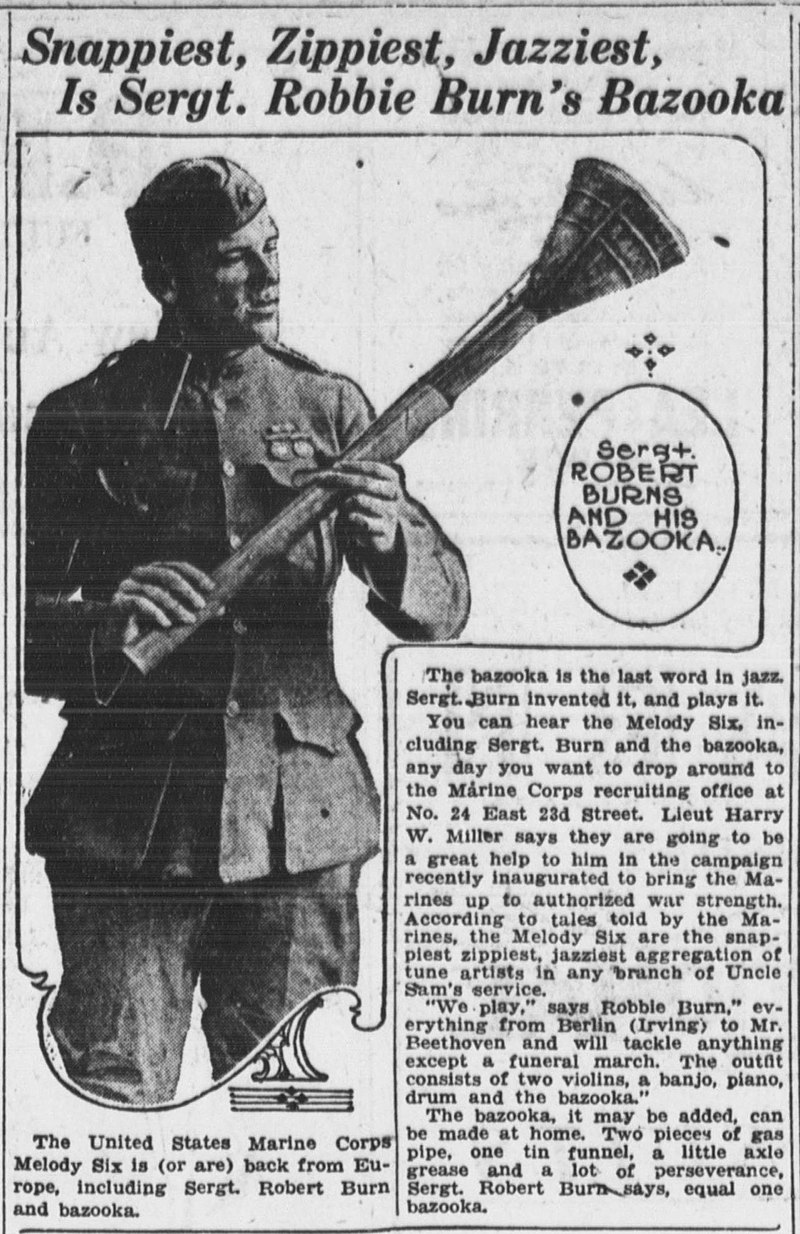
Not very long ago, I walked on Sixth Avenue and noticed in a Curiosity Shop a number of old second-hand music instruments, along them one which I thought would be a fine addition to my collection of antique instruments. While I purchased the instrument, a fat old lady came in and asked whether the store had any “bazooka” for sale. The store owner shook his head, said he never heard of such an instrument, and the lady became rather indignant and told him, “You shouldn’t be in the musical instrument business!”
The store owner retorted, “I want you to meet Mr. Bach, one of our famous instrument makers,” and he asked me what a bazooka was. I told him it was not a legitimate musical instrument but just a fun instrument played by the late Bob Burns – something like a kazoo, and you sing into it.
She turned around with a mad look on her face and told me, “You shouldn’t be in the instrument business either.”
– Vincent Bach
Mount Vernon, N. Y.