


Vincent Bach - Mechanical Engineer Becomes A Virtuoso of the Trumpet
This is the earliest article about Vincent Bach, published by Musical America in June 1916. It is pretty remarkable that despite being in the United States for under two years, Bach had already made a name for himself and was in high demand as a skilled cornet soloist.
The article below is a transcript of an interview conducted with Bach by an anonymous editor by H.B. Note: It is worth noting that there is some speculation as to whether H.B. may have been Hans Bach, possibly writing in as a guest contributor at the time of this publication. Nevertheless, this interview provides a fascinating insight into Vincent Bach’s early experiences and the development of his musical career.
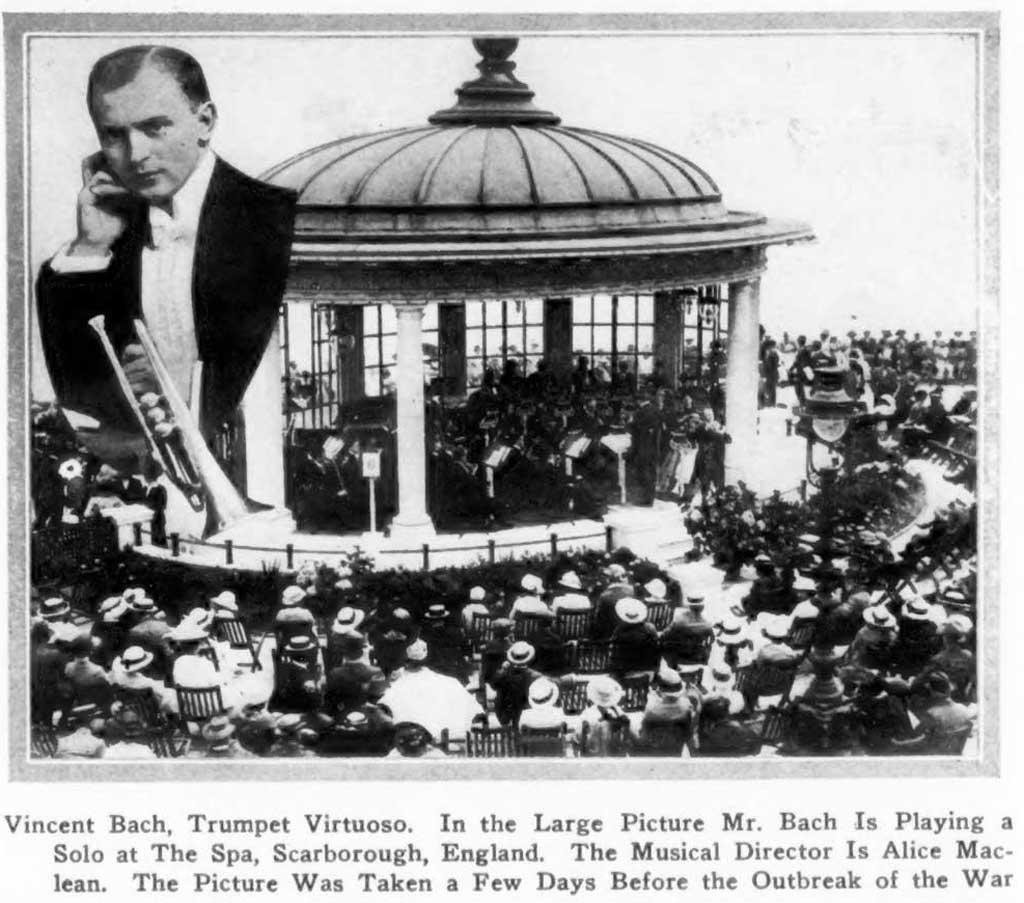
” If you are perchance dissatisfied with your daily, commonplace routine and are seeking a few thrills, you need only apply to Vincent Bach, trumpet virtuoso, erstwhile mechanical engineer, for the prescription. In a recent interview with a MUSICAL AMERICA representative, Mr. Bach spoke of his hair-breadth escapes and stormy experiences in the war zone of Europe. His first real thrill came when he found himself in Scarborough playing the Austrian national hymn on the day after war had been declared upon Germany. Hisses and cries of “kill him!” greeted his efforts and he prepared for a hasty exit to more friendly shores.
Mr. Bach came to this country with $20 in his pocket, a few friends to count on, shattered nerves, and none too bright prospects for a career as a trumpet virtuoso. To his good fortune, Oscar Hammerstein was acquainted of his circumstances and engaged him to play at the Lexington Opera House. Then Dr. Muck heard of him and offered him an engagement with the Boston Symphony Orchestra. Ordinarily, this would be considered a good start, but the Fates were cruel to Mr. Bach. Since he was a union man and was playing with a non-union orchestra, he was forced to pay a fine of $1,000. He has just completed an engagement with the Ballet Russe Orchestra, and is making plans for the coming season.
In the course of conversation, Mr. Bach pointed out a few of the changes that have taken place in this particular field. “About 12 years ago the cornet soloist had an assured position in a musical community of any size,” he said. “We can can recall such players as Levy, Theodore Hoch, Herbert L. Clark (who is still active), and Paris Chambers. Such men could demand high prices, but there has been a great deal of competition since that time. It seems that the cornet and the trumpet are not looked upon as solo instruments now. It will take something very startling to awaken people to the possibilities of these instruments. Besides there is only a limited repertory of original works for the trumpet, most of the material consisting of arrangements.” Mr. Bach has recently published several compositions for trumpet with piano and orchestra accompaniment.
“I began to play the cornet about eight years ago,” he continued. “I took it up at first merely for my own amusement, but found that I could do better as a musician than as a mechanical engineer. It may surprise you to know that I went on tour as a cornetist before I studied with a teacher. My serious studies began after I had had considerable experience in playing in public.
In Vienna, I studied with Stellwagen, the trumpet soloist of the Vienna Tonkiinstler Orchestra, and in Wiesbaden, Germany, my teacher was Fritz Werner, Koniglich Preussischer Kammermusiker. It seems that I had a natural aptitude for music. When I was only six years old, I took up the violin and learned the principles of it fairly well in three months and had the courage to appear in a semi-public way at the end of six months.
“But to talk of other things,” Mr. Bach went on in his very good English, “I am very glad to be in your peaceful America. You Americans cannot realize how fortunate you are unless you have been through the turmoil of this terrible war as I have.”
H. B.
source: Musical America, June 1916, page 55
