


Faulty Trumpet Ruins Vincent Bach's Lips from May 1934
Various articles have been written about how Vincent started his business in 1918. This is the most unique headline we’ve encountered. We enjoyed reading this newspaper story from May 1934.
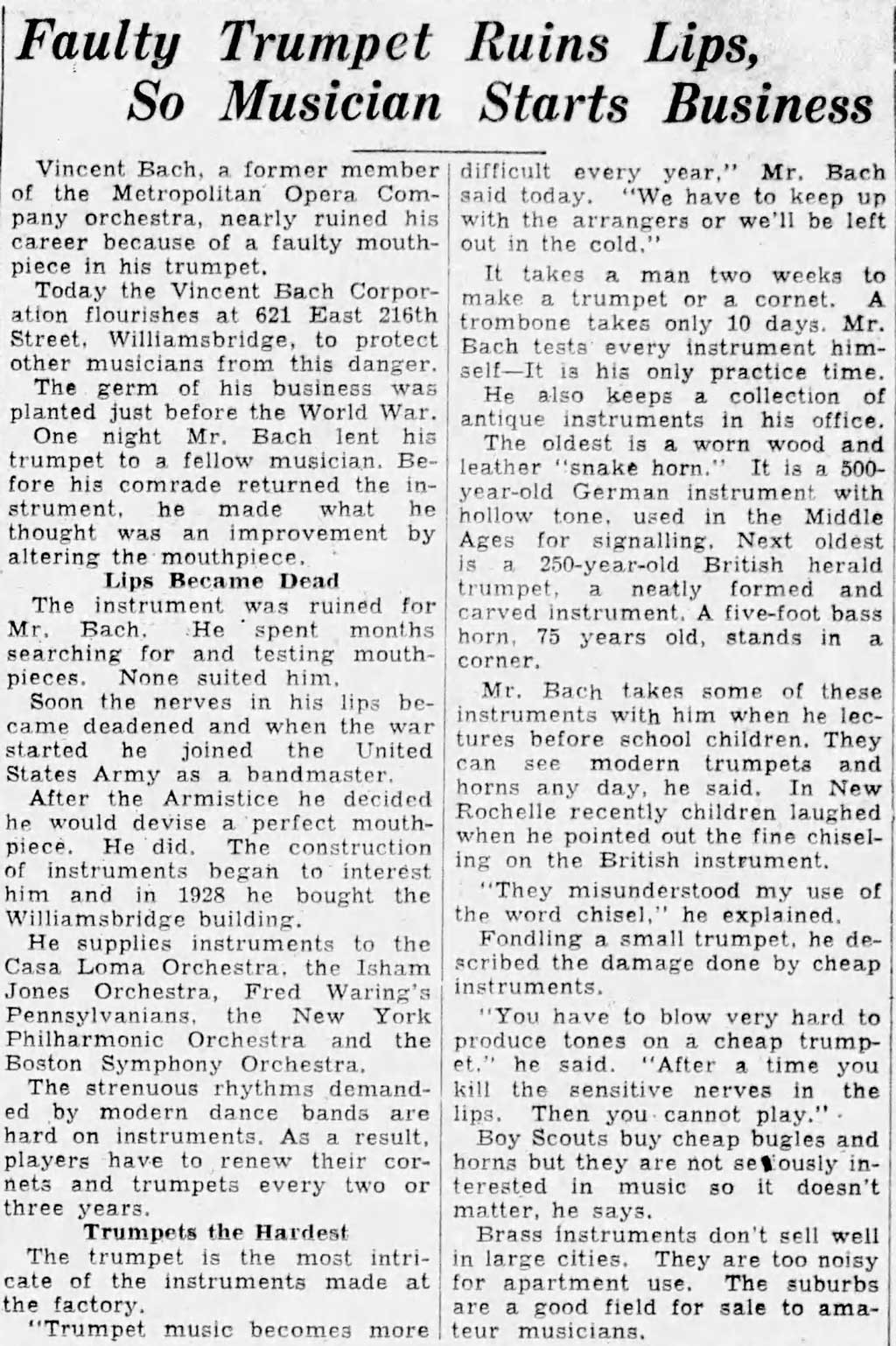
Faulty Trumpet Ruins Lips, So Musician Starts Business.
Vincent Bach, a former member of the Metropolitan Opera Company orchestra, nearly ruined his career because of a faulty mouthpiece in his trumpet.
Today the Vincent Bach Corporation flourishs at 621 East 216th Street, Williamsbridge, to protect other musicians from this danger. The germ of his business was planted just before the World War. One night Mr. Bach lent his trumpet to a fellow musician. Before his comrade returned the instrument, he made what he thought was an improvemnt by altering the mouthpiece.
Lips Became Dead
The instrument was ruined for Mr. Bach. He spent months searching for and testing mouthpieces. Non suited him.
Soon the nerves in his his lips became deadened and when the war started he joined the United States Army as a bandmaster.
After the Armistice he decided he would devise the perfect mouthpiece. he did. The construction of his instruments began to interest him, and in 1928, he bought the Williamsbridge building.
He supplied instruments to the Casa Loma Orchestra, the Isham Jones Orchestra, Fred Waring’s Pennsylvanians, the New York Philharmonic Orchestra, and the Boston Symphony Orchestra.
The strenuous rhythms demanded by modern dance bands are hard on instruments. As a result, players have to renew their cornets and trumpets every two or three years.
Trumpets the Hardest
The trumpet is the most intricate of the instruments made at the factory.
“Trumpet music becomes more difficult every year,” Mr. Bach said today. “We have to keep up with the arrangers, or we’ll be left out in the cold.”
It takes a man two weeks to make a trumpet or cornet. A trombone takes only 10 days. Mr. Bach tests every instrument himself. It is his only practice time.
He also keeps a collection of antique instruments in his office. The oldest is a worn wood and leather “snake horn.” It is a 500-year-old German instrument with a hollow tone used in the Middle Ages for signaling. Next oldest is a 250 year old British herald trumpet, a neatly formed and carved instruments. A five-foot bass horn, 75 years old, stands in a corner.
Mr. Bach takes some of these instruments with him when he lectures before school children. They can see modern trumpets and horns any day, he said. In New Rochelle recently, children laughed when he pointed out the fine chiseling on the British Instrument.
“They misunderstood my use of the word chisel,” he explained. Fondling a small trumpet, he described the damage done by cheap instruments.
“You have to blow very hard to produce tones on a cheap trumpet,” he said. “After a time, you kill the sensitive nerves in the lips. Then you can not play.”
Boy Scouts buy cheap bugles and horns, but they’re not seriously interested in music so it doesn’t matter, he says.
Brass instruments don’t sell well in large cities. They are too noisy for apartment use. The suburbs are a good field for sale to amateur musicians.
source: Mt. Vernon Daily Argus, May 9 1934.
