Vincent Bach - Educator & Teacher
Vincent from his earliest time in the Unites States wrote many educational guides and teaching tools for brass instrument players.
Below are references to his education articles, pamphlets, and press coverage of Vincent teaching & judging various events during the New York and Mt. Vernon eras.
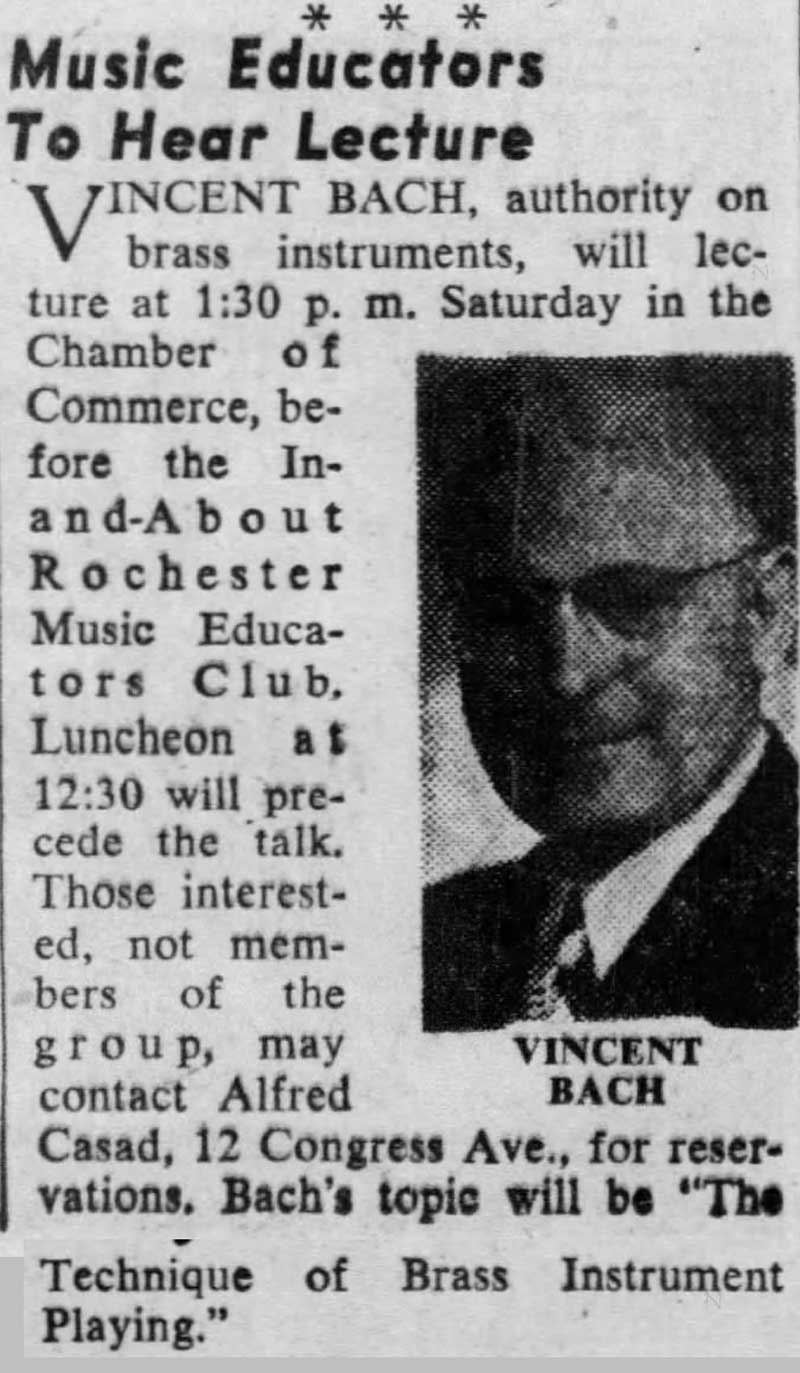
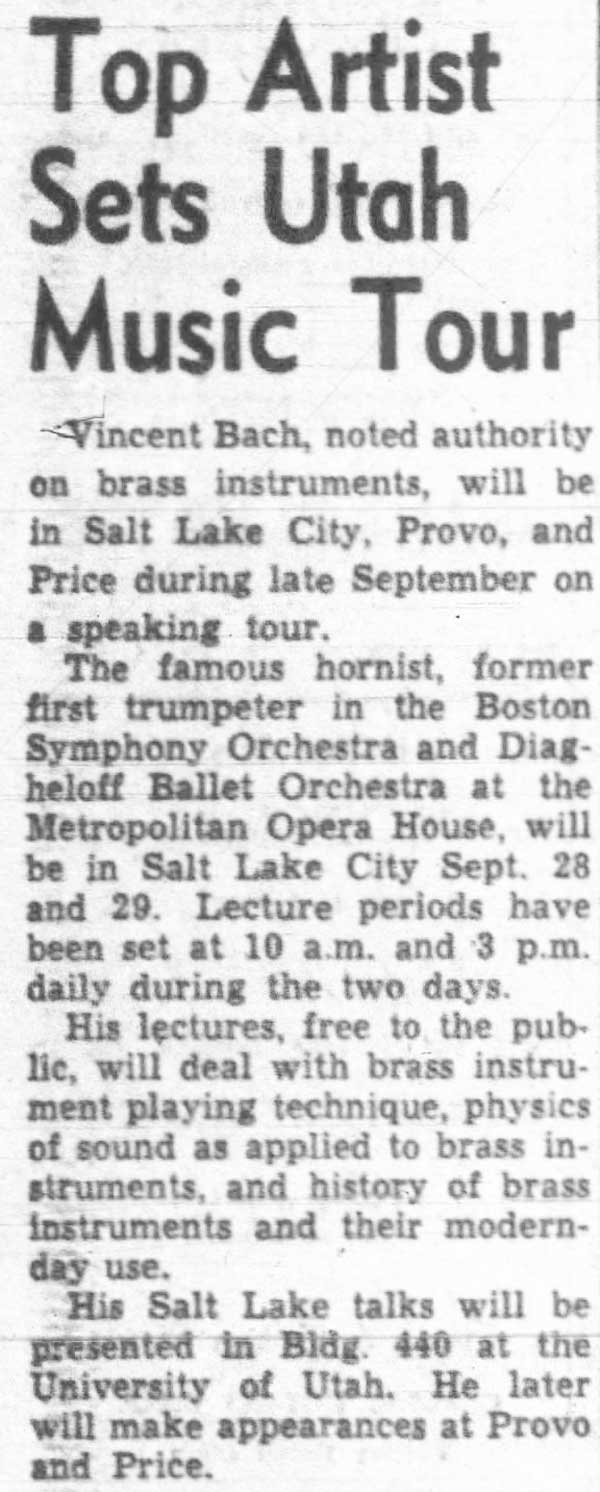
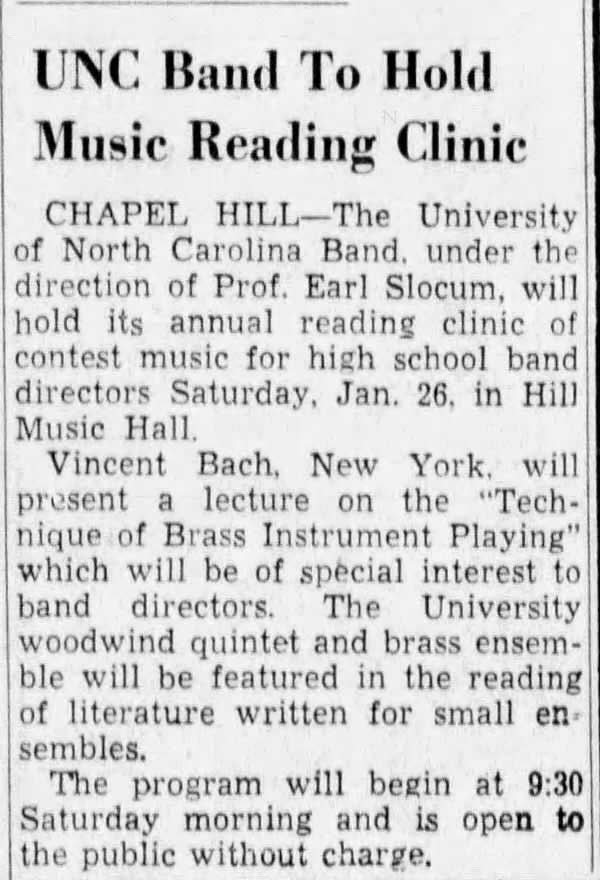
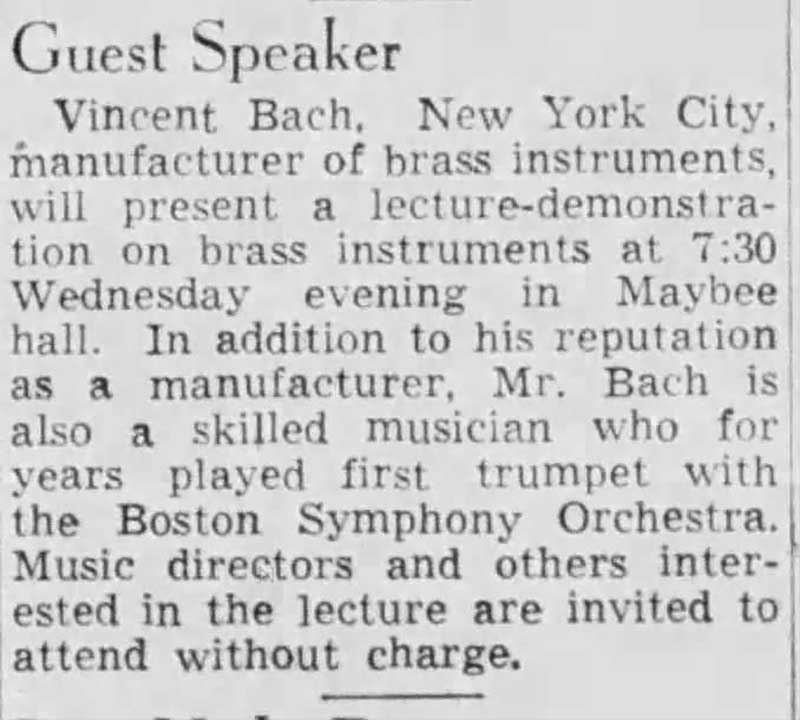
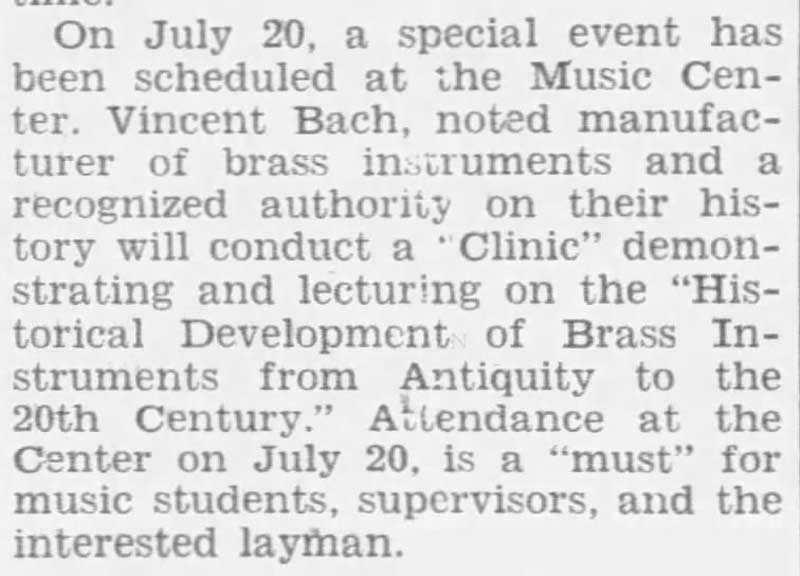
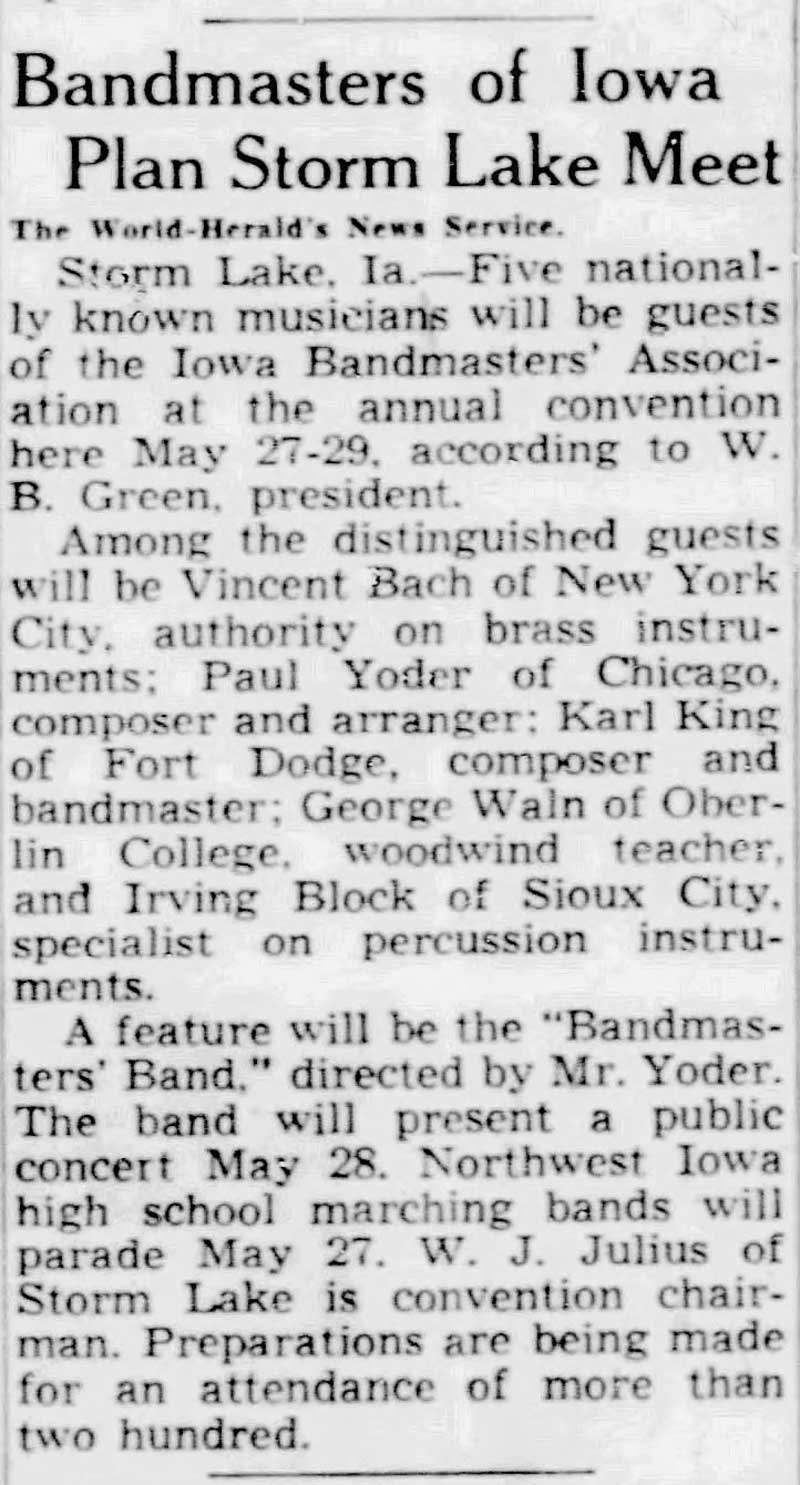
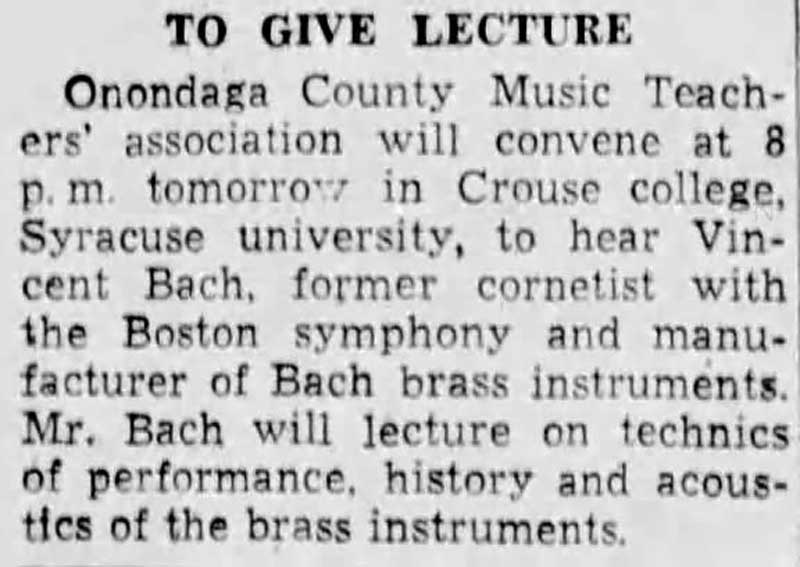
Vincent spoke regularly in the early 1950s on various topics related to brass instrument history, acoustics, and playing techniques.
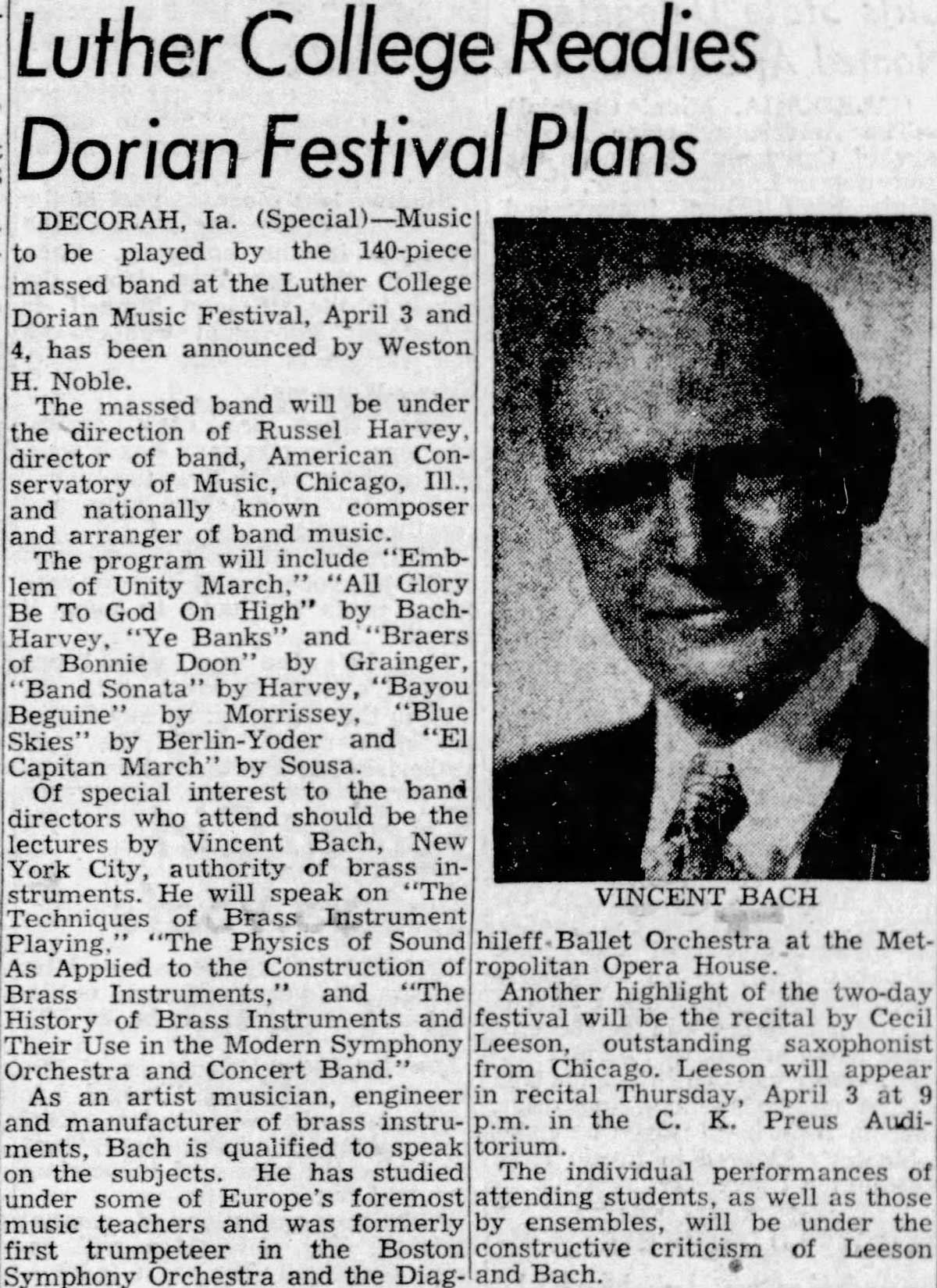
In this example from March 1952, Vincent spoke at Luther College (Decorah, Iowa) on the following topics:
- ” The Techniques of Brass Instrument Playing”
- ” The Physics of Sound As Applied to the Construction of Brass Instruments”
- ” The History of Brass Instruments and Their Use in the Modern Symphony Orchestra and Concert Band”
Other examples from the early 1950s (1950 – 1952) include the following:
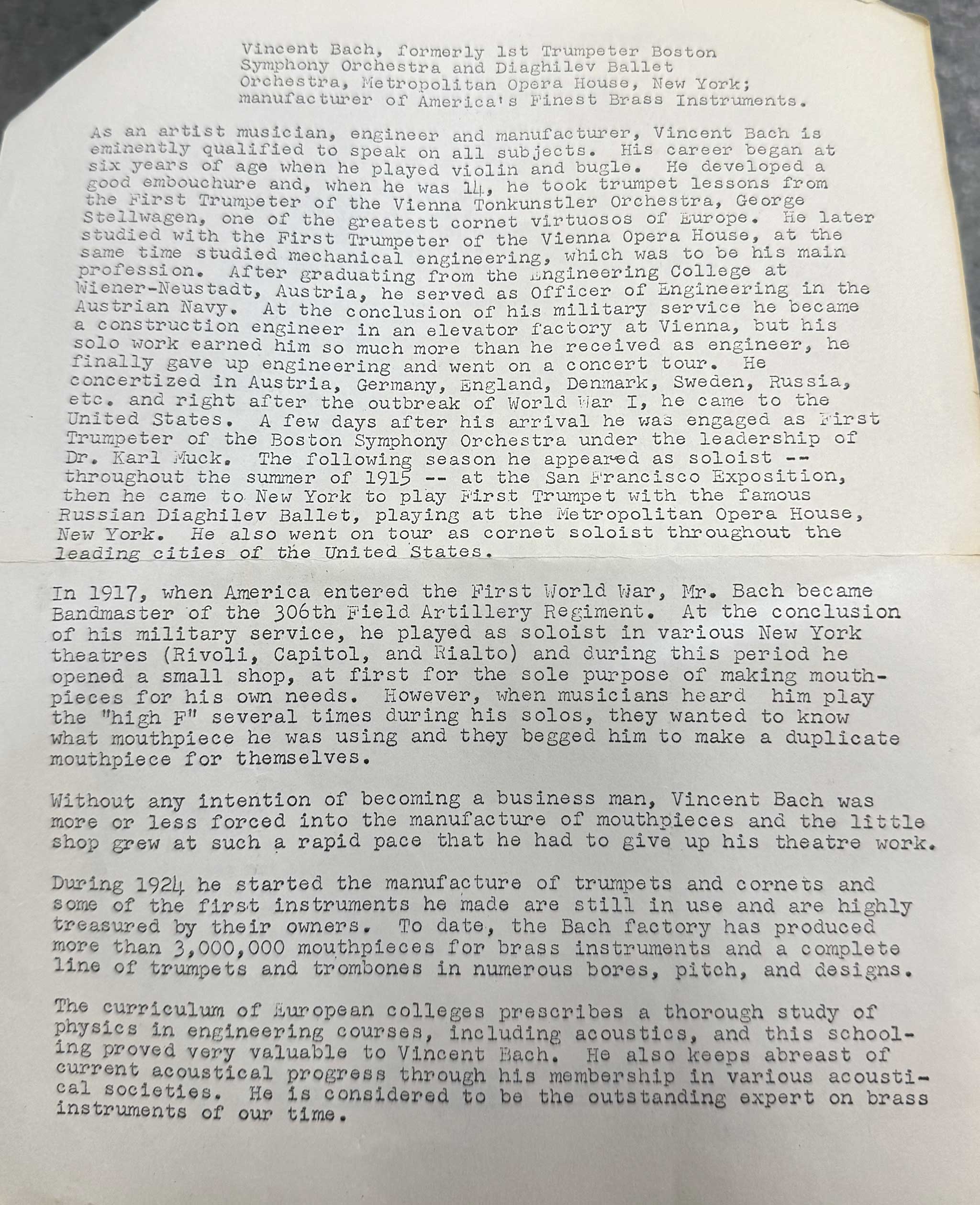
In preparation for educational speaking engagements across the globe, Vincent would use this one-page biographical overview of his career. The biography text below, from February 1952, was included in conjunction with his speaking engagements at educational, industry, and business events.
“
Vincent Bach, formerly 1st Trumpeter, Boston Symphony Orchestra and Diaghilev Ballet Orchestra, Metropolitan Opera House, New York, manufacturer of America’s finest brass instruments.
As an artist, musician, engineer, and manufacturer, Vincent Bach is eminently qualified to speak on all subjects. His career began at six years of age when he played the violin and bugle. He developed a good embouchure and, when he was 14, he took trumpet lessons from the First Trumpeter of the Vienna Tonkunstler Orchestra, George Stellwagen, one of the greatest cornet virtuosos of Europe. He later studied with the First Trumpeter of the Vienna Opera House, and at the same time studied mechanical engineering, which was to be his main profession. After graduating from the Engineering College at Wienter-Nuestadt, Austria, he served as Officer of Engineering in the Austrian Navy. At the conclusion of his military service, he became a construction engineer in an elevator factory at Vienna, but solo work earned him so much more than he received as an engineer, he finally gave up engineering and went on a concert tour. He concertized in Australia, Germany, England, Denmark, Sweden, Russia, etc., and right after the outbreak of World War I, he came to the United States. A few days after his arrival, he was engaged as First Trumpeter of the Boston Symphony Orchestra under the leadership of Dr. Karl Muck. The following season, he appeared as a soloist — throughout the summer of 1915 — at the San Francisco Exposition, then he came to New York to play first trumpet with the famous Russian Diaghilev Ballet, playing at the Metropolitan Opera House, New York. He also went on tour as cornet soloist throughout the leading cities of the United States.
In 1917, when America entered the First World War, Mr. Bach became Bandmaster of the 306th Field Artillery Regiment. At the conclusion of his military service, he played as a soloist in various New York Theatres (Rivoli, Capitol, and Rialto) and during this period, he opened a small shop, at first for the sole purpose of making mouthpieces for his own needs. However, when musicians heard him play the “high F” several times during his solos, they wanted to know what mouthpiece he was using, and they begged him to make a duplicate mouthpiece for themselves.
Without any intention of becoming a businessman, Vincent Bach was more or less forced into the manufacturing of mouthpieces, and the little shop grew at such a rapid pace that he had to give up his theatre work.
During 1924, he started to manufacture of trumpets and cornets, and some of the first instruments he made are still in use and are highly treasured by their owners. To date, the Bach factory has produced more than 3,000,000 mouthpieces for brass instruments and a complete line of trumpets and trombones in numerous bores, pitch, and designs.
The curriculum of European colleges prescribes a thorough study of physics in engineering courses, including acoustics, and this schooling proved very valuable to Vincent Bach. He also keeps abreast of current acoustical progress through his various memberships in various acoustical societies. He is considered to be the outstanding expert on brass instruments of our time.
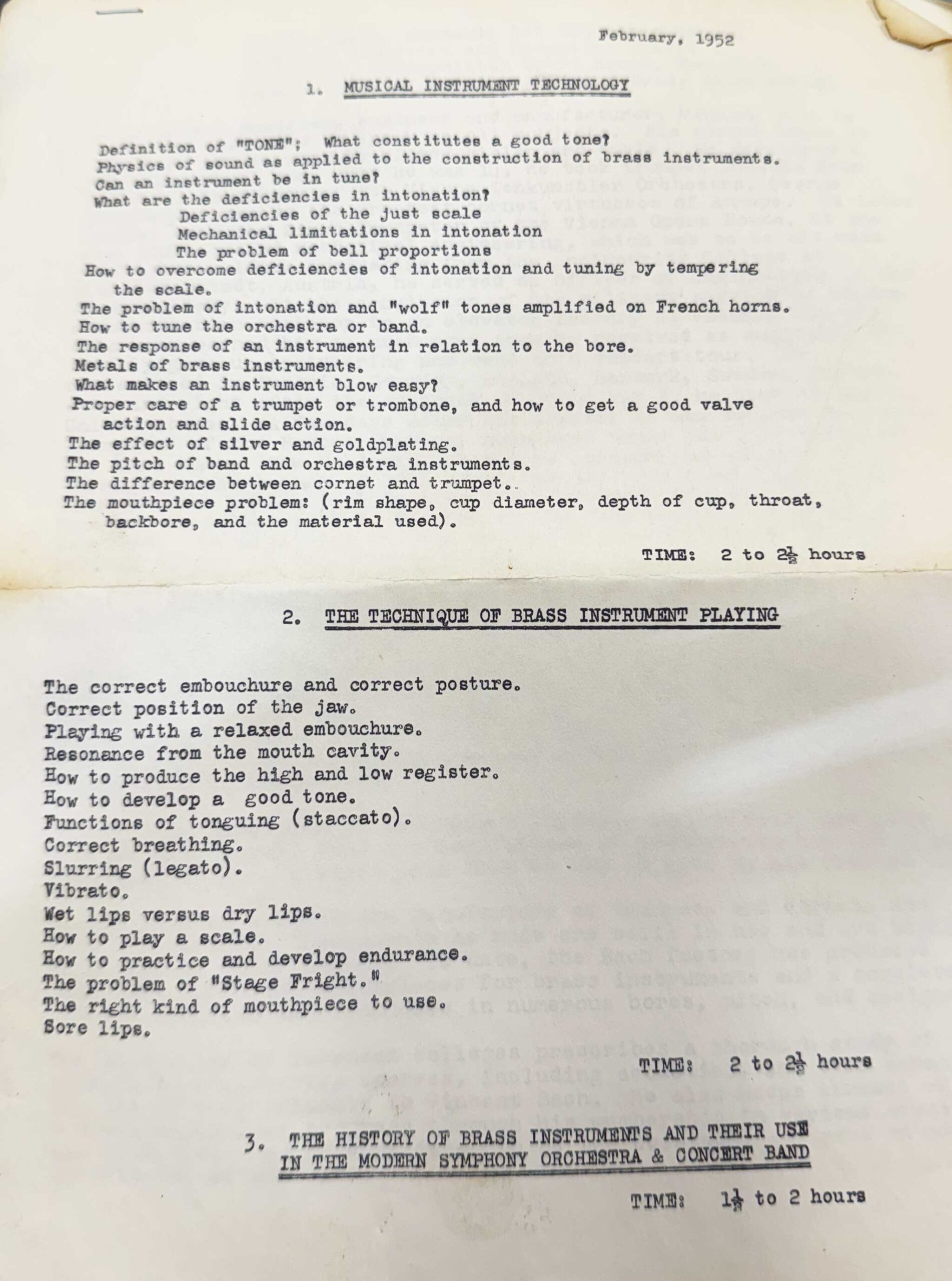
Vincent would use a simple list of curriculum topics for each of his sessions when discussing with a local educational conference or school. This curriculum outline was included for each of the subject matter topics Vincent would speak about.
Below are the known outlines Vincent would share with his audience.
" Musical Instrument Technology"
- Definition of “TONE”: What constitutes a good tone?
- Physics of sound as applied to the construction of brass instruments.
- Can an instrument be in tune?
- What are the deficiencies in intonation?
- Deficiences of the just scale
- Mechanical limitations in intonation
- The problem of bell proportions
- How to overcome deficiencies of intonation and tuning by tempering the scale.
- The problem of intonation and “wolf” tones amplified on French horns.
- How to tune the orchestra or band.
- The response of an instrument in relation to the bore.
- Metals of brass instruments.
- What makes an instrument blow easy?
- Proper care of a trumpet or trombone, and how to get a good valve action and slide action.
- The effect of silver and gold plating.
- The pitch of band and orchestra instruments.
- The difference between cornet and trumpet.
- The mouthpiece problem: (rim shape, cup diameter, depth of cup, throat, backbone, and the material used).
Time: 2 to 2.5 hours
February 1952
" The Technique of Brass Instrument Playing"
- The correct embouchure and correct posture.
- Correct position of the jaw.
- Playing with a relaxed embochure.
- Resonance from the mouth cavity.
- How to produce the high and low register.
- How to develop a good tone.
- Functions of tonguing (staccato).
- Correct breathing.
- Slurring (legato).
- Vibrato.
- Wet lips versus dry lips.
- How to play a scale.
- How to practice and develop endurance.
- The problem of “Stage Fright.”
- The right kind of mouthpiece to use.
- Sore lips.
Time: 2 to 2.5 hours
February 1952
" The History of Brass Instruments and Their Use in the Modern Symphony & Concert Band"
- No known outline exists
Time: 1.5 to 2 hours
February 1952
"Historical Development of Brass Instruments from Antiquity to the Twentieth Century."
- No known outline exists
Time: 1 hour
May 1951
This curriculum outline example dates back to February 1952.
source: La Cross Tribune, March 30, 1952
source: various newspaper clippings from 1950 - 1952
source: Vincent Bach archives