


Selmer's Biography & Tribute to Vincent Bach 1976
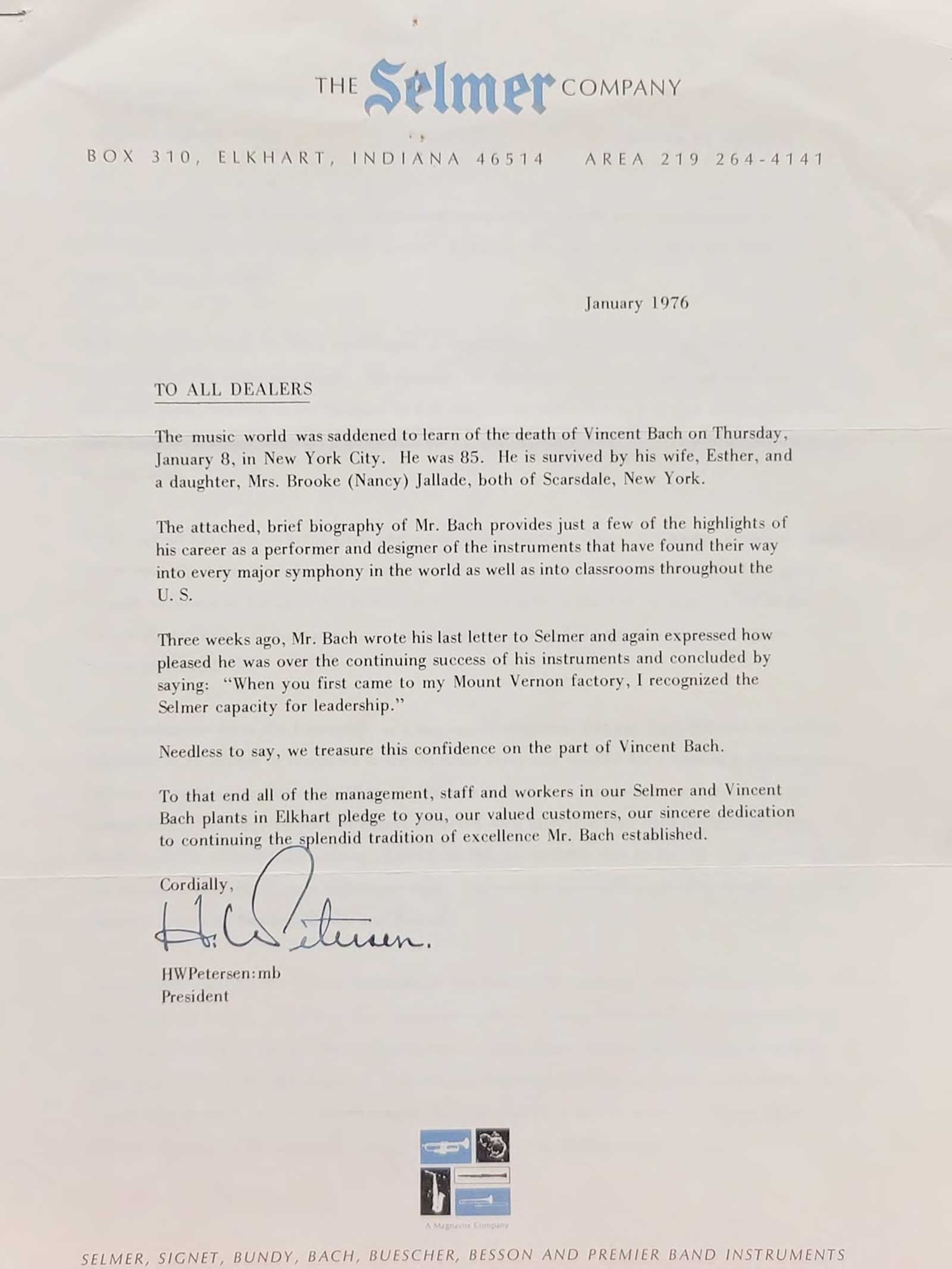
Upon Vincent Bach’s death in January 1976, The Slemer Company sent this letter to all its dealers. This letter thanked Vincent for his innovations in the brass manufacturing industry and included a brief biography of Vincent Bach and his many accomplishments.
The full letter can be found in the Library section of BachLoyalist.com
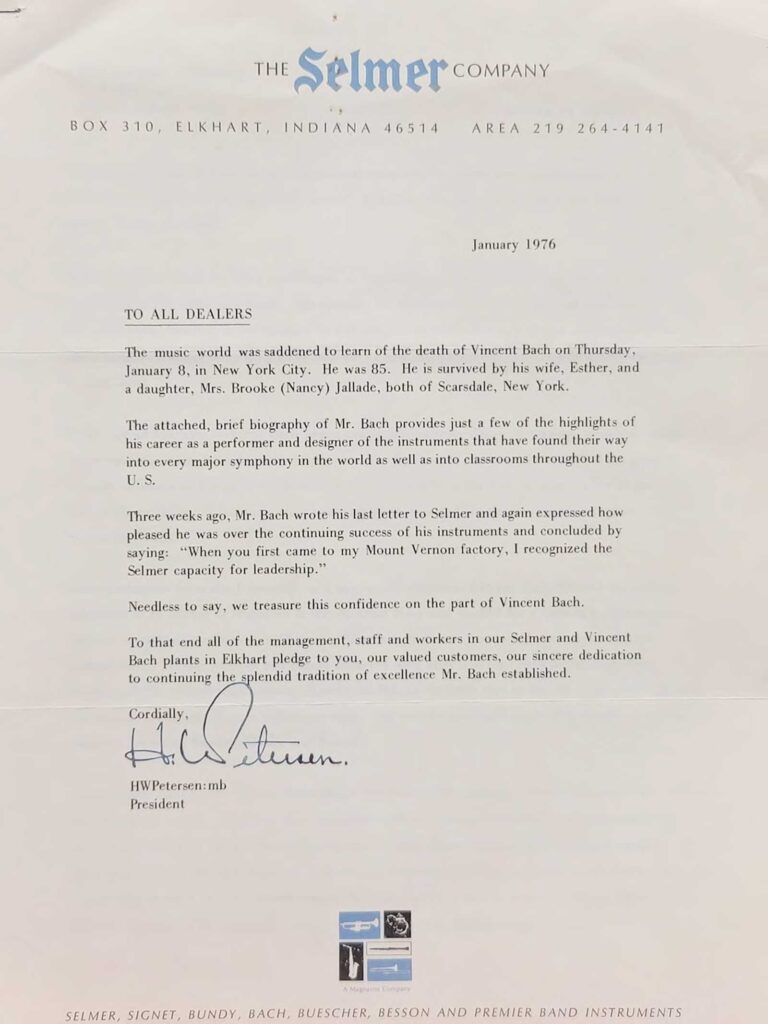
Cover Letter
TO ALL DEALERS
The music world was saddened to learn of the death of Vincent Bach on Thursday, January 89th, in New York City. He was 85. He is survived by his wife, Esther, and a daughter, Mrs. Brooke (Nancy) Jallada, both of Scarsdale, New York.
The attached brief biography of Mr. Bach provides just a few of the highlights of his career as a performer and designer of the instruments that have found their way into every major symphony in the world as well as into classrooms throughout the U.S.
Three weeks ago, Mr. Bach wrote his last letter to Selmer and again expressed how pleased he was over the continued success of his instruments and concluded by saying: “When youf rist came to my Mount Vernon factory, I recognized the Selmer capacity for leadership.”
Needless to say, we treasure this confidence on the part of Vincent Bach.
To that end, all of the management, staff, and workers in our Selmer and Vincent Bach plants in Elkhart pledge to you, our valued customers, our sincere dedication to continuing the splendid tradition of excellence Mr. Bach established.
Cordially,
HW Petersen
President
Brief Biography
The Selmer Company
P.O. Box 310
Elkhart, Indiana 46514
January 14, 1976
Vincent Bach, dean of brass instrument designers, engineers, and manufacturers, died in a New York hospital at the age of 85 on January 8, 1976. He was born in Baden bei Wein, Austria, Mark 24, 1890.
What turned out to be his life’s work began about the time he was six years old when he was introduced to the violin and bugle. His aptitude for the bugle and exceptional embouchure led to a lifetime interest in trumpet as a distinguished performance and designer of brass instruments. A substantial background of training and experience eminently qualified him to excel in both areas.
At the age of fourteen, Vincnet Bach began taking lessons from Georg Stellwagen, principal trumpet player in the Vienna Tonkunstler Orchestra. Mr. Stellwagen was considered one of the greatest trumpet virtuosos in Europe. Mr. Bach later took lessons from the first trumpet player of the Vienna Opera House, at the same time pursuing his studies to become a mechanical engineer, his chosen profession.
Upon graduation from university as a mechanical engineer, Vincent Bach fulfilled his military obligation as an officer of engineers in the Austrian Navy and worked for a time as a construction engineer in an elevator factory in Vienna. His artistic impulses, however, never lagged, and his unusual ability on the trumpet and cornet attracted such attention that soon his earnings from his music so far exceeded his earning capacity on the job he held that he turned to music exclusively and became a cornet virtuoso in his own right. His recitals were well received in Austria, Germany, England, Denmark, Sweden, Russia, and Poland.
Vincent Bach came to the United States about the time time of the outbreak of the first world war. Shortly after his arrival he was engaged as first trumpeter with the Boston Symphony Orchestra under the leadership of Dr. Karl Muck. The following season, Bach appeared as a trumpet soloist throughout the summer of 1915 at the San Francisco Exposition. Following that engagement, he returned to New York to play first trumpet with the world-famous Diaghilev Ballet at the Metropolitan Opera House and subsequently toured the principal cities of the U.S. with this distinguished company.
(more)
In 1917, when America entered the First World War, Mr. Bach became bandmaster of the U.S. 306th Field Artillery Regiment. At the conclusion of his military service, he returned to New York, where he played as a soloist in the leading theatres of the era.
It was during this time that Vincent Bach turned to the manufacture of brass instrument mouthpieces. He opened a small shop in New York City to make mouthpieces to meet his individual needs but soon was producing mouthpieces for his colleagues in various musical organizations in which he played. His reputation as a designer and manufacturer of mouthpieces spread rapidly, and by 1919, he was turning out the first Vincent Bach mouthpieces at the rate of one a day. Quantity production was to come later when Mr. Bach moved to a larger factory in New York City in 1922. In this shop, the first Bach trumpets and cornets were manufactured in 1924. Some of those early Bach instruments are still in use and highly treasured by their owners.
In 1928, to meet the increasing demand for Vincent Bach’s mouthpieces and brasses. Mr. Bach again relocated to a larger plant in New York City, and here began the manufacture of tenor and bass trombones and the other instruments in the trumpet and trombone family. Production was later moved to an ultra-modern facility in Mount Vernon in 1953.
In 1961, the Mount Vernon operation was purchased by H. & A. Selmer, Inc., now The Selmer Company, and operations continued in Mount Vernon for some two years with Mr. Bach serving as President of the Vincent Bach Corp. As a typical entrepreneur of the period, Vincent Bach served not only as chief engineer and designer of the instruments that bore his name but as sales manager and advertising manager as well. His Bach mouthpiece manual became a classic among teachers as well as players. Cataloging some 73 models of brass instrument mouthpieces, his descriptions of each model and the uses for which each was designed remain unsurpassed as an example of his superb attention to detail and his ability as a writer.
During this time, he was assisted by his wife, Esther, who survives in a nursing home in Scarsdale, New York. An example of his devotion to Esther and her contribution to the success of the business is seen in a letter recently addressed to C. L. Bickel, retired President of Selmer, asked that some
(more)
recognition be sent to Esher on the occasion of their golden wedding anniversary. He requested the inscription be worded, “To Esther Bach, the linguist and advertising promoter of Vincent Bach, the artists, and designer of Bach instruments, who both collaborated, laying the foundation for the undimished success of today’s Vincent Bach Corporation.”
In 1964, the operation was moved to Elkhart. After the move, and continuing until his death, Mr. Bach was retained as a consultant and maintained an active personal interest in manufacturing and selling the brass instruments bearing his name. One of his major contributions relates to his recognition of the rapidly growing school band movement. In the early 1960s, Mrt. Bach turned his attention to designing student brasses and his designs are incorporated in Bundy and Mercedes trumpets and cornet, widely used today by beginning students in school bands.
After the move, Mr. Bach was, for a time, a frequent visitor to Elkhart and, during the course of his visits, was a familiar figure to workers on the Selmer and Bach assembly lines. Travel became difficult for him due to his total deafness, and his visits to Elkhart became less frequent. During the last few years of his life, he did not travel at all, devoting his time extensively to his invalid wife, Esther. Until his death, he maintained a voluminous correspondence with brass performers throughout the world as well as with Selmer management people. His letters, handwritten in a firm Germanic script, have long served as treasured moments reflecting the vast humanitarian concern of Vincent Bach.
Also surviving in addition to the widow, is a daughter, Mrs. Brooke (Nancy) Jallada, of 53 High Ridge Road, Scarsdale, New York, and two granddaughters.
#
source: Letter to Selmer Dealers, Jan 14, 1976
